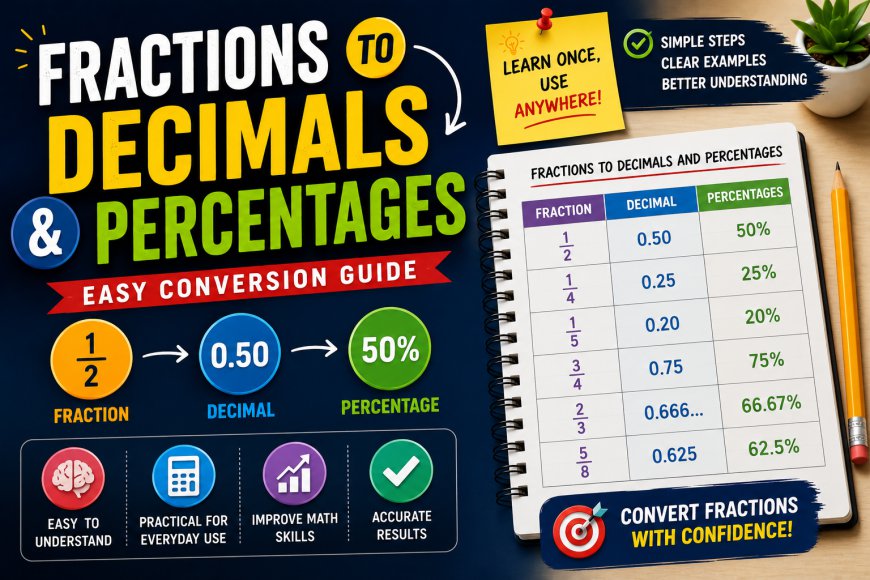
Fractions to Decimals and Percentages: Easy Conversion Guide
Learn how to convert fractions to decimals and percentages step by step, with easy examples, common mistakes, and simple conversion tips.
 Jamescarter123
Introduction
You see a recipe calling for 0.75 cups of sugar, but your measuring cup only shows fractions. Or a test result comes back as 17/20, and you need it as a percentage to understand how well you did. Converting between fractions, decimals, and percentages comes up constantly.
The process follows a simple, repeatable pattern once you know the steps. Online calculators make it faster when converting several numbers at once, but understanding the logic helps you catch mistakes and make sense of the results.
This guide covers how to convert fractions to decimals, decimals to percentages, and back again, with real examples and common mistakes to watch for.
Why These Conversions Matter
Fractions, decimals, and percentages are three ways of expressing the same value. A fraction shows a part of a whole using a numerator and denominator; a decimal uses place value; a percentage expresses it as a portion of 100.
Moving between these forms matters in cooking, shopping, grading, finance, and measurement. A grade of 85% means the same as 17/20 or 0.85 — just written differently.
When Each Format Is Useful
Percentages are easiest for comparing values quickly, like discounts or scores. Decimals work well for money or measurements. Fractions are often clearest for cooking or construction, where halves and quarters are more intuitive than decimals.
How to Convert a Fraction to a Decimal
The formula is simple:
Numerator ÷ Denominator = Decimal
Step 1: Divide the top number by the bottom number.
Example: 3/4 → 3 ÷ 4 = 0.75
Example: 5/8 → 5 ÷ 8 = 0.625
A fraction calculator can handle this instantly, especially useful for fractions that don't divide evenly, like 1/3, which becomes a repeating decimal (0.333...).
How to Convert a Decimal to a Percentage
Step 1: Multiply the decimal by 100. Step 2: Add a percent sign.
Example: 0.75 × 100 = 75%
Example: 0.625 × 100 = 62.5%
This step is why the earlier fraction-to-decimal conversion matters once you have the decimal, turning it into a percentage takes just one more step.
How to Convert a Percentage Back to a Fraction
Step 1: Write the percentage as a fraction over 100. Step 2: Simplify the fraction.
Example: 40% = 40/100, which simplifies to 2/5.
Example: 75% = 75/100, which simplifies to 3/4.
Real-World Examples
- Cooking: A recipe needing 0.5 cups of butter is the same as 1/2 cup or 50%.
- Grading: Scoring 27/30 on a test converts to 0.9, or 90%.
- Shopping: A "25% off" sign means the same as a 1/4 discount, or 0.25 off the original price.
- Finance: An interest rate of 0.045 is the same as 4.5%.
- Measurement: 3/8 inch is equal to 0.375 inch.
Other Useful Online Calculators
Conversion problems often overlap with percentage changes, ratios, or measurement conversions. Having access to a set of online calculators in one place makes it easier to move between these related tasks.
| Calculator Type | Common Use | Example |
|---|---|---|
| Fraction Calculator | Fraction operations | 1/2 + 1/4 |
| Percentage Calculator | Percentages and changes | 20% of 500 |
| Ratio Calculator | Comparing quantities | 2:3 |
| Average Calculator | Finding mean values | Test scores |
| Unit Converter | Converting measurements | km to miles |
Sites offering a full range of calculation tools, such as CalcFormulas, make it convenient to convert a fraction and then check a related percentage or measurement without switching tools.
Pros and Cons
Pros: Saves time, reduces errors, easy for beginners, works on any device, useful for cooking, grading, and shopping.
Cons: Results depend on correct input, repeating decimals can be tricky to interpret, a calculator can't catch a wrong entry, over-reliance can weaken understanding of the relationship between formats.
Expert Tips
- Double-check which format the final answer needs to be in.
- Remember that multiplying a decimal by 100 gives a percentage.
- Simplify fractions after converting from a percentage.
- Watch for repeating decimals and round only at the final step.
- Confirm the calculator is displaying the format you expect.
- Use calculators as a support tool, not a substitute for the logic.
Common Mistakes to Avoid
- Forgetting to multiply by 100 for a percentage
- Rounding a repeating decimal too early
- Mixing up numerator and denominator
- Leaving a percentage-to-fraction conversion unsimplified
- Misreading a decimal point, especially with small numbers
- Assuming every calculator shows the same decimal places
- Confusing a percentage with a percentage point
- Not checking the final answer against a rough estimate
Key Takeaways
- Fractions, decimals, and percentages all express the same value in different formats.
- Divide the numerator by the denominator to convert a fraction to a decimal.
- Multiply a decimal by 100 to get a percentage.
- Write a percentage over 100 and simplify to convert it back to a fraction.
- Choosing the right format depends on the context, whether it's cooking, grading, or finance.
FAQs
How do I convert a fraction to a decimal?
Divide the numerator by the denominator. For example, 3/4 becomes 0.75.
How do I convert a decimal to a percentage?
Multiply the decimal by 100 and add a percent sign, so 0.75 becomes 75%.
How do I convert a percentage to a fraction?
Write it over 100, then simplify, so 40% becomes 40/100, or 2/5.
Why do some fractions convert to repeating decimals?
Because the division doesn't end evenly, such as 1/3, which equals 0.333 repeating.
Can online calculators handle these conversions automatically?
Yes, a percentage calculator or fraction calculator can convert between formats instantly.
Are these conversions useful for students?
Yes, they're common in math class and help with understanding test scores and grades.
What's a common mistake in these conversions?
Forgetting to multiply by 100 when converting a decimal to a percentage.
Is it better to round early or late in a conversion?
Rounding at the final step keeps the result more accurate, especially with repeating decimals.
Conclusion
Fractions, decimals, and percentages are simply different ways of writing the same number, and knowing how to move between them makes everyday numbers easier to understand, whether you're reading a grade, a discount, or a recipe. The core steps dividing, multiplying by 100, and simplifying apply no matter which direction you're converting.
Whether you prefer calculating by hand or want a faster option, online calculators make it simple to confirm your conversion. For readers who want to handle these calculations alongside other everyday math, resources such as CalcFormulas offer a convenient way to check your work without replacing the value of understanding how the numbers connect.