Gate Barrier System in UAE - Complete Guide for Modern Access Control
 TekYousuf26
A robust Gate Barrier System is no longer a luxury feature reserved for premium real estate — it is a foundational security infrastructure component for any UAE facility that needs to manage, monitor, and control vehicular access. From the sprawling logistics parks of JAFZA and DWC to the high-rise residential towers of Downtown Dubai and the government campuses of Abu Dhabi’s Al Maryah Island, automated vehicle barriers have become the defining technology layer between an uncontrolled perimeter and a genuinely secure one. This complete guide walks through the full barrier landscape: system types, technology features, sector applications, compliance obligations, and the deployment methodology that UAE businesses should demand from a qualified integrator.
Understanding the UAE’s Growing Demand for Automated Vehicle Access Control
The UAE registered more than 4.2 million vehicles in 2024, a figure that continues to climb in step with population growth, free-zone expansion, and mega-project construction activity. Managing the flow of that traffic through commercial, industrial, and residential perimeters is a challenge that cannot be addressed with static bollards or manned checkpoints alone. UAE Vision 2031, the Smart Dubai 2021 strategy, and Abu Dhabi’s urban master planning frameworks all explicitly call for the integration of intelligent infrastructure technologies — and automated barrier systems sit squarely within that mandate.
Beyond the strategic context, practical security imperatives are accelerating adoption. Insurance underwriters are increasingly conditioning commercial property coverage on the presence of certified vehicle access control at primary entry points. Dubai Police and Abu Dhabi Police commercial security guidelines recommend automated barriers for any facility processing more than 100 vehicle movements per day. And the post-pandemic redesign of facility management workflows has created a strong commercial case for contact-free, credential-driven entry that eliminates the cost and inconsistency of manual guard-and-logbook operations.
The Full Spectrum of Gate Barrier Technologies
The UAE market offers a well-developed range of barrier technologies, each engineered for a specific combination of throughput requirement, security classification, and operating environment. Understanding the distinctions is the first step in specifying the right solution.
Boom Barrier System
Boom Barrier System units are the most widely deployed vehicle access solution across the UAE, using a motorised horizontal arm that rises and falls to control single-lane entry and exit. Modern units offer arm lengths from 3 to 9 metres, opening cycle times as low as 0.9 seconds, and LED-illuminated arms that increase visibility in low-light conditions. They integrate natively with RFID readers, ANPR cameras, loop detectors, and intercom systems, making them the workhorse solution for corporate car parks, residential compound gates, hotel drop-off zones, and light industrial facilities.
Parking Access Barriers
Parking Access Barriers are purpose-engineered variants of the boom gate family, designed specifically for multi-storey and basement car park environments. They incorporate anti-crash safety sensors that immediately reverse arm travel if a vehicle or pedestrian is detected in the sweep zone, reducing liability exposure. Ticket-dispenser integration, cashless payment terminal connectivity, and real-time occupancy counter interfaces make them the operational core of revenue-generating managed parking assets — a category that is expanding rapidly across Dubai’s retail and mixed-use developments.
Toll Gate Barriers
Toll Gate Barriers are heavy-duty, high-cycle-rated units designed for the continuous-operation demands of toll plazas, weigh bridges, and high-volume logistics entry points. They are specified for a minimum of 5 million operational cycles and incorporate industrial-grade motors and reinforced arm mechanisms that withstand the mechanical stress of round-the-clock deployment. RFID transponder and ANPR camera integrations enable fully automated, touchless vehicle processing at speeds that maintain traffic flow without creating queue backup.
Intelligent Gate Barriers
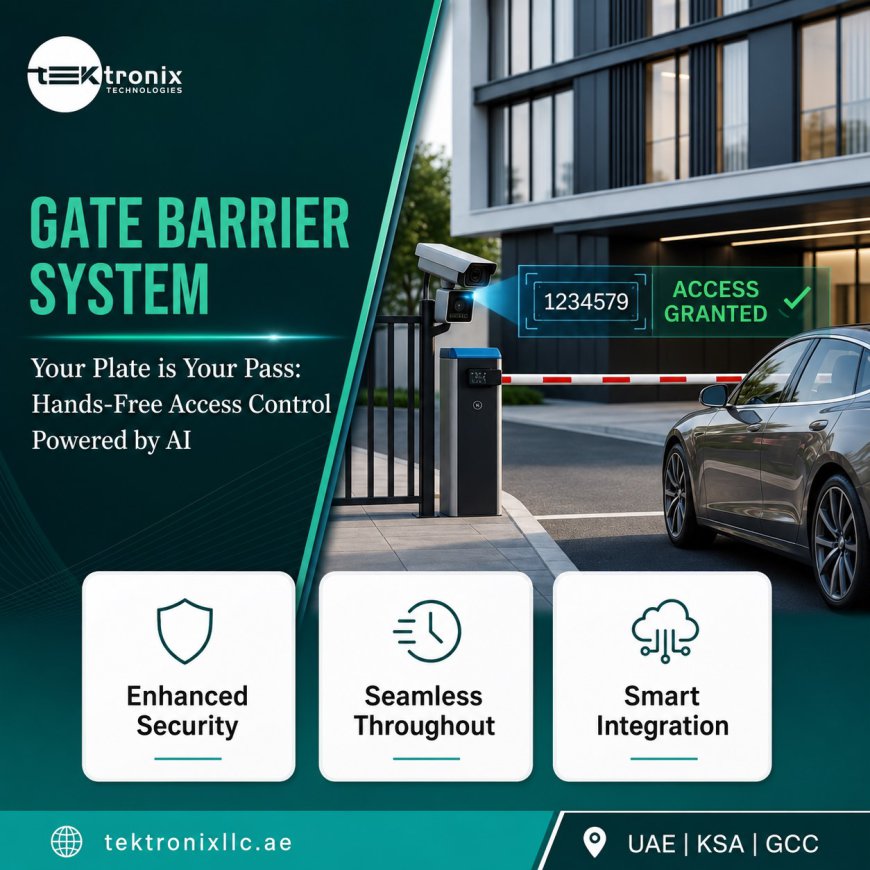
Intelligent Gate Barriers represent the current frontier of vehicle access technology, combining the physical barrier mechanism with an embedded AI processing unit capable of running Automatic Number Plate Recognition (ANPR), vehicle classification, driver facial recognition, and predictive traffic management algorithms at the edge. These systems communicate in real time with centralised security operations platforms, ERP systems, and smart city data aggregators, enabling use cases such as automatic contractor vehicle pre-authorisation, real-time parking utilisation dashboards, and exception-based security alerts triggered by unrecognised plate numbers or after-hours access attempts.
Vehicle Control Barriers
Vehicle Control Barriers encompass the broader category of road-blocking devices used to manage vehicular flow at controlled perimeters: hydraulic road blockers, surface-mounted wedge barriers, and retractable kerb systems. Unlike boom gates, which deter rather than physically stop an unauthorised vehicle, hydraulic blockers and wedge barriers are IWA-14 or PAS 68 crash-rated and can physically arrest a 7,500 kg vehicle travelling at 80 km/h. They are specified for critical national infrastructure, embassy compounds, government ministry entrances, and any facility identified under UAE Critical Infrastructure and Coastal Protection Authority (CICPA) protection mandates.
Security Gate Barriers
Security Gate Barriers combine a physical vehicle-stopping mechanism with an integrated access control and surveillance overlay: CCTV, intercom, guard booth integration, and remote management capability. They are the standard specification for military installations, data centres, power generation facilities, and desalination plants across the UAE, where the consequence of an unauthorised vehicle incursion is classified as a critical security event. Dual-factor authorisation — RFID credential plus guard visual verification, or ANPR plus biometric — is mandatory in these environments.
Key Technology Features That Define a Modern Barrier Deployment
Automatic Number Plate Recognition (ANPR) Integration
ANPR cameras mounted at barrier entry and exit points capture and decode vehicle registration plates in under 200 milliseconds, cross-referencing the result against an authorisation database and triggering barrier operation without any driver interaction. UAE-specification ANPR systems are trained on the distinctive plate formats of all seven Emirates as well as GCC visitors from Saudi Arabia, Kuwait, Bahrain, Oman, and Qatar, delivering greater than 98% read accuracy across the full range of lighting and weather conditions present in the Gulf.
RFID and UHF Long-Range Reader Integration
UHF RFID transponders mounted in or on vehicles allow long-range reader antennas positioned up to 10 metres from the barrier to authenticate the vehicle before it reaches the boom arm, enabling the gate to be already rising as the vehicle arrives. This architecture eliminates the stop-and-wait cycle entirely, maintaining traffic flow at 30 or more vehicles per minute in high-throughput scenarios such as warehouse shift changes and airport staff car parks.
Loop Detectors and Safety Sensors
In-ground inductive loop detectors detect vehicle presence in the approach and departure zones, providing the barrier controller with real-time information on vehicle position to prevent arm lowering while a vehicle is still under the boom. Photoelectric safety beams provide a secondary protection layer, immediately halting and reversing arm travel if a pedestrian enters the barrier swing zone unexpectedly. Both technologies are mandatory under UAE Civil Defence vehicle safety standards for any barrier installation in a publicly accessible area.
Remote Management and Cloud Monitoring
Enterprise barrier management platforms provide security operations teams with a live dashboard of every controlled entry point across a multi-site estate, with real-time event logs, exception alerts, remote arm control, and scheduled access window configuration accessible from any browser or mobile device. API integrations connect barrier event data with visitor management systems, HRM platforms, and building automation controllers, creating a unified access intelligence layer across the full property portfolio.
Gate Barrier System UAE: Compliance, Climate, and Certification Requirements
Specifying a Gate Barrier System UAE-wide requires close attention to a set of environmental and regulatory parameters that are unique to the Gulf region.
- Extreme Temperature Tolerance: UAE outdoor barrier installations must sustain reliable mechanical and electronic operation at sustained ambient temperatures of 55–60°C. Specify motor assemblies with thermal protection circuits, UV-stabilised arm materials, and control enclosures rated to at least IP54 for dust and moisture ingress resistance.
- UAE Civil Defence Compliance: All vehicle barrier installations at facilities governed by UAE Civil Defence must incorporate fail-safe modes that open barriers and clear vehicular egress routes automatically on activation of the building fire alarm system. Design documentation must be submitted to the relevant emirate-level Civil Defence authority for approval prior to installation.
- CICPA Critical Infrastructure Classification: Facilities on the CICPA protected-site register must deploy crash-rated barriers meeting IWA-14 or PAS 68 standards, with independent third-party certification of impact resistance. Installation contractors must hold CICPA-recognised security contractor accreditation.
- UAE PDPL Data Residency: Barrier systems that collect ANPR images or biometric data must store and process that data within UAE data-residency boundaries under Federal Decree-Law No. 45 of 2021. On-premise edge processing or UAE-hosted cloud deployments satisfy this requirement; offshore cloud storage does not.
- Estidama and LEED Integration: Premium developments targeting Estidama Pearl or LEED certification should specify barrier systems with low-standby-power modes and integration with the building’s BMS energy management layer to support green building scoring credits.
Gate Barrier System Dubai: Sector-Specific Applications
Dubai’s density of commercial, hospitality, and logistics activity creates a correspondingly diverse range of Gate Barrier System Dubai deployment contexts:
- Commercial Towers & Business Parks (DIFC, Business Bay, JLT): Boom barriers with RFID and ANPR manage tenant and visitor vehicle access to basement and podium car parks, integrated with parking management systems that provide real-time space availability data to building apps and digital signage.
- Logistics & Free Zones (JAFZA, DWC, Dubai Industrial City): High-cycle toll gate barriers with UHF long-range readers process thousands of HGV and LCV movements per day at free-zone entry portals, feeding ANPR event data into customs and cargo management platforms.
- Hospitality (Palm Jumeirah, Downtown Dubai, Dubai Marina): Aesthetically integrated barrier systems with valet management software and pre-registered guest RFID manage drop-off zone and basement access at five-star hotels and serviced apartment developments.
- Residential Communities (Arabian Ranches, Dubai Hills, Jumeirah): Community developer-standard boom barriers with resident transponders, visitor pre-registration via mobile app, and 24-hour remote monitoring provide controlled community gate access without requiring a full-time guard presence at every secondary entry point.
- Healthcare (DHA-Regulated Facilities): Barrier systems at hospital vehicle entry points integrate with visitor management platforms to enforce parking authorisation and support emergency vehicle priority override protocols compliant with DHA facility management guidelines.
Gate Barrier System Abu Dhabi: Strategic Infrastructure Deployments
As the UAE’s capital and home to its most sensitive government and critical infrastructure assets, Abu Dhabi presents a distinct deployment profile for Gate Barrier System Abu Dhabi projects:
- Government Ministries and Federal Buildings (Al Maryah Island, Corniche): Security gate barriers with crash-rated hydraulic road blockers, dual-factor authorisation, and integration with Abu Dhabi Police command-and-control systems protect ministerial campuses and federal government facilities.
- ADNOC and Energy Sector Facilities: CICPA-classified energy infrastructure sites deploy PAS 68-certified vehicle control barriers with ANPR watchlist integration and automatic escalation to the Abu Dhabi National Emergency Crisis and Disasters Management Authority (NCEMA) on security exception events.
- Yas Island and Saadiyat Island Entertainment & Cultural Districts: High-throughput parking access barriers with cashless payment integration and dynamic tariff management support the peak-demand vehicle volumes generated by major events at Yas Arena, Ferrari World, and the Louvre Abu Dhabi.
- Khalifa Industrial Zone Abu Dhabi (KIZAD): UHF RFID-integrated boom barriers manage the complex multi-class vehicle authorisation requirements of one of the region’s largest industrial zones, with separate access rules for HGVs, light commercial vehicles, and private cars applied at the controller level.
Deployment Methodology: From Site Survey to Commissioning
A professionally executed barrier deployment follows a structured process that eliminates the specification errors and integration gaps that account for the majority of post-installation performance complaints.
- Traffic Flow & Security Audit: Peak and off-peak vehicle count analysis, entry and exit lane sizing, security classification review, and Civil Defence egress route confirmation.
- System Design & Specification: Barrier category selection, arm length and cycle time specification, credential technology choice (RFID, ANPR, intercom, biometric), and third-party integration architecture design.
- Regulatory Submission: Preparation and submission of Civil Defence compliance documentation, CICPA accreditation confirmation where applicable, and municipality NOC applications.
- Supply, Installation & Civil Works: Foundation pad construction, in-ground loop detector installation, structured cabling, barrier unit installation, and controller rack commissioning.
- Integration & Configuration: ANPR camera calibration, RFID reader positioning and sensitivity tuning, access rule configuration, and third-party system API connection testing.
- User Acceptance Testing & Handover: Cycle speed validation, safety sensor testing, fail-safe mode verification, remote management platform walkthrough, and SLA contract activation.
ROI and Total Cost of Ownership
Automated barrier systems consistently deliver measurable return on investment within 18 to 30 months across UAE commercial deployments. The principal value drivers are: elimination of manned gatehouse operating costs at secondary entry points (typically AED 80,000 to AED 150,000 per annum per staffed post); reduction of unauthorised vehicle incursions and the associated security investigation and insurance claim costs; parking revenue leakage elimination through ANPR-verified exit control in managed car parks; and a measurable reduction in commercial property and asset insurance premiums linked to certified perimeter security upgrades.
Maintenance cost modelling should account for the UAE climate premium: more frequent motor and sensor servicing intervals than temperate-climate benchmarks, UV-resistant arm replacement cycles, and the cost of annual Civil Defence compliance re-certification where required. An SLA-backed maintenance contract with a UAE-resident engineering team is the most cost-effective mechanism for managing these obligations without building specialist in-house capability.
Why Tektronix LLC Is the UAE’s Trusted Gate Barrier Specialist
Tektronix LLC has designed, supplied, and commissioned intelligent gate barrier systems across Dubai, Abu Dhabi, and the wider UAE for over a decade. Our project portfolio spans DIFC-regulated commercial towers, JAFZA logistics facilities, Abu Dhabi government campuses, and CICPA-classified critical infrastructure sites. Every deployment is delivered by Civil Defence-certified engineers holding OEM-accredited competencies from the world’s leading barrier manufacturers, and every project package includes full regulatory documentation, third-party integration sign-off, and a structured handover programme.
Our 24/7 SLA-backed maintenance contracts provide UAE-resident technical response within four hours for critical faults, proactive preventive maintenance scheduling aligned to Gulf climate demands, and annual compliance audit support. Whether your requirement is a single boom barrier for a residential compound gate or a multi-technology vehicle security complex for a critical infrastructure perimeter, Tektronix LLC delivers specification confidence, installation quality, and long-term performance assurance.
Conclusion
The adoption of advanced Gate Barrier System technology across the UAE reflects a fundamental shift in how organisations think about perimeter security: from a static, guard-dependent line of defence to a dynamic, data-generating access control infrastructure that simultaneously reduces operating costs, satisfies regulatory obligations, and provides security operations teams with real-time situational awareness across every vehicle entry point in their estate.
Whether your priority is high-cycle throughput at a logistics facility, crash-rated protection at a critical infrastructure site, or a seamless guest arrival experience at a five-star hotel, the right barrier specification starts with a thorough understanding of your site’s unique traffic profile, security classification, and integration requirements — and with an integrator that has the UAE field experience to translate that understanding into a certified, performance-guaranteed deployment.
FAQs
1. What is the difference between a Boom Barrier System and a Vehicle Control Barrier?
A Boom Barrier System uses a motorised arm to deter and control authorised vehicle entry, relying on the expectation of driver compliance. It is not designed to physically stop a vehicle attempting to force passage. A Vehicle Control Barrier — such as a hydraulic road blocker or wedge barrier — is engineered to physically arrest an unauthorised or hostile vehicle, and is independently crash-tested and certified to international standards such as IWA-14 or PAS 68. The correct choice depends on the facility’s security classification: commercial car parks and residential compounds typically specify boom barriers, while government buildings, data centres, and CICPA-classified sites require certified vehicle control barriers.
2. How do Intelligent Gate Barriers integrate with ANPR and access control platforms?
Intelligent gate barriers communicate with ANPR cameras and access control platforms via standard protocols including Wiegand, OSDP, and TCP/IP. The ANPR camera captures and decodes the vehicle registration plate, transmits the result to the access control platform, which cross-references it against the authorisation database and sends an open command to the barrier controller if authorised. RESTful APIs enable integration with visitor management systems, HRM platforms, and ERP solutions, allowing vehicle access events to trigger workflows such as automated visitor arrival notifications, parking fee calculations, and contractor time-logging entries.
3. Are Parking Access Barriers required to comply with UAE Civil Defence regulations?
Yes. Any parking access barrier installed at a UAE facility governed by UAE Civil Defence must incorporate a fail-safe mode that automatically opens all vehicular egress barriers on activation of the building’s fire alarm system, ensuring unobstructed evacuation of vehicles and occupants. Design and installation documentation must be submitted to the relevant emirate-level Civil Defence authority for review and approval before works commence. Non-compliant installations are subject to stop-work orders and may invalidate the facility’s operating licence. Tektronix LLC prepares and manages the full Civil Defence submission process as a standard component of every barrier project.
4. What maintenance schedule is recommended for Toll Gate Barriers in the UAE climate?
UAE climate conditions require a more intensive maintenance regime than temperate-region benchmarks. Best practice for high-cycle toll gate barriers in the UAE includes: monthly visual inspection of arm condition, motor housing, and cable entry points for UV degradation and dust ingress; quarterly mechanical service covering gear assembly lubrication, torque limiter calibration, and safety sensor alignment; bi-annual electrical service covering control board health, power supply condition, and communication interface testing; and an annual full-system performance audit benchmarking cycle speed and detection accuracy against original commissioning data. Facilities with critical operational continuity requirements should also maintain a spare motor assembly and control board on-site to enable same-day swap replacement in the event of component failure.
5. How long does a Gate Barrier System installation typically take in Dubai or Abu Dhabi?
A standard single-lane boom barrier installation at an existing facility with prepared civil works — foundation pad, conduit runs, and power supply in place — can be completed and commissioned within two to three working days. A more complex multi-lane deployment with ANPR integration, in-ground loop detector installation, and third-party system connectivity typically requires two to four weeks from signed project order to handover, depending on the scope of civil works required. Projects at CICPA-classified or Civil Defence-regulated facilities should allow an additional two to four weeks for regulatory submission and approval processes. Tektronix LLC provides a detailed project timeline with milestones and dependency mapping at the proposal stage for every engagement.