Global Next-Generation Sequencing Informatics Market Set for Strong Growth Through 2034
 Raymond10
The Next-Generation Sequencing (NGS) Informatics is the backbone of modern genomic science. It refers to the integrated ecosystem of software tools, computational pipelines, cloud infrastructure, and data management platforms that process, analyze, and interpret the massive volumes of genetic data produced by high-throughput sequencing technologies
Market Overview: Where Is the NGS Informatics Market Headed by 2034?
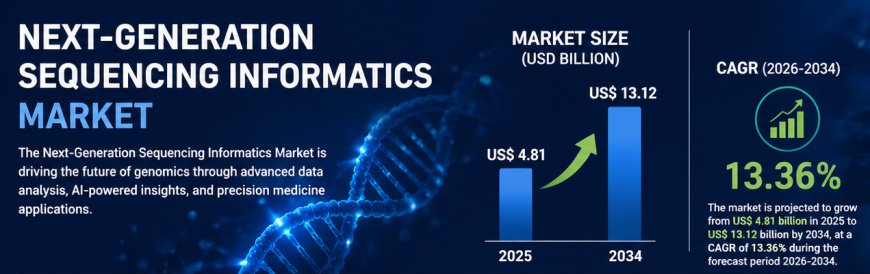
The global Next-Generation Sequencing Informatics Market size is projected to reach US$ 13.12 billion by 2034 from US$ 4.81 billion in 2025. The market is anticipated to register a CAGR of 13.36% during the forecast period 2026 to 2034. This near-tripling of market value over a decade reflects the accelerating integration of genomic intelligence into mainstream healthcare, pharmaceutical development, and population health management. As sequencing costs continue to decline and clinical evidence for NGS-guided interventions continues to accumulate, the informatics infrastructure that makes genomic insights actionable is becoming a non-negotiable investment for health systems, diagnostic laboratories, and life sciences organizations globally.
Next-Generation Sequencing Informatics Market Drivers
The Next-Generation Sequencing Informatics Market Drivers include the surging global burden of cancer and genetic disorders creating unprecedented demand for genomic diagnostics, accelerating adoption of precision medicine and personalized treatment protocols requiring deep genomic profiling, rapidly declining sequencing costs making NGS accessible to a broader range of institutions, expanding government-funded national genome projects generating large-scale informatics requirements, growing integration of artificial intelligence and cloud computing into genomic workflows, increasing clinical reimbursement coverage for NGS-based oncology testing, and the expanding role of NGS in infectious disease surveillance and pandemic preparedness.
How Is AI Integration Accelerating the Value of NGS Informatics Platforms?
Artificial intelligence has emerged as a transformative force within NGS informatics, enabling capabilities that were not achievable through conventional bioinformatics approaches. Deep learning models trained on large annotated genomic datasets have demonstrated superior performance in variant pathogenicity classification, structural variant detection, and copy number variation analysis compared to traditional rule-based algorithms. Natural language processing tools integrated into tertiary analysis platforms can automatically interrogate clinical literature and genomic databases to surface relevant evidence for variant interpretation, dramatically reducing the time required for manual curation by clinical geneticists and molecular pathologists.
AI-driven quality control systems can identify systematic sequencing errors, contamination signals, and library preparation artifacts earlier in the analytical workflow, preventing downstream interpretation errors and improving overall data reliability. As the volume of available training data grows and model architectures continue to improve, the performance advantages conferred by AI-integrated informatics platforms will widen, creating competitive differentiation for vendors that invest in machine learning research and development as a core competency.
Segmentation Analysis: Understanding the Market Structure
By Products and Services
The NGS informatics market is segmented into NGS informatics services and data analysis and management tools. Data analysis and management tools constitute the dominant revenue category, encompassing primary, secondary, and tertiary analysis software, variant databases, and clinical reporting systems. The services segment, including managed bioinformatics, cloud migration consulting, and training, is growing at the fastest rate as institutions seek external expertise to supplement in-house analytical capabilities and accelerate the deployment of clinical-grade informatics workflows.
By Application
Drug discovery is the leading application segment, driven by pharmaceutical companies integrating NGS informatics into target identification, biomarker discovery, and companion diagnostic development programs. Precision medicine and oncology diagnostics collectively represent the highest-growth application area, supported by expanding clinical evidence and increasing physician confidence in NGS-guided treatment decisions. Genetic screening, encompassing newborn screening, carrier testing, and prenatal diagnostics, contributes a large and stable revenue base, while infectious disease genomics has emerged as a newly significant application following the global experience of pathogen genomic surveillance during pandemic response.
By End User
Hospitals and clinics are the fastest-growing end-user segment, driven by the adoption of NGS-based oncology panels, pharmacogenomics testing, and rare disease programs within integrated health systems. Academic and research institutes retain the largest aggregate usage volume, supported by government grant funding and institutional genomics initiatives. Pharmaceutical and biotechnology companies represent the highest per-customer spend, deploying enterprise-grade informatics solutions across multi-site global research and development operations.
Get Sample PDF @ https://www.theinsightpartners.com/sample/TIPRE00006921
Top Players in the Next-Generation Sequencing Informatics Market
The global NGS informatics market features a competitive landscape of established genomics leaders, specialized bioinformatics software companies, and major cloud technology providers. Key players include:
- Agilent Technologies Inc.
- DNANEXUS, INC.
- F. Hoffmann-La Roche Ltd
- PerkinElmer Inc
- Illumina, Inc.
- GENEWIZ
- Partek, Incorporated
- QIAGEN
- DNASTAR
- Thermo Fischer Scientific Inc.
Regional Analysis
North America
The United States benefits from the world's largest concentration of genomics companies, a well-funded research ecosystem anchored by NIH annual genomics investments, expanding Medicare reimbursement for oncology sequencing, and a dense network of academic medical centers driving clinical genomics innovation. Canada contributes a growing market anchored by national precision medicine programs and strong biomedical research infrastructure.
Europe
Europe represents the second-largest regional market, supported by national precision medicine initiatives across the United Kingdom, Germany, France, and the Nordic countries. The Genomics England program, the European Genome-phenome Archive, and cross-border data sharing frameworks under GDPR-compliant research agreements are generating sustained institutional demand for enterprise informatics solutions. The region's strong regulatory environment around clinical genomics is creating premium market conditions for validated, compliance-ready platforms.
Asia Pacific
Asia Pacific is the fastest-growing regional market, projected to register the highest CAGR through 2034. China leads regional growth through large-scale national genomics investments and a rapidly expanding clinical sequencing industry anchored by BGI Group and a growing ecosystem of domestic informatics companies. India's Genome India Project and expanding private diagnostics sector are building sequencing and informatics capacity at an accelerating pace. Japan and South Korea contribute mature research markets with increasing clinical adoption of NGS across oncology and rare disease programs.
Latin America and Middle East and Africa
Latin America and the Middle East and Africa are early-stage but rapidly developing markets for NGS informatics. Brazil, South Africa, and Saudi Arabia are investing in national genomics infrastructure through public-private partnerships, international academic collaborations, and targeted healthcare modernization initiatives. Growing awareness of genetic disease burden, improving sequencing affordability, and expanding bioinformatics training programs are building the foundational capacity for accelerated market growth across both regions during the latter half of the forecast period.
Future Outlook
The next decade will be defined by the full maturation of NGS informatics as a clinical utility rather than a research specialty. As whole-genome sequencing approaches routine affordability, the informatics infrastructure required to interpret and act on genomic data will become as fundamental to healthcare delivery as laboratory information management systems are today. Long-read sequencing technologies will create new analytical challenges and opportunities, requiring informatics platforms capable of handling complex structural variants, phasing information, and epigenomic data layers that short-read systems cannot capture.
About The Insight Partners
The Insight Partners delivers market intelligence and consulting services to help clients make informed decisions. The firm covers industries such as Aerospace and Defense, Automotive and Transportation, Semiconductor and Electronics, Biotechnology, Healthcare IT, Manufacturing, Medical Devices, Technology, Media, and Chemicals and Materials.
Contact Us
Email: sales@theinsightpartners.com
Website: www.theinsightpartners.com
Phone: +1-646-491-9876
Also Available in :