How Automated Workflows Improve Efficiency and Reduce Costs
The companies cutting operational costs without cutting headcount are doing it through ai automation services that remove the manual work nobody should be doing in the first place.
 notionmind
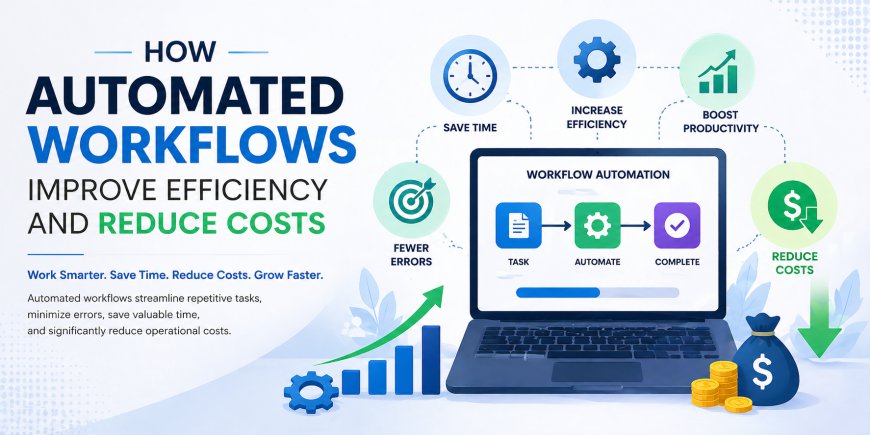
The companies cutting operational costs without cutting headcount are doing it through ai automation services that remove the manual work nobody should be doing in the first place.
Efficiency does not come from working harder.
It comes from stopping the work that should not exist. Every business has it. Tasks that repeat daily without anyone questioning why they still require a human. Approval processes that move through four inboxes when one decision-maker would have been enough. Reports that three people touch before they reach the person who actually needs them.
That kind of operational waste does not show up as a line item anywhere. It hides inside payroll, inside delayed decisions, inside the compounding cost of good people spending their time on low-value work. Intelligent automation consulting exists to make that waste visible and then systematically eliminate it. Across the USA businesses that have done this work are not just running leaner. They are running faster, with fewer errors, and with teams that are noticeably less burned out than before.
Where the Cost Actually Lives
Most cost reduction conversations start in the wrong place.
Headcount. Software subscriptions. Office space. These are visible costs that get reviewed regularly. The costs quietly destroying margins are different. They live inside processes nobody has formally measured.
An invoice approval that takes four days when the information needed to approve it is available in thirty seconds. A customer onboarding process that depends on one person remembering every step rather than a system that handles it automatically. A weekly status report that three team members compile manually from five different sources when the data could aggregate itself.
None of these appear on a budget review. All of them have a real price attached that compounds every week they go unaddressed.
What Automation Actually Changes
The Work That Disappears First
Intelligent automation consulting done properly starts with an audit of where time actually goes rather than where people assume it goes.
The gap between those two things is almost always significant. Teams consistently underestimate how much of their week goes toward work that adds no value to the actual output. Data entry that feeds into a system that could capture it directly. Status updates that exist because nobody built a system that surfaces status automatically. Handoffs that require a human in the middle when the routing logic is simple enough to automate completely.
When that work disappears the people doing it do not disappear with it. They redirect toward work that actually requires human judgment. That shift produces returns that go well beyond the hours saved.
Error Reduction That Compounds Over Time
Manual processes have errors baked into them. Not because people are careless. Because humans processing high volumes of repetitive work make mistakes at a predictable rate regardless of how skilled or motivated they are.
Ai automation services do not make those mistakes. The same process runs the same way every time. Invoices do not get missed. Data does not get entered incorrectly. Steps do not get skipped because someone was handling three other things simultaneously.
The cost of errors in manual workflows is rarely calculated properly. Fixing a mistake takes time. The downstream effects of that mistake — a delayed payment, a frustrated customer, a compliance issue — take more time. Preventing the error entirely through automation is almost always cheaper than managing the consequences of it after the fact.
The Businesses Getting This Right Are Not the Biggest Ones
Here is something that consistently surprises people new to this conversation.
The organizations seeing the fastest returns from workflow automation are not large enterprises with dedicated operations teams and massive technology budgets. They are mid-size businesses where a relatively small number of well-chosen automations produce visible, measurable improvements quickly.
Intelligent automation consulting scaled to the actual size and complexity of the business consistently outperforms enterprise-scale implementations that take eighteen months to deploy and another six to adopt. Starting focused and expanding from proven wins produces better outcomes than trying to automate everything simultaneously.
The Cost of Waiting One More Year
Every month a business runs on manual workflows is a month of recoverable efficiency loss that does not get recovered.
The work still happens. The errors still occur. The good people still spend chunks of their day on tasks that add nothing to the outcomes the business actually cares about. Ai automation services applied to the right processes eliminate that cost permanently rather than managing it indefinitely.
Across the USA the businesses that have made this shift are not looking back at what they gave up. They are looking at what they gained and wondering why they waited as long as they did.