How to book the best Fes to Marrakech desert tours for your adventure
 blitz.maz
Introduction to the trans-Saharan odyssey
Embarking on one of the many available Fes to Marrakech desert tours is not simply a matter of moving between two imperial cities; it is a profound immersion into the shifting landscapes, ancient cultures, and architectural wonders of Morocco. This specific route is often considered the ultimate Moroccan road trip because it bridges the gap between the scholarly, medieval labyrinth of Fes and the vibrant, ochre-walled energy of Marrakech. Travelers who choose this expedition find themselves traversing the high peaks of the Atlas Mountains, descending into the deep silence of the Sahara, and finally emerging in the spiritual heart of the south. It is a journey of contrasts where the air transitions from the cool, pine-scented breeze of the Middle Atlas to the dry, sun-baked heat of the Erg Chebbi dunes. For a professional wanderer, this itinerary represents the most evocative way to see the diverse face of Morocco in a single sweep, combining the rugged beauty of the desert with the refined hospitality of luxury camps. Whether you are riding a camel across the golden sands or exploring the clay fortresses of the south, these tours offer a curated sequence of sights that have captivated explorers for centuries.
Navigating the Middle Atlas and the gateway to the dunes
The first chapter of the Fes to Marrakech desert tours experience involves a dramatic ascent into the Middle Atlas Mountains. This range acts as a refreshing contrast to the arid landscapes that lie ahead, featuring alpine scenery that surprises many first-time visitors. The journey typically begins with a stop in Ifrane, a town designed in the 1930s with a distinct style that has earned it the nickname "Little Switzerland" due to its sloped roofs and tidy parks. As you continue south, you enter the fragrant cedar forests of Azrou, where the native Barbary macaques are frequently seen playing among the ancient trees. According to technical definitions found on Wikipedia, the Atlas Mountains are a mountain range in the Maghreb which separates the Sahara Desert from the Mediterranean Sea and the Atlantic Ocean, stretching around 2,500 kilometers through Morocco, Algeria, and Tunisia. This geological barrier dictates the climate and the lifestyles of the Berber populations who have inhabited these high-altitude villages for millennia.
After descending from the mountains, the road follows the Ziz Valley, home to one of the largest continuous palm oases in the world. The lush green ribbon of date palms tucked between deep red canyon walls provides a spectacular visual transition into the Saharan world. Most professional tours culminate the first or second day in Merzouga, the small village standing at the edge of the Erg Chebbi dunes. These dunes are world-renowned for their impressive heights, reaching up to 150 meters, and their unique, wind-sculpted peaks that change color from gold to deep copper as the sun moves across the sky. Arriving at the dunes marks the official start of the Saharan portion of the trip, where the vehicle is often traded for a camel trek into the heart of the desert. This transition is essential for those seeking an authentic connection with the nomadic spirit of the region, allowing for a slower pace that matches the timeless rhythm of the Sahara.
The golden heart of the Sahara and the night under the stars
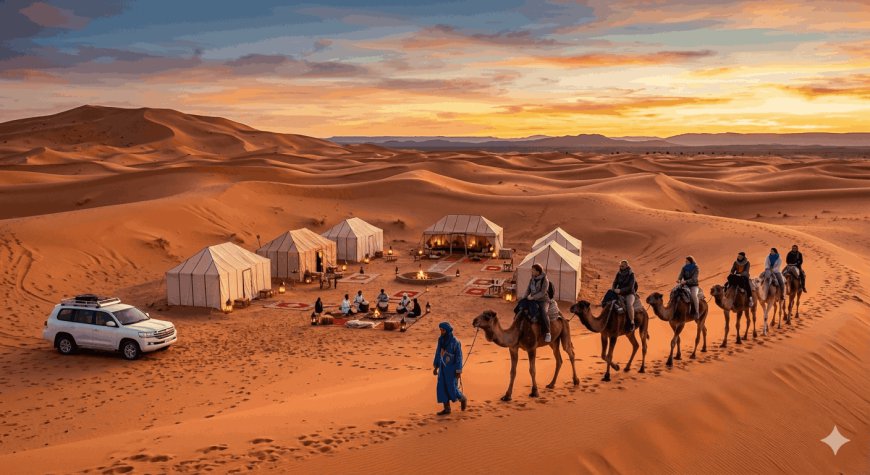
The true centerpiece of all Fes to Marrakech desert tours is the overnight stay in a desert camp. Riding a camel across the silent, shifting sands of Erg Chebbi as the sun dips below the horizon is a meditative experience that allows for deep reflection as the shadows lengthen and the sand turns from gold to a fiery orange. Modern desert tourism has evolved significantly, with many operators now offering high-end glamping options that cater to professional standards of comfort. Travel industry insights from Forbes emphasize that the growth of luxury hospitality in Morocco has extended into the desert, where travelers can find camps equipped with king-sized beds, en-suite bathrooms, and gourmet Moroccan cuisine served under a canopy of stars.
An evening in the desert is usually punctuated by the rhythmic sounds of Berber drumming and traditional Gnaoua music performed around a central campfire. This cultural exchange provides a bridge between the visitor and the nomadic traditions of the Saharan tribes, offering a moment of absolute clarity before the journey continues. The stargazing here is unparalleled; the lack of light pollution reveals the Milky Way in such vivid detail that it feels within reach. According to recent research highlighted by Google News, Morocco is currently seeing a significant surge in interest for its "green" inland routes as travelers seek more sustainable and nature-focused experiences. This movement ensures that the majesty of the Sahara remains intact for future generations, with a focus on low-impact camping and supporting local communities. Waking up to the first light of dawn over the dunes is a ritual that marks the emotional peak of the journey, signaling the start of the final transit toward the "Red City" through the valley of the kasbahs.
Exploring the road of a thousand kasbahs and the High Atlas
The final phase of the journey westward toward Marrakech takes you through the "Road of a Thousand Kasbahs," a region defined by its ancient earthen fortifications and lush river valleys. After leaving the desert, tours often stop at the Todra Gorge, a massive limestone canyon where the walls rise nearly 300 meters high. Walking through the narrowest part of the gorge allows travelers to appreciate the immense scale of the geological forces at play. Further along the route lies Ouarzazate, known as the "Hollywood of Africa" due to its famous film studios and its proximity to the Ksar of Ait Benhaddou. This UNESCO World Heritage site is a stunning example of southern Moroccan architecture, featuring a complex of earthen buildings surrounded by high walls, and it has served as a filming location for numerous epic productions, from Gladiator to Game of Thrones.
The final obstacle between the desert and Marrakech is the High Atlas Mountains, crossed via the Tizi n'Tichka pass. Reaching an elevation of 2,260 meters, this mountain pass offers some of the most dramatic panoramic views in the country. The winding roads pass through Berber villages that seem to cling precariously to the mountain slopes, where traditional life continues much as it has for centuries. Descending from the Atlas, the air becomes warmer and more humid as you enter the Haouz Plain. The sight of the Koutoubia Mosque on the horizon marks the end of your trans-Saharan odyssey. Arriving in Marrakech after the solitude of the desert provides a vibrant sensory overload, as the city’s energy, colors, and sounds welcome you back to the modern world. This transition from the silent dunes to the chaotic souks completes the circle of the Moroccan experience, leaving you with a deeper understanding of the country's complex identity.
Conclusion and taking the next step on your Moroccan adventure
Choosing to take one of the professional Fes to Marrakech desert tours is a decision to see Morocco in its most complete and authentic form. Over the course of three or four days, you witness the intersection of history, geography, and hospitality that defines this North African kingdom. From the heights of the Atlas to the depths of the Sahara and finally to the gates of Marrakech, every mile traveled tells a story of survival, trade, and artistry. If you have ever dreamed of riding a camel across the dunes or sleeping under a canopy of Saharan stars, this is the route that will fulfill those aspirations with comfort and expertise. Don't let the opportunity to experience this legendary path slip away; it is an investment in a lifetime of memories that will transform your perspective on travel. Start planning your desert adventure today and prepare to see a side of the world that will stay with you long after the sand has been brushed from your shoes.