How to Build a 90-Day Study Plan for CA Foundation Preparation
 nagardaksh024
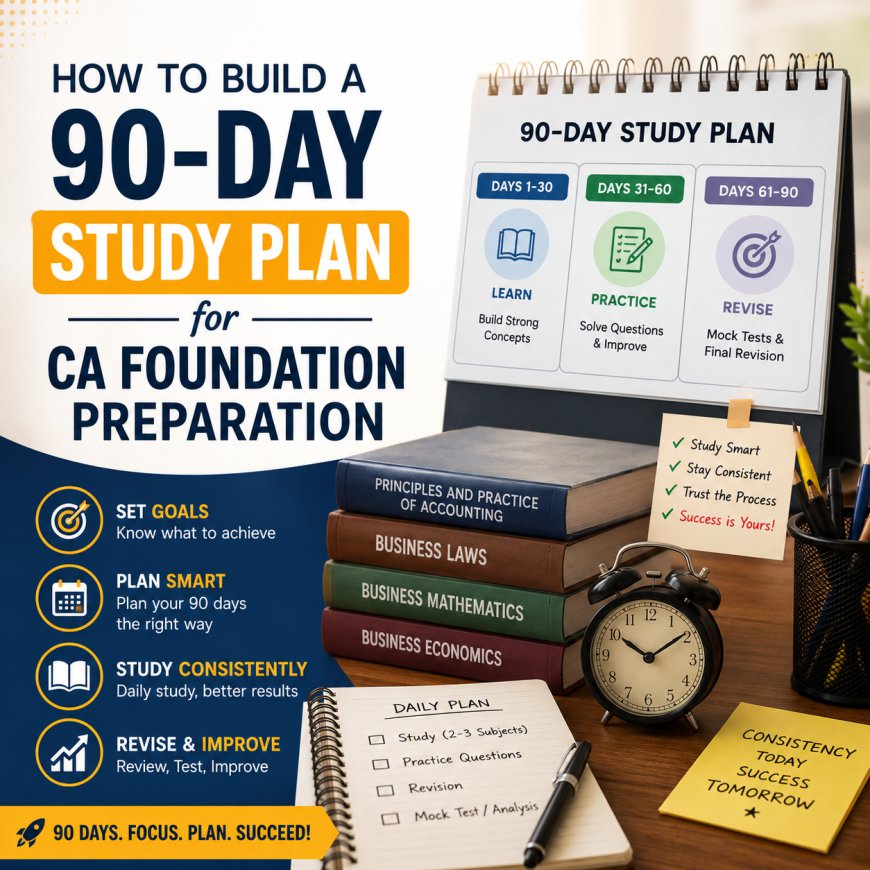
Preparing for CA Foundation requires more than simply studying for a few hours every day. Students need a structured plan that covers the syllabus, practice, revision, and mock tests without creating unnecessary pressure. A good ca foundation book can make this process easier by providing organized explanations and practice material in one place. With a focused 90-day strategy, students can divide their preparation into manageable stages and work toward completing the syllabus with confidence.
Why a 90-Day Plan Can Be Effective
A fixed preparation period gives students a clear target. Instead of wondering what to study every day, you can create weekly objectives and track your progress.
A 90-day plan can help you:
- Divide the syllabus into smaller sections
- Maintain consistency
- Allocate time to every subject
- Schedule regular revision
- Practice questions systematically
- Identify weak areas early
The goal should not be to study for maximum hours but to use your available time efficiently.
Understand Your Starting Point
Before beginning your 90-day preparation, evaluate your current level.
Ask yourself:
- Which subjects are strongest?
- Which chapters have already been completed?
- Which topics are difficult?
- How much time can you study each day?
- How much of the syllabus still needs to be covered?
This assessment will help you create a realistic schedule rather than copying someone else's routine.
Divide Your 90 Days into Three Phases
A simple approach is to divide your preparation into three 30-day phases.
Phase 1: Build Your Foundation
The first 30 days should focus primarily on learning concepts and completing the initial portion of the syllabus.
During this stage:
- Understand basic concepts
- Read your study material carefully
- Make concise notes
- Solve basic questions
- Identify difficult topics
Do not rush through chapters simply to mark them as completed. Your objective should be understanding.
Phase 2: Complete the Syllabus and Practice
The second 30 days should focus on completing the remaining syllabus while increasing your practice.
During this stage:
- Finish pending chapters
- Solve practice questions
- Revise previously completed topics
- Attempt chapter-wise tests
- Maintain an error notebook
By the end of this phase, you should have studied the complete syllabus at least once.
Phase 3: Revision and Mock Tests
The final 30 days should primarily focus on revision and examination practice.
You should:
- Revise important concepts
- Practice previous questions
- Attempt full-length mock tests
- Analyze mistakes
- Improve speed and accuracy
Avoid spending the entire final month learning completely new material unless absolutely necessary.
Create a Daily Study Routine
A daily routine should be practical enough to follow consistently.
For example, you could divide your day into:
Morning: Accounting or Mathematics
Afternoon: Law or Economics
Evening: Practice questions
Night: Revision of topics studied during the day
The exact timing is less important than maintaining a consistent routine.
Give Every Subject Enough Attention
One of the biggest mistakes students make is spending too much time on their favorite subject while ignoring difficult ones.
Your schedule should include all four subjects regularly. If you find Accounting difficult, give it additional practice time, but do not completely neglect Law or Economics.
Balanced preparation helps prevent last-minute pressure.
How to Plan Accounting Preparation
Accounting generally requires regular problem-solving practice.
Start by strengthening your fundamentals and then move toward more complex questions.
Focus On:
- Basic accounting concepts
- Journal entries
- Ledger and trial balance
- Adjustments
- Financial statements
- Other syllabus-specific numerical areas
Instead of reading solutions repeatedly, attempt questions yourself. When you make a mistake, understand why it happened and record the correction.
How to Prepare for Business Laws
Law requires both conceptual understanding and effective answer presentation.
Read provisions carefully and try to understand their practical meaning.
Your Law Strategy Should Include:
- Reading concepts carefully
- Highlighting important terms
- Creating short revision notes
- Practicing answer writing
- Revising regularly
Do not wait until the final month to begin Law revision. Regular exposure makes remembering concepts much easier.
How to Prepare for Mathematics, Logical Reasoning and Statistics
Mathematics-based preparation improves through repetition.
Start with formulas and fundamental concepts before attempting difficult questions.
Follow This Method:
- Understand the formula or concept.
- Solve a basic example.
- Attempt questions independently.
- Check your solution.
- Record recurring mistakes.
- Repeat similar questions later.
Speed comes naturally when you practice consistently.
How to Prepare for Economics
Economics requires conceptual understanding as well as regular revision.
Instead of memorizing every line, understand the relationship between concepts.
For example, when studying demand, understand why demand changes and what factors influence it. Once you understand the underlying idea, remembering details becomes easier.
Create short notes containing:
- Definitions
- Important concepts
- Differences
- Key points
- Difficult areas
Follow the Official Study Material
Your preparation should remain aligned with the latest applicable ICAI syllabus and study resources.
For students preparing for icai ca foundation, official study material should form the foundation of preparation. Reference books and additional resources should be used to improve understanding and practice rather than replacing the primary material.
Use the Right Number of Resources
More books do not automatically mean better preparation.
Using five different books for one subject can create unnecessary confusion. You may end up reading the same concepts repeatedly without completing any resource properly.
A practical combination can include:
- Official study material
- One reliable reference resource
- Practice questions
- Mock tests
- Your own revision notes
The objective is depth of preparation rather than quantity of material.
Create Weekly Targets
Daily goals are useful, but weekly targets give you a broader perspective.
At the beginning of each week, decide:
- Which chapters you will complete
- Which topics you will revise
- How many questions you will solve
- Whether you will attempt a test
At the end of the week, evaluate your progress honestly.
If you completed 80% of your target, determine what caused the remaining 20% to be unfinished and adjust the following week accordingly.
Keep an Error Notebook
An error notebook can become one of your most valuable revision resources.
Whenever you make a mistake in a question, record:
- The question type
- Your mistake
- The correct method
- The concept involved
Review these mistakes regularly. Your objective is not simply to solve more questions but to avoid repeating the same mistakes.
Include Revision from Day One
Do not wait until your syllabus is complete before revising.
A simple revision cycle can be:
Day 1: Learn a topic
Day 2: Quick review
Day 7: Weekly revision
Day 30: Monthly revision
This approach makes information easier to retain and reduces the burden during the final revision period.
Practice Previous Questions
Previous examination questions can help you understand how concepts are tested.
While practicing, pay attention to:
- Question patterns
- Frequently tested concepts
- Difficulty level
- Time required
- Common mistakes
Do not simply memorize previous questions. Learn the concepts behind them.
Take Mock Tests Seriously
Mock tests should be treated as practice for the actual examination.
During a mock test:
- Follow the time limit
- Avoid checking answers midway
- Attempt the paper under exam-like conditions
- Analyze your performance afterward
The analysis is just as important as the test itself.
Improve Your Speed Gradually
Speed should not come at the cost of accuracy.
During the first few weeks, prioritize understanding and correctness. As your preparation improves, begin solving questions within specific time limits.
For numerical subjects, calculate how long you take for different question types. This will help you develop a realistic exam strategy.
Avoid Procrastination
A 90-day plan only works when you actually follow it.
If you continuously postpone difficult chapters, they will eventually accumulate and create unnecessary pressure.
When a topic feels difficult, break it into smaller tasks. Instead of saying, "I need to finish this entire chapter," decide to complete one concept or a small set of questions first.
Starting is often the hardest part.
Manage Your Phone and Social Media
Digital distractions can consume significant study time.
During focused sessions:
- Keep your phone away
- Disable unnecessary notifications
- Avoid social media
- Use your device only when required for studying
Even small distractions can break concentration and make study sessions less productive.
Take Proper Breaks
A productive schedule should include breaks.
Studying continuously for several hours does not necessarily mean you are learning effectively. Short breaks can help refresh your mind and maintain concentration.
You can use techniques such as focused study intervals followed by short breaks, depending on what works best for you.
Maintain Your Health
Preparation should not come at the cost of basic health habits.
Try to maintain:
- Regular sleep
- Balanced meals
- Some physical activity
- Adequate breaks
A tired mind finds it harder to concentrate, remember information, and solve problems accurately.
What to Do During the Final 10 Days
The final 10 days should be used strategically.
Focus on:
- Important concepts
- Short notes
- Formulas
- Previously incorrect questions
- Mock tests
- Weak areas
Avoid constantly switching between different books or starting large amounts of unfamiliar material.
Your final days should be about strengthening what you already know.
How a Structured Course Can Help
Some students prefer independent preparation, while others perform better with structured guidance. A properly designed ca foundation course can provide a planned learning schedule, expert instruction, assessments, and doubt-solving support.
If you choose coaching, make sure the course fits your learning style and preparation requirements.
Sample 90-Day Preparation Framework
| Period | Primary Focus | Key Activities |
|---|---|---|
| Days 1–30 | Concept Building | Learn topics, make notes, solve basic questions |
| Days 31–60 | Syllabus Completion | Finish remaining topics, practice questions, revise |
| Days 61–75 | First Revision | Revise all subjects, solve previous questions |
| Days 76–85 | Mock Tests | Full-length tests and detailed analysis |
| Days 86–90 | Final Revision | Formulas, notes, weak areas and important concepts |
You can modify this framework according to your preparation level and available study time.
Final Thoughts
A 90-day preparation plan can give your CA Foundation journey a clear direction, but the plan only works when you follow it consistently. Focus on conceptual understanding, regular practice, revision, and mock tests rather than trying to use every available resource. Choose reliable study material, track your weekly progress, and continuously work on your weak areas. With disciplined preparation and the right ca foundation book, icai ca foundation resources, and a suitable ca foundation course, you can approach the examination with greater confidence and better preparation.