How Reliable Bearings Support India’s Vehicle Performance
India's automotive bearing market is driven by vehicle production, passenger cars, EV adoption, and aftermarket demand, reaching USD 982 million by 2032.
 Jhon223
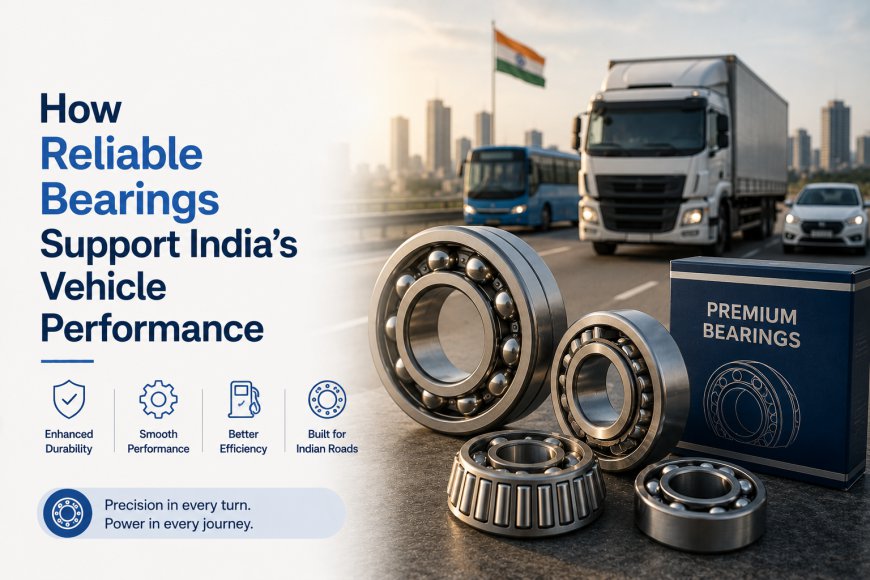
Automotive bearings are small but essential components that support movement, reduce friction, and improve mechanical efficiency across vehicles. They are used in wheels, engines, transmissions, steering systems, alternators, clutches, and electric drivetrains. In India, demand for reliable bearings is being shaped by vehicle production, replacement needs, road usage, passenger vehicle ownership, and the gradual shift toward cleaner mobility technologies.
According to MarkNtel Advisors, the India vehicle component outlook states that the India automotive bearing market was valued at USD 688 million in 2025 and is projected to grow from USD 721 million in 2026 to USD 982 million by 2032. The study estimates a CAGR of around 5.28% during 2026–2032, supported by passenger vehicle demand, ball bearing use, aftermarket replacement, and automotive manufacturing activity.
Vehicle Production Supports Component Demand
India’s automotive sector depends on a broad supplier base that provides components for passenger vehicles, two-wheelers, commercial vehicles, and three-wheelers. Bearings are used in multiple moving systems, so their demand rises with vehicle production and replacement cycles. Original equipment manufacturers need precision bearings that can support performance, durability, and safety across different vehicle platforms.
The Society of Indian Automobile Manufacturers reported in its monthly industry update that total production of passenger vehicles, three-wheelers, two-wheelers, and quadricycles reached 29,43,456 units in November 2025, showing the scale of automotive activity that supports demand for bearings and related components across the supply chain.
Ball Bearings Remain Widely Used
Ball bearings accounted for around 42% share in 2026, according to the shared study. These bearings are widely used because they can handle radial and axial loads while reducing friction between moving parts. Their versatility makes them suitable for wheel hubs, alternators, steering systems, gearboxes, electric motors, and several auxiliary vehicle systems.
Ball bearings are preferred in many applications because they support smoother rotation, lower energy loss, and reliable performance under repeated operating conditions. For vehicle manufacturers, bearing quality affects noise, vibration, harshness, efficiency, and component life. For consumers, better bearing performance can contribute to smoother driving, reduced repair frequency, and improved vehicle reliability.
Passenger Vehicles Lead Application Demand
Passenger vehicles accounted for around 52% share in 2026, making them the leading application category in the shared study. This reflects the importance of cars and utility vehicles in India’s mobility landscape, especially as urban households, working professionals, and families continue to depend on personal transportation.
Passenger vehicles require bearings across multiple systems, including wheel assemblies, engines, transmissions, compressors, steering columns, and electric motors. As vehicles become more comfortable, efficient, and technology-driven, bearing suppliers must meet tighter performance requirements. Lower friction, longer service life, and better heat resistance are becoming more important for both conventional and electric passenger vehicles.
Road Usage Reinforces Replacement Needs
India’s expanding road mobility creates continuous wear on vehicle components. Bearings experience stress from load, speed, heat, road conditions, braking forces, lubrication quality, and maintenance practices. Over time, worn bearings can cause noise, vibration, heat buildup, wheel play, or system failure, making replacement an important part of vehicle maintenance.
The Ministry of Road Transport and Highways provides transport statistics covering registered vehicles, road networks, and transport activity, which helps explain why India’s large vehicle base supports recurring replacement demand. A larger vehicle population increases the need for aftermarket bearings, workshop services, diagnostics, and spare parts availability across urban and regional markets.
Electric Vehicles Are Changing Design Needs
Electric vehicles are creating new requirements for automotive bearings. EV motors operate at high rotational speeds and often require bearings that can manage lower noise, reduced friction, electrical insulation, thermal stability, and longer service intervals. Bearings used in electric drivetrains must support efficiency because even small friction losses can affect range and performance.
The Bureau of Energy Efficiency explains through its electric mobility information that electric mobility can reduce local tailpipe emissions and noise, which is relevant as vehicle components are redesigned for quieter and more efficient propulsion systems. Bearing manufacturers must therefore adapt products for both internal combustion and electric vehicle platforms.
Aftermarket Channels Remain Important
The aftermarket plays an important role in automotive bearing demand because vehicles require replacement parts throughout their operating life. Workshops, service centers, dealers, distributors, and spare-part retailers help supply bearings for wheel hubs, clutch systems, alternators, gearboxes, and other mechanical assemblies. Timely replacement helps prevent wider component damage and improves road safety.
Aftermarket demand is influenced by vehicle age, road conditions, maintenance awareness, brand trust, part availability, and price sensitivity. Consumers and mechanics often evaluate bearings based on durability, fitment accuracy, warranty, and compatibility. Counterfeit or low-quality components can create safety and reliability risks, making trusted distribution channels important.
Manufacturing Quality Is Becoming More Important
Automotive bearings must meet precise engineering standards because they operate under constant movement and stress. Material quality, surface finishing, lubrication, sealing, heat treatment, and dimensional accuracy all influence performance. Poorly manufactured bearings can increase friction, generate noise, reduce efficiency, or fail earlier than expected.
Indian suppliers are increasingly focusing on quality systems, automation, testing, and localization to serve both domestic and export-oriented vehicle manufacturers. As OEMs demand stronger performance and lower warranty risk, bearing suppliers need to provide consistent quality, technical support, and products designed for evolving vehicle architectures.
Competition Reflects Precision and Trust
The shared study notes that leading players collectively account for about 37% of the organized share. This indicates a competitive environment shaped by established manufacturers, domestic suppliers, international brands, distributors, and aftermarket channels. Buyers often value engineering capability, product reliability, fitment range, pricing, and service support.
Competition also depends on application expertise. Bearings used in wheel ends, transmissions, engines, and EV drivetrains require different design priorities. Suppliers that can serve multiple platforms while maintaining quality and availability are better placed to meet the needs of OEMs, service networks, and replacement-part buyers.
Outlook for Automotive Bearings in India
India’s automotive bearing demand is being shaped by vehicle production, passenger vehicle usage, replacement cycles, ball bearing applications, and emerging electric mobility requirements. Bearings remain essential to vehicle reliability because they reduce friction, support rotation, and improve mechanical performance across critical systems.
The long-term direction will depend on how manufacturers balance cost, durability, localization, EV readiness, aftermarket quality, and supply reliability. As India’s vehicle