Low Power Wide Area (LPWA) Internet of Things Market Size, Share & Growth Forecast 2031
 Raymond10
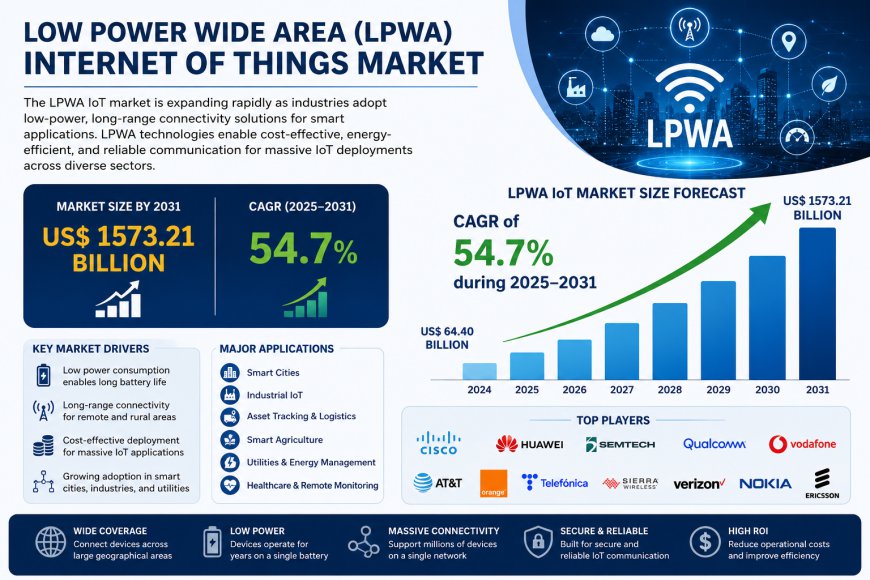
The Low Power Wide Area (LPWA) Internet of Things is witnessing remarkable growth as businesses increasingly adopt connected technologies for smart operations, automation, and real-time monitoring.
Market Size, Share And Trends
The Low Power Wide Area Internet of Things Market size is expected to reach US$ 1573.21 Billion by 2031. The market is anticipated to register a CAGR of 54.7% during 2025-2031. This substantial growth reflects the rising penetration of connected devices, expanding industrial IoT applications, and increasing demand for scalable communication technologies across multiple sectors.
What is Driving the Growth of the Low Power Wide Area Internet of Things Market?
The primary growth driver of the LPWA IoT market is the increasing demand for low-cost and energy-efficient connectivity solutions. Businesses require communication technologies that can support millions of connected devices while minimizing operational costs. LPWA networks fulfill this requirement by enabling devices to operate for several years on a single battery.
Another major factor contributing to market growth is the rapid expansion of smart city initiatives worldwide. Governments are implementing intelligent transportation systems, smart lighting, waste management solutions, and smart water monitoring systems that rely heavily on LPWA communication technologies. These applications require reliable long-distance connectivity with low power consumption.
Get Sample PDF @https://www.theinsightpartners.com/sample/TIPTE100000455
What Are the Major Challenges in the LPWA IoT Market?
Despite its rapid growth, the LPWA IoT market faces several challenges. One of the primary concerns is network security. As the number of connected devices increases, cybersecurity threats and data privacy risks continue to grow. Organizations must invest in robust security solutions to protect sensitive data and prevent unauthorized access.
Interoperability issues also present a challenge for market participants. Different LPWA technologies and communication standards can create compatibility problems between devices and networks. This may limit seamless integration and increase deployment complexity for businesses.
Another challenge is the limited data transmission capacity of LPWA networks. While LPWA is ideal for low-bandwidth applications, it may not be suitable for applications requiring high-speed data transfer or real-time video streaming.
Additionally, regulatory and spectrum allocation challenges can impact market growth. Governments and regulatory bodies must establish clear communication standards and spectrum management policies to support the widespread adoption of LPWA technologies.
Segmentation Analysis of the Low Power Wide Area Internet of Things Market
By Network Technology
The LPWA IoT market is segmented into LoRaWAN, Sigfox, NB-IoT, LTE-M, and others. NB-IoT is expected to hold a significant market share due to its strong cellular support and widespread deployment by telecom operators. LoRaWAN is also gaining popularity because of its flexibility and low deployment costs.
By Service
Based on service, the Low Power Wide Area Internet of Things Market is segmented into professional services and managed services. Managed services are witnessing increasing demand as enterprises seek end-to-end IoT connectivity and network management solutions.
By Application
The Low Power Wide Area Internet of Things Market includes smart buildings, smart agriculture, smart transportation, industrial IoT, asset tracking, smart healthcare, utilities, and environmental monitoring. Asset tracking and industrial IoT applications are expected to generate substantial revenue growth during the forecast period.
By End User
Major end users include manufacturing, healthcare, agriculture, transportation and logistics, retail, energy and utilities, and government sectors. The manufacturing sector is expected to dominate due to increasing automation and predictive maintenance applications.
Which Regions are Leading the LPWA IoT Market?
North America
North America holds a significant share of the LPWA IoT market due to strong technological infrastructure and high adoption of smart technologies. The presence of leading technology companies and increasing investments in industrial automation continue to drive regional growth.
Europe
Europe is witnessing strong market growth due to the rapid implementation of smart city projects and environmental monitoring initiatives. Countries such as Germany, the United Kingdom, and France are investing heavily in digital infrastructure and IoT deployment.
Asia Pacific
Asia Pacific is expected to register the highest growth rate during the forecast period. Rapid industrialization, increasing smartphone penetration, and government support for smart city development are fueling market expansion in countries such as China, Japan, South Korea, and India.
Middle East and Africa
The Middle East and Africa region is experiencing growing adoption of LPWA technologies in smart utilities, oil and gas monitoring, and infrastructure development projects. Increasing investments in digital transformation initiatives are expected to support future market growth.
South America
South America is gradually adopting LPWA IoT solutions across agriculture, transportation, and energy sectors. Expanding connectivity infrastructure and increasing awareness of IoT benefits are contributing to market development.
Top Players in the Low Power Wide Area Internet of Things Market
Several leading companies are actively operating in the LPWA IoT market and focusing on technological innovation, partnerships, and product development to strengthen their market position.
Key market players include:
- Atmel Corporation
- IBM Corporation
- Deutsche Telekom (DT)
- Cisco Systems, Inc.
- Hewlett Packard Enterprise
- Huawei Corporation
- Ericcson
- AT&T Inc.
- Alcatel Lucent SA
- Qualcomm Inc.
These companies are investing heavily in advanced connectivity solutions, cloud integration, and next-generation IoT platforms to meet the growing demand for LPWA technologies.
What is the Future Outlook for the LPWA IoT Market?
The future outlook for the LPWA IoT market remains highly positive due to the increasing adoption of connected devices and smart technologies across industries. The expansion of 5G infrastructure is expected to further enhance LPWA network capabilities and improve device connectivity.
Artificial intelligence and edge computing integration will create new opportunities for intelligent IoT applications. Businesses are expected to increasingly adopt predictive analytics and automation systems powered by LPWA communication networks.
Related Report
About The Insight Partners
The Insight Partners delivers market intelligence and consulting services to help clients make informed decisions. The firm covers industries such as Aerospace and Defense, Automotive and Transportation, Semiconductor and Electronics, Biotechnology, Healthcare IT, Manufacturing, Medical Devices, Technology, Media, and Chemicals and Materials.
Contact Us
Email: sales@theinsightpartners.com
Website: www.theinsightpartners.com
Phone: +1-646-491-9876
Also Available in :
Korean German Japanese French Chinese Italian Spanish