MCP Server: The Complete Guide to Connecting AI Platforms with Enterprise Data and APIs
Learn how MCP Server connects AI platforms with APIs, enterprise data, SQL databases, file systems, authentication systems, prompt templates, and multiple backends for scalable AI solutions.
 manipattar
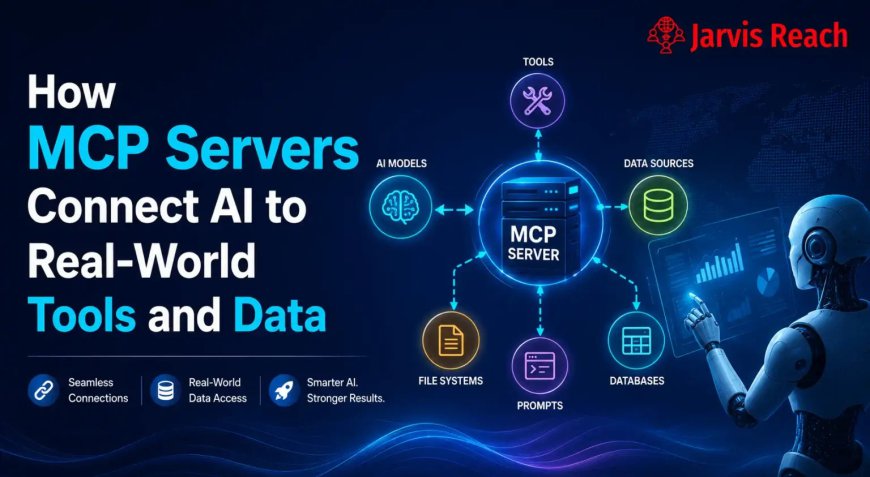
Artificial intelligence is becoming more powerful, but its true potential is unlocked when it can access real-world information and external systems. This is where an MCP Server plays a critical role. By providing a standardized connection between AI applications and external resources, MCP Servers help organizations build intelligent, scalable, and context-aware solutions.
Whether you're working with an MCP Client, connecting to an API, managing Enterprise data, or integrating SQL databases, understanding MCP Server architecture is essential for modern AI development.
What Is an MCP Server?
An MCP Server (Model Context Protocol Server) acts as a bridge between an AI platform and external resources. Instead of giving AI models direct access to systems, the server provides a secure and structured method for retrieving information and performing actions.
An MCP Server can connect AI applications to:
- APIs
- SQL databases
- File systems
- Enterprise data repositories
- Internal tools
- External services
- Business applications
This standardized approach simplifies integration and improves security.
How an MCP Client Works
An MCP Client is the application that communicates with the MCP Server.
The typical workflow looks like this:
- User submits a request.
- AI platform processes the request.
- MCP Client sends a structured query.
- MCP Server accesses the required data source.
- Results are returned to the AI model.
- AI generates a context-aware response.
This architecture allows AI systems to work with dynamic information instead of relying only on training data.
Connecting APIs Through MCP Servers
Most organizations rely on multiple API connections for business operations.
MCP Servers simplify API management by:
- Standardizing requests
- Managing authentication
- Improving security
- Reducing integration complexity
- Supporting multiple backends
This allows developers to connect AI applications to external services without building custom integrations for every tool.
Accessing Enterprise Data Securely
Modern businesses generate massive amounts of Enterprise data.
MCP Servers help organizations:
- Control access permissions
- Protect sensitive information
- Maintain compliance requirements
- Enable AI-powered insights
- Improve data accessibility
This makes enterprise AI deployments more practical and secure.
Integrating SQL Databases
Many business systems store information inside SQL databases.
An MCP Server can:
- Query databases
- Retrieve records
- Update information
- Support analytics workflows
- Provide real-time business data
This enables AI assistants to answer questions using current organizational information.
Managing Multiple Data Sources
Organizations rarely rely on a single repository.
Common Data sources connected through MCP Servers include:
- Customer relationship management systems
- Document repositories
- SQL databases
- APIs
- Knowledge bases
- Cloud storage platforms
By centralizing access, MCP Servers help AI models retrieve information from multiple systems efficiently.
Using Prompt Templates for Consistency
Many organizations use Prompt templates to standardize AI interactions.
Benefits include:
- Consistent responses
- Improved accuracy
- Faster deployment
- Better user experiences
- Easier maintenance
Prompt templates work especially well when combined with enterprise workflows powered by MCP Servers.
Stateless vs Stateful Architectures
Understanding Stateless and Stateful systems is important when designing AI infrastructure.
Stateless Systems
Stateless architectures do not store session information between requests.
Advantages include:
- Better scalability
- Simpler deployment
- Easier maintenance
Stateful Systems
Stateful architectures maintain context across interactions.
Benefits include:
- Personalized experiences
- Long-term memory
- Enhanced workflows
- Better conversational continuity
Many modern MCP Server implementations support both approaches depending on application requirements.
Supporting Modern AI Platforms
Every advanced AI platform requires reliable access to external information.
MCP Servers help AI platforms:
- Access live data
- Execute business workflows
- Integrate enterprise systems
- Improve decision-making
- Deliver context-aware responses
This makes AI applications significantly more useful in real-world environments.
Managing Multiple Backends
Organizations often operate multiple Backends simultaneously.
Examples include:
- CRM systems
- ERP software
- Analytics platforms
- Cloud applications
- Internal databases
MCP Servers provide a unified interface that simplifies communication between AI systems and backend infrastructure.
Authentication and Security
Strong authentication mechanisms are essential when AI systems access sensitive resources.
MCP Servers typically support:
- API keys
- OAuth authentication
- Role-based permissions
- Access controls
- Secure communication protocols
These security measures help protect enterprise environments while maintaining functionality.
Working with File Systems
Many organizations store important information within File systems.
MCP Servers can help AI applications:
- Access documents
- Search files
- Retrieve knowledge assets
- Analyze content
- Support document-based workflows
This capability enables AI assistants to work directly with organizational resources.
Benefits of Using an MCP Server
Organizations implementing MCP Servers often experience:
- Faster AI integration
- Improved scalability
- Better security
- Simplified architecture
- Access to real-time data
- More accurate AI responses
- Reduced development complexity
These benefits make MCP Servers a foundational technology for modern AI ecosystems.
Conclusion
An MCP Server provides the infrastructure needed to connect AI applications with APIs, enterprise data, SQL databases, file systems, and other critical resources. By supporting MCP Clients, authentication, prompt templates, multiple backends, and both stateless and stateful architectures, MCP Servers help organizations build intelligent, scalable, and secure AI solutions. As AI adoption continues to grow, MCP Servers are becoming an essential component of enterprise AI platforms and modern application development.