Microgreens Market Size, Growth, Industry Trends and Forecast 2026-2034
The microgreens market is expected to reach USD 3,379.5 Million by 2034, exhibiting a growth rate (CAGR) of 6.62% during 2026-2034.
 torylanez27
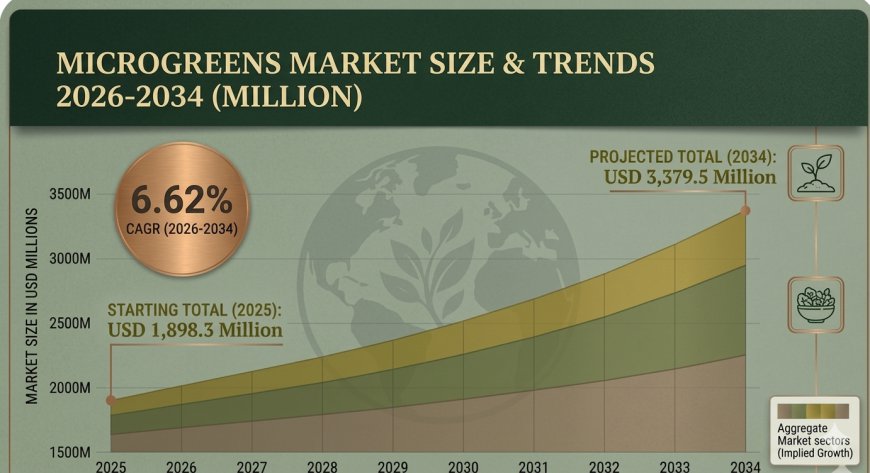
According to a research report by IMARC Group, the global microgreens market size reached USD 1,898.3 Million in 2025. The market is projected to reach USD 3,379.5 Million by 2034, exhibiting a growth rate (CAGR) of 6.62% during 2026–2034. The market is primarily driven by increasing consumer demand for nutrient-rich and health-focused foods, advancements in indoor farming technologies, the growing popularity of gourmet dining and plant-based diets, and the shift toward sustainable agricultural practices.
Market at a Glance
|
Report Attribute |
Key Statistics |
|
Base Year |
2025 |
|
Forecast Years |
2026–2034 |
|
Historical Years |
2020–2025 |
|
Market Size in 2025 |
USD 1,898.3 Million |
|
Market Forecast in 2034 |
USD 3,379.5 Million |
|
Market Growth Rate (CAGR) |
6.62% |
Request for a Sample Report for Detailed Evaluation: https://www.imarcgroup.com/microgreens-market/requestsample
Key Microgreens Market Trends Driving Expansion
Nutritional Benefits and Health-Conscious Consumers
Consumer awareness of health and nutrition is a major driver for the microgreens market growth as they contain higher concentration of vitamins‚ minerals and antioxidants․ This is supported by industry surveys listing 65% of consumers responding positively to food products with natural ingredients‚ and 55% of consumers respond to food products with dietary value beyond basic food and nutrition․ Consumer demand is increasing for functional foods and nutrient-dense dietary foods․ Microgreens provide a concentrated source of nutrition in a small convenient package․
Growing Culinary Trends and Chef Endorsements
Chefs of high-end restaurants and hotels often use microgreens for flavor‚ texture and appearance․ Microgreens can therefore be found on many restaurant menus and at establishments such as hotels‚ cafés‚ and fine dining restaurants․ Growing consumer interest in farm-to-table dining‚ gourmet cooking‚ and plant-based menus continues to drive demand from commercial food operators․
Urban Agriculture and Sustainable Farming Practices
Urban farming and sustainable agriculture have also contributed to the growth in the microgreens industry․ Urban farms produce microgreens quickly and relatively easily in a controlled environment using hydroponic systems or small containers․ Reductions in farmland‚ (900 million acres (360 million hectares) of farmland in 2017‚ and 880 million acres (360 million hectares) in 2022)‚ and changing consumer preferences for locally sourced and environmentally friendly food have also contributed to a growing interest in high-yield and low-resource intensive farming methods like microgreens․
Advancements in Indoor Vertical Farming Technology
Improvements in indoor vertical farming technology allow for year-round production of consistently produced microgreens‚ where light‚ temperature and humidity can be controlled․ Indoor vertical farms use 70% to 95% less freshwater than is used in customary farms․ With 40% of the world's vertical farming taking place in the United States‚ the industry is now seen as a mature‚ good investment opportunity․
Microgreens Market Segmentation Analysis
By Type
- Broccoli
- Cabbage
- Cauliflower
- Arugula
- Peas
- Basil
- Radish
- Others
Broccoli leads the market with around 27.2% of market share in 2025 - driven by its exceptional nutritional profile and broad consumer appeal. Rich in vitamins, minerals, and antioxidants, broccoli microgreens are particularly favored by health-conscious individuals. Their versatility in culinary applications and growing inclusion in wellness-oriented food products, salads, and smoothies further reinforce their segment dominance.
By Farming Method
- Indoor Vertical Farming
- Commercial Greenhouses
- Others
Indoor vertical farming leads the market with around 44.3% of market share in 2025 - leveraging controlled environments to optimize growth conditions and ensure consistent quality. Year-round production capability, efficient use of water and energy, and a reduced land footprint make this method the preferred choice among growers, especially in urban settings.
By End Use
- Residential
- Commercial
The commercial end-use segment dominates the market - driven by adoption in restaurants, hotels, and catering services, where microgreens are used to enhance the aesthetic and flavor profile of dishes. The growing trend of plant-based dining and emphasis on culinary innovation continue to fuel commercial demand.
By Distribution Channel
- Supermarkets and Hypermarkets
- Retail Stores
- Others
Retail stores lead the market with around 42.6% of market share in 2025 - owing to their convenience, wide accessibility, and ability to offer an extensive variety of microgreens in eco-friendly packaging. Collaborations with local growers and strategic marketing by retail chains strengthen supply consistency and consumer awareness.
By Region
- North America
- Asia Pacific
- Europe
- Latin America
- Middle East and Africa
North America leads the market with over 36.5% share in 2025 - driven by heightened health awareness, strong culinary culture, advanced indoor farming technologies, and a robust distribution network spanning supermarkets, restaurants, and farmers’ markets.
Connect for Detailed Competitive Analysis - Speak to an Analyst: https://www.imarcgroup.com/request?type=report&id=4310&flag=C
Competitive Landscape in the Microgreens Industry
The global microgreens market features a mix of innovative startups and established agri-food companies. Key players are investing in R&D to enhance cultivation techniques, expand microgreen variety portfolios, and establish partnerships with distributors, supermarkets, and restaurant chains. Eco-friendly and technology-driven farming practices such as vertical farming and hydroponics are common strategic themes across the competitive landscape.
Key Microgreens Market Players Include:
- 2BFresh
- 80 Acres Farms
- AeroFarms
- Badia Farms
- Farm.One Inc.
- Farmbox Greens (Charlie’s Produce)
- Fresh Origins
- GoodLeaf Farms (True Leaf)
- Greeneration
- Ibiza Microgreens
- Living Earth Farm
- Metro Microgreens
- The Chef’s Garden Inc.
Key Regional Insight: North America’s Strategic Position
North America has the largest mature microgreens market‚ due to increasing health-consciousness‚ growing culinary interest‚ and an established farming infrastructure․ The US is responsible for 84․5% of North America's market share‚ with over 3400 hydroponic farms‚ many retail stores including Whole Foods and Kroger‚ as well as a farm-to-table restaurant industry with a high demand for microgreens․ In Canada‚ the agri-food industry generates CAD 143․8 billion (7․4%) of the national GDP‚ adding to the agricultural capacity and demand for high-value crops such as microgreens․
Market Drivers, Challenges & Opportunities
Major Market Drivers:
- Rising consumer demand for nutrient-dense, health-focused foods
- Expansion of indoor vertical farming enabling year-round production
- Growing popularity of plant-based diets and gourmet dining
Key Challenges:
- Short shelf life requiring efficient cold-chain logistics
- High initial investment costs for indoor farming infrastructure
Emerging Opportunities:
- Partnerships between growers and retail chains for farm-to-table supply chains
- Rising e-commerce demand for microgreen kits and seeds
- Expansion into functional food innovations and wellness-oriented product lines
Conclusion: Microgreens Market Outlook to 2034
Due to the health consciousness of consumers‚ innovation in controlled environment agriculture‚ and the increased use of plant-based food in restaurants and at home‚ the global microgreens market is expected to continue growing past 2023 through to 2034․ As consumers increasingly seek socially and environmentally sustainable products‚ the efficient use of inputs in the growth of microgreens positions them at the forefront of the future of fresh․
North America is the largest market in terms of volume and innovation; while regions‚ such as Asia Pacific and Europe‚ have emerged as high growth markets for microgreens‚ which bodes well for the market growth․
IMARC Group is a leading global market research company providing data-driven insights and expert consulting services to businesses seeking to achieve their strategic objectives. With a multi-disciplinary team of industry experts, IMARC delivers thorough, reliable market intelligence across sectors including Food & Beverages, Packaging, Chemicals and Materials, Healthcare, Technology, Agriculture, and more.
Media & Sales Contact
IMARC Group
United States: +1-201-971-6302
India: +91-120-433-0800
United Kingdom: +44-753-714-6104