Multimodal AI Development Company in Dubai & UAE: Custom AI Solutions & Development Services (2026)
Looking for a Multimodal AI development company in Dubai & UAE? SISGAIN delivers custom AI solutions integrating text, image, audio, and video for businesses.
 sisgaintechsolutions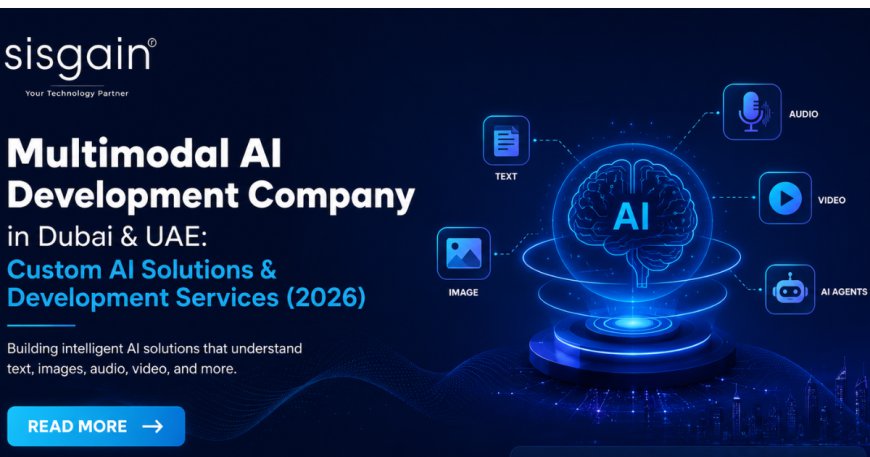
Key Takeaways
- Multimodal AI combines text, images, audio, video, documents, and sensor data into one system, instead of relying on separate single-format tools.
- The UAE's AI market is projected to reach $72.1M by 2030 at a 37% CAGR, backed by $4.5B in funding and 72 active AI startups.
- Sovereign models like Falcon 3 and growing Arabic-language capability (via benchmarks like CAMEL Bench) are reshaping what businesses expect from a local AI partner.
- AI agents are the layer that turns multimodal understanding into action — reading a document or image and triggering the next workflow step automatically.
- Healthcare, banking, logistics, government, and real estate are seeing the fastest returns, largely due to high document and image volume.
- Arabic AI, edge AI, and SME-focused solutions remain under-served market opportunities in the UAE.
- The right development partner should be judged on industry knowledge, LLM and computer vision depth, AI agent experience, security, and genuine Arabic AI capability — not just a sales pitch.
- SISGAIN Technologies builds custom, enterprise-ready multimodal AI and AI agent solutions across Dubai and the wider UAE.
Your business runs on more than plain text. You have scanned invoices, WhatsApp voice notes, CCTV footage, PDF contracts, and customer photos, all sitting in different systems and speaking different "languages." A single-mode chatbot cannot make sense of all that. This is where a Multimodal AI Development Company comes in.
In this guide, you will learn what multimodal AI actually is, why Dubai and the wider UAE are becoming a serious hub for it, and how the right development partner turns scattered data into automated decisions. By the end, you will know exactly what to look for before you hire a Multimodal AI Development Company for your business.
Most companies in Dubai already have the data they need to run smarter operations. The problem is rarely a lack of information — it's that the information lives in five different formats, across five different systems, and no single tool reads all of them together. A customer complaint might arrive as a voice note, a photo of a damaged item, and a follow-up email, and today, three separate teams handle those three pieces separately. A Multimodal AI Development Company exists specifically to close that gap, connecting every format into one system that understands the full picture and, increasingly, acts on it through AI agents without waiting for a human to stitch the pieces together manually.
A Multimodal AI Development Company builds AI systems that understand and combine multiple types of data — text, images, audio, video, and documents — in a single workflow, so businesses can automate decisions instead of relying on siloed, single-format tools.
What is Multimodal AI?
Understanding Multimodal AI
Multimodal AI is a type of artificial intelligence that can process more than one form of data at the same time. Traditional AI models usually work with just one input, like text-only chatbots or image-only recognition tools. Multimodal AI combines several of these:
- Text – emails, chat messages, reports
- Images – product photos, ID scans, satellite images
- Audio – call recordings, voice notes, dictation
- Video – surveillance footage, site inspections
- Documents – PDFs, invoices, contracts, forms
- Sensor data – IoT feeds, temperature logs, GPS data
A single model reasoning across all of these gives a far more complete picture than five separate tools bolted together.
How Multimodal AI Works
A working system built by a Multimodal AI Development Company generally follows four stages:
- Data Processing – raw text, images, audio, and video are cleaned and converted into a format the model can read.
- Cross-modal Learning – the model learns relationships between formats, for example, matching a spoken complaint to a photo of a damaged product.
- Context Understanding – the system connects the dots across formats to understand intent, not just individual data points.
- Decision Making – the model produces an output: an answer, a flag, a summary, or a triggered action.
The final layer that makes this useful in daily operations is AI Agents, which take the model's understanding and act on it automatically, such as approving an invoice or routing a support ticket.
Here's what that looks like in practice: a logistics company receives a delivery-proof photo, a driver's voice note about a delay, and a customer's text complaint, all within the same hour. A multimodal system reads the photo to confirm the package condition, transcribes and interprets the voice note, matches it against the customer's complaint, and automatically issues a resolution — a refund, a replacement, or an escalation — without a support agent touching a single one of those three inputs by hand. That is the practical difference between a single-mode chatbot and a genuine multimodal AI system.
Why the UAE is Becoming a Global Leader in Multimodal AI
The UAE's National AI Strategy has pushed government investment into AI infrastructure well beyond most regional peers. Homegrown players like G42, the Technology Innovation Institute (TII), and MBZUAI are producing foundation models and research at a pace few countries in the Middle East can match, and partnerships with global names like Microsoft have brought enterprise-grade AI tooling directly into the region.
G42 has grown into one of the region's most active AI infrastructure and applied-AI groups, feeding compute and data capacity into everything from healthcare diagnostics to government services. TII, based in Abu Dhabi, is the research engine behind the open-source Falcon model family, which has become a genuine talking point in global AI circles rather than a regional footnote. MBZUAI, the world's first graduate-level university dedicated entirely to artificial intelligence, is quietly building the local talent pipeline that every Multimodal AI Development Company in the region will eventually draw from. Layer the Microsoft partnership — bringing Azure AI infrastructure and enterprise tooling directly into UAE data centers — on top of that, and you get a market with both the ambition and the underlying infrastructure to support serious multimodal AI adoption, not just pilot projects.
UAE AI Market Snapshot:
| Metric | Figure |
|---|---|
| Projected market value by 2030 | $72.1M |
| CAGR | 37% |
| Active AI startups | 72 |
| Total AI funding | $4.5B |
This momentum is exactly why demand for a capable Multimodal AI Development Company Dubai has grown so quickly — enterprises want a local partner who understands both the technology and the regulatory landscape.
Latest Multimodal AI Trends in Dubai & UAE (2026)

Sovereign AI Models
The UAE is investing in its own foundation models, including Falcon 3 and its perception-focused variants like Falcon Perception, to reduce dependency on foreign AI infrastructure. This "AI independence" push isn't just a national policy talking point — it changes what businesses expect from a vendor. Local enterprises increasingly want solutions built or fine-tuned on regional models that were trained with an understanding of local language, culture, and regulation, rather than a foreign model with an Arabic translation layer bolted on afterward.
Arabic Multimodal AI
Arabic-language AI has historically lagged behind English, largely because training data was scarce and dialect variation across the Gulf, Levant, and North Africa made generalization difficult. New Arabic datasets and benchmarks like CAMEL Bench are closing that gap, giving rise to genuinely capable Arabic large multimodal models (LMMs). For a Multimodal AI Development Company serving the GCC, this is quickly becoming table stakes rather than a nice-to-have, since Arabic-first government and citizen-service platforms need models that read Arabic handwriting, understand Arabic voice input, and interpret Arabic documents natively.
AI Agents + Multimodal AI
AI agents are no longer limited to text chat. Modern agents read documents, look at images, listen to voice input, and interpret photos, then trigger the next step in a workflow without a human clicking a single button. A procurement agent, for example, can now read a supplier's invoice image, cross-check it against a purchase order in the ERP, flag a mismatch, and notify the right team — all in one automated pass. This is workflow automation at its most practical, and it's the single biggest reason enterprise interest in multimodal AI has jumped over the last year.
Enterprise AI Adoption
Adoption is accelerating fastest in healthcare, banking, government, logistics, and construction — sectors with heavy document loads, compliance pressure, and a clear cost case for automation. What's changed in 2026 is that these deployments are moving past pilot programs into core operational infrastructure, with boards asking for measurable ROI rather than experimental proof-of-concepts.
Why Businesses Need a Multimodal AI Development Company
Most UAE enterprises are stuck with the same operational bottlenecks:
- Data scattered across incompatible sources
- Manual, repetitive workflows eating staff hours
- Slow decision-making because information isn't connected
- Compliance risk from inconsistent document handling
- Rising operational costs with no automation in sight
A specialist Multimodal AI Development Company solves these by building one system that reads across formats, applies business rules consistently, and hands off decisions to AI agents — cutting manual work while improving accuracy.
Businesses need a Multimodal AI Development Company because in-house teams rarely have the combined expertise in computer vision, NLP, and AI agent orchestration required to connect fragmented data sources into one automated system.
Multimodal AI Development Services
A strong Multimodal AI Development Company Dubai offers a full stack of services, not a single tool. Here's what that stack typically includes.
Custom Multimodal AI Development
Every business has a different mix of data. Custom multimodal AI development means building models trained specifically on your documents, images, and workflows, rather than forcing your operations into a generic template built for someone else's business. This is the difference between a system that technically works and one your team actually trusts enough to remove the manual double-check.
Enterprise Multimodal AI Development
At enterprise scale, the priority shifts to security, uptime, and integration with existing systems across multiple departments and, often, multiple countries. An enterprise deployment also needs to survive audits, handle role-based access across large teams, and scale without a full rebuild every time a new department joins.
Multimodal AI App Development
For customer-facing products, multimodal AI app development brings vision, voice, and text understanding directly into mobile and web apps — think a real estate app that lets buyers search using a photo instead of typing keywords, or a banking app that verifies identity through a live selfie instead of a manual back-office check.
AI Agent Development
Agents built on top of multimodal models can read a document, check a policy, and approve or escalate a request without waiting on a human at every step.
Computer Vision Integration
From quality inspection on a factory floor to ID verification at a government counter, computer vision gives the system "eyes."
NLP + LLM Development
Natural language processing and large language models give the system the ability to understand intent in emails, chats, and voice transcripts.
Voice AI Development
Voice AI captures spoken input — customer calls, field-staff dictation — and converts it into structured, actionable data.
Document Intelligence
This covers OCR, invoice processing, and contract analysis, turning static paperwork into searchable, structured records.
AI Workflow Automation
Once data is understood, workflow automation strings together the approvals, notifications, and updates that used to require manual intervention.
API & Enterprise Integration
None of this matters if it can't talk to your existing stack. Integration with ERP, CRM, EMR, SAP, Salesforce, and Microsoft Dynamics is what turns a proof-of-concept into a production system.
Industry Use Cases of Multimodal AI Solutions in Dubai

Different industries need very different applications of multimodal AI solutions Dubai businesses can actually use day to day.
Healthcare Medical imaging analysis, patient report summarization, voice dictation for doctors, and automated clinical documentation. A radiologist's spoken notes, a scanned lab report, and an X-ray image can all feed the same patient file automatically instead of three separate manual entries. Many providers pair this with dedicated Healthcare Software Development Dubai partners to connect AI output directly into patient records and existing EMR systems.
Logistics Reading warehouse images for stock checks, verifying delivery proof photos, monitoring fleets in real time, and processing invoices automatically. A driver's photo of a delivered package, a GPS ping confirming location, and a scanned delivery note can all be cross-checked in seconds instead of end-of-day manual reconciliation. This is a natural extension of what a specialist Logistics Software Development Company in Dubai already builds — multimodal AI simply adds the vision and document layer, with AI agents handling exceptions like damaged goods or delayed shipments.
Government Document verification, Arabic form processing, citizen service chatbots, and identity verification — all high-volume, high-accuracy use cases where a single misread form can mean real delays for a citizen. Multimodal systems that read handwritten Arabic forms alongside scanned ID photos are becoming a core part of digital government rollouts.
Real Estate Property image analysis, contract review, virtual tour generation, and AI-driven property recommendations. A buyer can upload a photo of a layout they like and get matching listings back, while an agent gets contract clauses flagged automatically before signing. Many developers now build this directly into their real estate software solutions Dubai, so buyers can search visually and agents can process paperwork faster without a separate manual review step.
Banking KYC checks, fraud detection from behavioral and document signals, loan document processing, and AI-assisted customer support. A loan application with a scanned salary certificate, a selfie for identity match, and a voice-recorded verification call can all be assessed together instead of routed through three separate compliance checks. This is often delivered alongside custom fintech software development , where compliance requirements demand a purpose-built, auditable system rather than an off-the-shelf tool.
Manufacturing Quality inspection through computer vision, IoT sensor monitoring, predictive maintenance, and safety monitoring on the factory floor. A camera flagging a defective part, a sensor reporting abnormal vibration, and a technician's voice report can be correlated automatically to predict which machine needs attention next.
Retail Visual search, automated inventory tracking, AI customer support, and personalized recommendations based on browsing and purchase history. A customer photographing a product they saw elsewhere can be matched instantly against your own catalog, turning a browsing moment into a sale.
Market Opportunities for Multimodal AI Development Companies
Several gaps remain wide open in the UAE market:
- Arabic AI gap – demand for Arabic-first multimodal tools still outpaces supply, especially for government and citizen-facing platforms
- Edge AI – on-device processing for sectors with strict data residency needs, where data cannot leave a facility or a country
- SMEs – smaller businesses are largely underserved by enterprise-only vendors, leaving room for scoped, affordable multimodal projects
- Oil & Gas – heavy equipment monitoring and safety compliance, where a missed visual defect can mean a costly shutdown
- Construction – site inspection automation via video and image analysis, replacing slow manual walkthroughs
- Government – ongoing digitization of citizen services, with Arabic document processing as a core requirement
A Multimodal AI Development Company that can move into these gaps early has a clear first-mover advantage, both in winning contracts and in building the domain expertise that's hard for a generic vendor to replicate later.
Current Challenges in UAE Multimodal AI Adoption
No transformation is without friction. The main hurdles right now:
- Arabic language complexity and dialect variation across the region
- AI talent shortage, with demand for skilled engineers still outpacing local supply
- Hardware imports for GPU-heavy workloads, which can affect project timelines
- Data security requirements for regulated sectors like banking and healthcare
- Infrastructure gaps outside major cities like Dubai and Abu Dhabi
- Compliance with evolving UAE data protection rules, which every deployment must be built around, not retrofitted for
An experienced development partner plans around these constraints from day one, rather than discovering them mid-project when they become expensive to fix.
Benefits of Enterprise Multimodal AI Development
Quick Answer: Enterprise Multimodal AI Development helps businesses make faster, more accurate decisions, automate repetitive work, cut operational costs, and deliver a better customer experience — all through AI agents that act on multiple data types at once.
- Better, faster-informed decisions
- End-to-end automation of document-heavy processes
- Higher team productivity
- Lower operational cost over time
- Improved customer experience through faster response
- Faster, leaner workflows across departments
- AI agents that handle routine decisions without human review
How to Choose the Right Multimodal AI Development Company
Use this checklist before you sign a contract:
- Proven experience with multimodal projects, not just single-mode AI
- Real industry knowledge in your specific sector
- Depth in LLM development and fine-tuning
- Strong computer vision capability
- Experience building production-grade AI agents
- Comfort working across major cloud platforms
- Clear approach to security and compliance
- Genuine Arabic AI capability, not a translation layer bolted on
- Flexible deployment options (cloud, on-premise, edge)
- Ongoing support after go-live
Our Multimodal AI Development Process
- Discovery – we start by understanding your data sources, existing systems, and the actual business problem you're trying to solve, not just the technology you've heard about
- Data Assessment – we audit what data actually exists, in what format, and how usable it is before writing a single line of model code
- Model Selection – we choose or fine-tune the right foundation model for your use case, rather than defaulting to whichever model is trending
- AI Training – the model is trained on your specific documents, images, and workflows, so it understands your business, not a generic dataset
- Integration – we connect the system to your ERP, CRM, EMR, or other core platforms, so it fits into how your teams already work
- Testing – we validate accuracy across every input type before go-live, including edge cases most teams don't think to check
- Deployment – we roll out in a controlled, monitored environment, so issues surface early and get fixed before they affect your customers
- Optimization – we continuously refine the system based on real usage data after launch, since a multimodal system should keep improving, not stay frozen at version one
Technology Stack We Use
| Category | Tools |
|---|---|
| LLMs | GPT, Claude, Llama, Falcon, Gemini |
| Computer Vision | YOLO, OpenCV, PaddleOCR, Tesseract |
| Speech AI | Whisper, Azure Speech |
| Cloud | AWS, Azure, Google Cloud, Oracle |
| Vector Databases | Pinecone, Weaviate, Milvus |
| Orchestration | LangChain, LlamaIndex |
Why Choose SISGAIN for Multimodal AI Development in Dubai
SISGAIN Technologies brings UAE-focused AI expertise built around real enterprise needs, not generic templates. Here's what sets us apart as a Multimodal AI Development Company:
- Deep, UAE-specific AI development expertise
- Fully custom multimodal AI development, tailored to your data
- Proven enterprise system integrations (ERP, CRM, EMR)
- AI agents built for real workflow automation, not demos
- Secure, compliance-ready deployments
- Scalable, cloud-native architecture
- Dedicated, ongoing support post-launch
- Industry-specific solutions across healthcare, logistics, banking, real estate, and government
If you are evaluating a Multimodal AI Development Company Dubai partners can rely on long-term, SISGAIN is built to be that partner. We work directly with your existing teams rather than handing over a black-box system and disappearing after launch — every project includes a clear handover, documentation, and a support plan so your team understands exactly how the system makes its decisions.
Future of Multimodal AI in the UAE
Looking ahead, expect multimodal capability to merge deeply with AI agents, robotics, and smart city infrastructure. Autonomous systems, edge AI deployments, and Arabic foundation models will keep maturing alongside government AI initiatives, pushing enterprise transformation further across every sector this guide has covered.
Smart city projects across Dubai and Abu Dhabi will increasingly rely on multimodal systems that read traffic camera footage, sensor data, and citizen reports together in real time, rather than as separate feeds monitored by separate teams. Robotics in warehouses and construction sites will lean on the same underlying vision-plus-language models already powering document and image processing today, meaning the multimodal AI infrastructure businesses build now will keep paying off as these use cases expand. Businesses that adopt early will hold a meaningful advantage over those that wait for the technology to become an industry default rather than a differentiator.
Conclusion
Multimodal AI is no longer an experiment — it's becoming standard infrastructure for enterprises across the UAE. Businesses that connect their text, image, voice, and document data into one intelligent system are already moving faster and spending less than competitors stuck with single-format tools.
Choosing the right Multimodal AI Development Company is the difference between a proof-of-concept that never scales and a system your business actually runs on. SISGAIN Technologies builds custom, enterprise-ready multimodal AI and AI agent solutions for businesses across Dubai and the UAE.
Frequently Asked Questions
What is multimodal AI? Multimodal AI is AI that understands and combines multiple data types — text, images, audio, video, and documents — in a single system.
How is multimodal AI different from generative AI? Generative AI focuses on creating new content, usually from one input type. Multimodal AI focuses on understanding and reasoning across several input types at once, and can include generative components.
How much does multimodal AI development cost in Dubai? Cost depends on data complexity, integrations needed, and deployment scale. A discovery call with a Multimodal AI Development Company is the fastest way to get an accurate estimate.
Which industries benefit the most? Healthcare, banking, logistics, government, real estate, manufacturing, and retail see the fastest returns due to high document and image volume.
Can multimodal AI understand Arabic? Yes, with the right training data and models like Falcon-based LMMs, Arabic-language multimodal AI is now genuinely capable, not just a translation add-on.
How long does development take? Timelines vary from a few weeks for a focused pilot to several months for full enterprise deployment.
Is multimodal AI secure? Security depends entirely on how the system is built. A qualified development partner applies encryption, access controls, and compliance measures from the design stage, not after the fact.
Can it integrate with ERP or CRM? Yes. Integration with systems like SAP, Salesforce, and Microsoft Dynamics is a standard part of enterprise multimodal AI development.
What cloud platforms support multimodal AI? AWS, Azure, Google Cloud, and Oracle all support multimodal AI workloads, each with different strengths depending on your existing infrastructure.
What is the ROI of multimodal AI? ROI typically comes from reduced manual labor hours, faster processing times, and fewer errors in document-heavy processes.
What is enterprise multimodal AI development? It's the process of building multimodal AI systems designed for enterprise-scale security, integration, and reliability requirements.
How do AI agents use multimodal AI? AI agents use multimodal models to read documents, view images, and interpret voice input, then act on that understanding automatically within a workflow.
Can SMEs use multimodal AI? Yes. Smaller, scoped multimodal AI projects are increasingly accessible to SMEs, especially for document processing and customer support use cases.
What is the future of multimodal AI in the UAE? Expect deeper integration with AI agents, robotics, smart cities, and sovereign Arabic foundation models over the next few years.
Why hire a Multimodal AI Development Company? Because building multimodal AI in-house requires expertise across computer vision, NLP, AI agents, and enterprise integration — capabilities most internal teams don't have all at once.