Silicone Bellows: Durable Solutions for Industrial Protection
Silicone bellows offer exceptional industrial protection. Know about their high heat resistance, chemical stability, and flexible durability.
 rubbersiliconemolds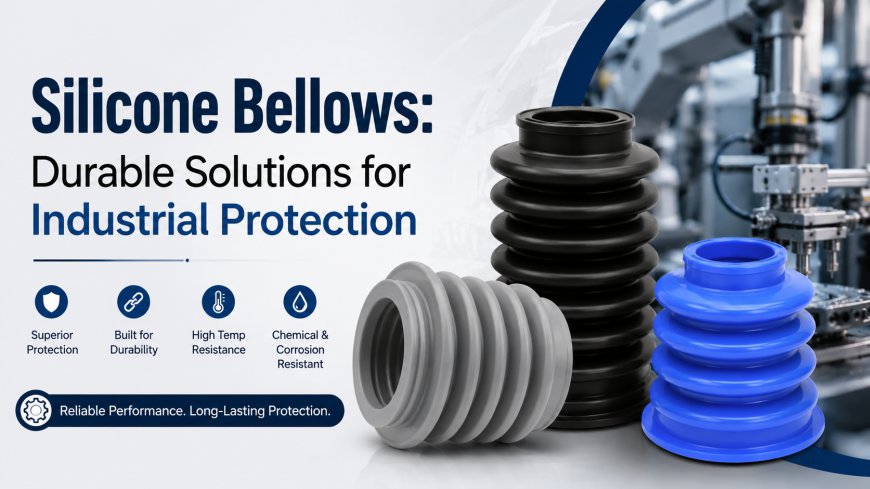
Most industrial equipment relies on small parts to survive. These components operate out of sight and are rarely noticed until failure. One of the most effective of these components is silicone bellows. They serve as robust protective shields in harsh industrial environments.
Their flexible accordion style design allows movement while blocking contaminants. They are used across manufacturing, automotive, aerospace and medical sectors. They withstand consistent temperatures from -60°C right up to 230°C. They protect sensitive equipment from dust, debris, chemicals and moisture. Rubber Silicone Molds specialises in the custom manufacture of silicone bellows.
Silicone Bellows vs. Rubber Bellows
Most industrial designers choose one of these two materials for protection. Standard rubber remains a common and low cost option for general use. Each material has distinct performance limits and service lifespans. Most application failures come from choosing the wrong base material.
Silicone handles higher heat than standard rubber materials. It offers far better UV and ozone resistance than natural rubber. It maintains full flexibility even in extended cold conditions. It remains non-reactive with most common chemicals and solvents.
The food grade options are available for clean and sanitary industries. It delivers far longer service life in all permanent outdoor applications. It does not harden or crack over time the way rubber does.
Additional considerations for this comparison:
- Most rubber bellows reach the end of their life at 3-5 years outdoors
- Material cost difference is often recovered in less than 12 months
- No regular maintenance or treatment is required for silicone
- The compression set remains almost zero for the full service life
Heat and Cold Resistance Properties
This is the single most significant difference between the two materials. Performance across temperature extremes separates good components from great ones. Most materials lose core properties once moved outside a narrow range.
- Continuous operating temperature range
- Short term peak exposure tolerance
- Sub-zero elasticity retention
- Elasticity consistency across the temperature range
- High temperature application suitability
- Thermal shock resistance
- Thermal conductivity
The silicone bellows operate continuously across a range from -60°C to 230°C. They tolerate brief exposure up to 300°C without any permanent damage. They experience no brittleness even in extended sub-zero environments. They maintain 100% of their elasticity across their full temperature spectrum.
This is the ideal choice for furnace protection and cryogenic applications. Their excellent thermal shock resistance prevents sudden cracking under load. Their low thermal conductivity reduces unwanted heat transfer between components.
How Do Silicone Bellows Protect Machinery Components?
Most protection solutions create one problem while solving another. These components solve multiple problems.
They create an effective barrier against airborne particles and contaminants. They seal open gaps while allowing full linear or rotational movement. They prevent corrosive chemical splashes from reaching sensitive internal parts.
The silicone bellows block moisture ingress in permanently humid or wet operating environments. They reduce friction and unwanted wear on all types of moving parts. They contain lubricants permanently within fully sealed operating systems. They also absorb unwanted vibration and mechanical shock from operation.
Additional functional benefits:
- They compensate for small misalignments between connected components
- They reduce the operating noise generated by fast moving machinery parts
- They eliminate the need for separate clearance gaps around moving parts
- They extend the service interval of all protected components
Shapes and Sizes for Various Industrial Protection
One size never fits all when it comes to industrial flexible protection. The correct shape will have a far larger impact on service life than material choice. They also produce Rubber Silicone Molds and other related components to the same standard.
- Cylindrical bellows
- Rectangular bellows
- Tapered conical bellows
- Custom molded geometries
- Diameter range
- Wall thickness
Round cylindrical designs are used for shafts and rods. Rectangular designs are the standard choice for linear guide protection. Conical tapered designs provide variable diameter coverage across stroke.
The custom molded shapes are produced for completely unique application requirements. Available diameters range from 10mm right up to 500mm and larger. Available compression ratios range from 2:1 all the way up to 10:1. Standard wall thickness options run from 0.5mm through to 5mm.
|
Compression Ratio and Movement Capabilities |
|||
|
Bellows Design |
Compression Ratio |
Maximum Stroke |
Lateral Movement |
|
Standard Pitch |
2:1 |
50mm |
Limited 5mm |
|
Deep Convolution |
4:1 |
120mm |
Moderate 15mm |
|
Multi-Ply |
6:1 |
200mm |
Good 25mm |
|
Reinforced |
3:1 |
80mm |
Minimal 8mm |
|
Custom Profile |
10:1 |
350mm+ |
Excellent 40mm+ |
Material Grade Options for Different Uses
The base polymer is only one part of the complete material specification. Different formulations are designed for very specific operating requirements. Using the wrong grade will result in premature failure even if the base material is correct. An experienced rubber bellows manufacturer will help select the correct grade and design for each application.
- Commercial general purpose grade
- High temperature grade
- FDA approved food grade
- USP Class VI medical grade
- Conductive static dissipative grade
- UL94 flame retardant grade
- Transparent inspection grade
The commercial grade is used for all general non critical industrial applications. High temperature grade is formulated for continuous extreme heat operation. Food grade FDA approved silicone is used for all sanitary industry needs.
The medical grade materials meet full USP Class VI certification requirements. Conductive silicone is used for applications requiring static dissipation.
The flame retardant grades meet all relevant UL94 V0 safety standards. Transparent silicone allows full visual inspection of protected components. This same formulation is also used for custom butter molds for food production.
Why Choose Molded vs Fabricated Bellows?
The manufacturing method has as much impact on performance as the material. Two identical looking bellows can perform completely differently based on production. Standard molded rubber bellows are also available in all the same material grades.
Molded bellows offer one piece construction. They have no weak points created by glued or welded seams. They have uniform wall thickness throughout the entire design. They offer far better dimensional accuracy and run to run consistency.
The fabricated bellows are best suited for low volume custom requirements. Molding reduces per unit costs for medium and large production runs. Complex internal geometries are far easier to produce with the molding process. The molded rubber bellows is the popular choice for volume production.
Additional comparison points:
- Molded components have consistent performance across every unit
- Fabricated bellows have a higher unit cost for production runs
- Seam failure accounts for 70% of all fabricated bellows failures
- Molded designs can hold much higher pressure and vacuum levels
Can Silicone Bellows Handle Vacuum Applications?
Many flexible materials perform poorly under negative pressure. Most people are surprised by how well silicone performs in this application.
Silicone offers excellent vacuum stability right down to high vacuum levels. It has extremely low outgassing properties critical for clean environments. It maintains its original shape perfectly under sustained negative pressure.
The wall thickness can be adjusted to resist collapse under load. Reinforced designs are available for operation at deep vacuum levels. They are used in semiconductor and laboratory equipment. Internal support rings can be added to completely prevent implosion.
- Most rubber materials will collapse at very modest vacuum levels
- Outgassing from rubber will contaminate sensitive vacuum processes
- Silicone retains its vacuum properties across its full temperature range
- No other elastomer comes close to this combination of properties
Manufacturing Excellence
The material and design mean nothing if produced poorly to lose tolerances. Many specialist manufacturers produce precision silicone components to tight tolerances. Modern advanced molding equipment delivers consistent results run after run. A good rubber bellows manufacturer will also provide full design support.
The full quality control testing is completed on all production batches. Full material certifications and compliance documentation are supplied with every order. Custom material formulation is available for special application requirements.
The full engineering support is provided from initial design through to delivery. The manufacturer serves industrial clients worldwide with proven long term reliability.
All production processes operate under full ISO certified quality systems. The team holds decades of specialist silicone molding expertise. Many clients also order custom silicone gaskets alongside their bellows orders.
Additional manufacturer considerations:
- Prototyping can be completed in as little as three working days
- Small production runs are supported alongside large volume orders
- Full material traceability is provided for every single component
- No minimum order quantity applies to most standard designs
Conclusion
Silicone bellows have high temperature resistance and handle the most extreme operating conditions. The inherent material flexibility accommodates all types of complex movements.
The custom design options allow them to fit almost any unique industrial application. Rubber Silicone Molds provides proven expert manufacturing solutions for all needs. The right initial selection and basic maintenance maximise total service life.