SPARK Matrix™: IT Infrastructure Monitoring (ITIM) Tools – Market Trends, Vendor Analysis & Growth Outlook
Discover how IT Infrastructure Monitoring (ITIM) Tools are transforming modern IT operations with AI, automation, cloud monitoring, and observability. Explore market trends, key challenges, business benefits, and insights from the SPARK Matrix™.
 ICTblog
Introduction
In today's digital economy, uninterrupted IT services are no longer optional—they are fundamental to business success. As enterprises accelerate cloud adoption, hybrid work, edge computing, and AI-driven applications, IT environments have become significantly more distributed and complex. Traditional monitoring approaches that focus on isolated infrastructure components are no longer sufficient to ensure performance, availability, and business continuity.
IT Infrastructure Monitoring (ITIM) Tools have emerged as a strategic capability that enables organizations to gain end-to-end visibility across their IT ecosystems. Rather than simply detecting outages, modern monitoring platforms leverage AI, automation, analytics, and observability to predict issues before they impact users, helping organizations improve operational resilience and deliver superior digital experiences.
QKS Group's SPARK Matrix™ research provides an in-depth assessment of this evolving market, helping technology vendors benchmark innovation while enabling enterprise buyers to evaluate leading solutions based on technology excellence and customer impact.
Market Overview: Why IT Infrastructure Monitoring Matters
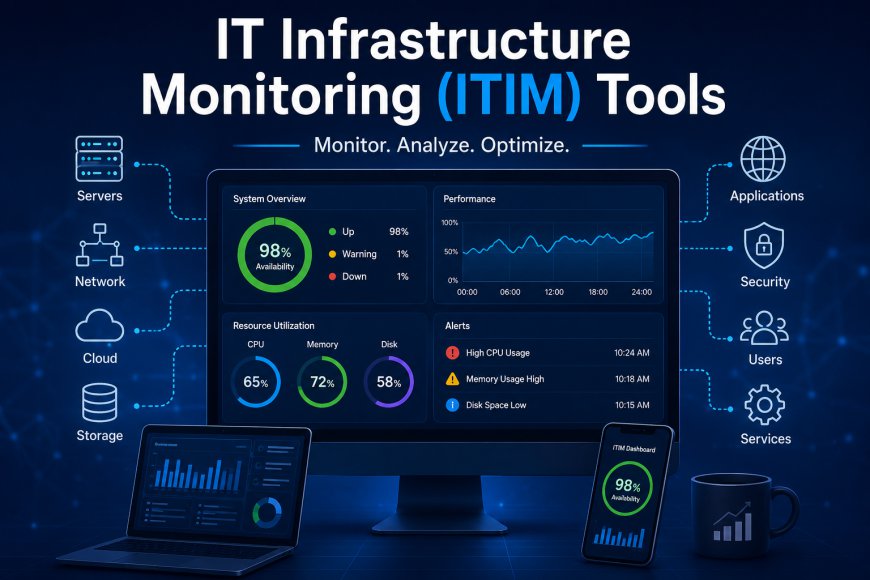
IT Infrastructure Monitoring (ITIM) Tools are comprehensive software platforms designed to monitor servers, networks, cloud environments, virtual machines, applications, databases, storage systems, and other IT assets from a centralized interface.
Unlike legacy monitoring solutions, modern ITIM platforms combine monitoring with intelligent analytics, automation, AIOps, alert correlation, and incident management to provide actionable insights instead of overwhelming IT teams with alerts.
As digital transformation initiatives expand, organizations increasingly rely on ITIM platforms to:
- Monitor hybrid and multi-cloud environments
- Improve infrastructure availability
- Reduce downtime
- Ensure SLA compliance
- Optimize infrastructure costs
- Enhance customer experience
The growing convergence between infrastructure monitoring, observability, AIOps, and IT Service Management (ITSM) is redefining how enterprises manage IT operations.
Key Challenges Organizations Face
Modern IT teams face several operational challenges that increase complexity and impact service quality.
Increasing Infrastructure Complexity
Organizations manage workloads across on-premises data centers, multiple cloud providers, containers, Kubernetes, and edge environments, making centralized monitoring increasingly difficult.
Alert Fatigue
Thousands of alerts generated daily often overwhelm IT teams. Without intelligent correlation, identifying root causes becomes time-consuming.
Longer Incident Resolution
Limited visibility across interconnected systems results in higher Mean Time to Identify (MTTI) and Mean Time to Resolve (MTTR).
Cloud Visibility Gaps
Dynamic cloud environments continuously change, making manual monitoring ineffective.
Rising Security and Compliance Risks
Infrastructure failures can affect security, compliance, customer trust, and business continuity.
Key Trends Shaping the ITIM Market
AI-Powered AIOps
Artificial Intelligence is transforming infrastructure monitoring by automatically identifying anomalies, predicting failures, and prioritizing incidents before users experience disruptions.
AI-driven root cause analysis significantly reduces troubleshooting time while improving operational efficiency.
Cloud-Native Monitoring
As enterprises embrace hybrid and multi-cloud strategies, ITIM vendors are expanding cloud-native monitoring capabilities for AWS, Azure, Google Cloud, and containerized workloads.
Cloud observability is becoming a standard capability rather than a premium feature.
Unified Observability
Organizations increasingly prefer platforms that combine:
- Infrastructure monitoring
- Application monitoring
- Network monitoring
- Log analytics
- Distributed tracing
- User experience monitoring
This unified approach provides complete visibility across modern IT ecosystems.
Intelligent Automation
Automation now extends beyond alert generation.
Modern ITIM platforms automatically:
- Execute remediation workflows
- Trigger incident tickets
- Restart failed services
- Scale infrastructure
- Optimize workloads
Reducing manual intervention improves service reliability.
Predictive Analytics
Advanced analytics help organizations forecast capacity requirements, anticipate infrastructure bottlenecks, and optimize resource utilization before performance issues occur.
Business Benefits of IT Infrastructure Monitoring
Organizations implementing modern IT Infrastructure Monitoring (ITIM) Tools realize measurable business value across multiple operational areas.
Improved Service Availability
Continuous monitoring minimizes unexpected outages and improves business continuity.
Faster Incident Resolution
AI-assisted diagnostics reduce MTTI and MTTR, enabling IT teams to restore services more quickly.
Better User Experience
Proactive issue detection prevents service degradation that impacts employees and customers.
Lower Operational Costs
Automation reduces manual monitoring effort while optimizing infrastructure utilization.
Enhanced SLA Compliance
Real-time monitoring enables organizations to consistently meet internal and external service level agreements.
Greater Operational Efficiency
Centralized dashboards provide IT teams with unified visibility across hybrid environments, simplifying infrastructure management.
Real-World Use Cases
Financial Services
Banks monitor mission-critical payment platforms across hybrid cloud environments to maintain high availability and meet regulatory requirements.
Healthcare
Hospitals leverage ITIM platforms to monitor electronic health record systems, medical devices, and cloud infrastructure, ensuring uninterrupted patient care.
Manufacturing
Manufacturers monitor production systems, industrial networks, and connected factory infrastructure to minimize downtime and improve operational efficiency.
Retail
Retail organizations use infrastructure monitoring to support e-commerce platforms, point-of-sale systems, and supply chain applications during peak shopping periods.
Telecommunications
Service providers rely on ITIM tools to monitor complex network infrastructure and maintain consistent service quality for millions of customers.
Choosing the Right IT Infrastructure Monitoring Solution
Selecting the right platform requires more than evaluating dashboards and reporting capabilities.
Organizations should consider:
- AI-driven anomaly detection and AIOps capabilities
- Hybrid and multi-cloud monitoring support
- Scalability for future growth
- Automation and orchestration features
- Integration with ITSM and DevOps platforms
- Predictive analytics capabilities
- Security and compliance support
- Vendor innovation roadmap
- Customer support and ecosystem maturity
QKS Group's SPARK Matrix™ helps enterprises objectively compare vendors based on technology leadership, customer impact, innovation, and market presence.
Future Outlook (2025–2028)
Between 2025 and 2028, IT Infrastructure Monitoring will evolve into intelligent operational decision platforms rather than traditional monitoring solutions.
Key developments expected include:
- AI agents performing autonomous infrastructure management
- Predictive self-healing environments
- Expanded observability across edge computing and IoT
- Greater adoption of generative AI for operational insights
- Integration between cybersecurity, observability, and infrastructure monitoring
- Enhanced FinOps capabilities for cloud cost optimization
- Real-time digital twin models for infrastructure simulation
As enterprises continue investing in cloud modernization and digital transformation, ITIM platforms will become foundational technologies supporting resilient and autonomous IT operations.
Conclusion
Modern enterprises require continuous visibility, intelligent automation, and predictive insights to manage increasingly complex IT environments. Traditional monitoring tools are evolving into intelligent platforms capable of delivering proactive infrastructure management, improving operational efficiency, and strengthening business resilience.
QKS Group's SPARK Matrix™: IT Infrastructure Monitoring (ITIM) Tools provides technology buyers, CIOs, IT leaders, and infrastructure teams with comprehensive market intelligence, competitive analysis, and vendor evaluations to support confident technology investment decisions. As AI, cloud computing, and automation reshape enterprise IT, organizations that adopt advanced monitoring platforms will be better positioned to deliver exceptional digital experiences, minimize operational risks, and drive long-term business growth.