The Intelligence Layer Nobody Talks About: Why AI Data Annotation Services Are Defining the Future of Human-Centered AI
Whether it is a healthcare diagnostic model or an AI-powered customer support assistant, the goal is the same building AI that aligns with human needs.
 vanesa
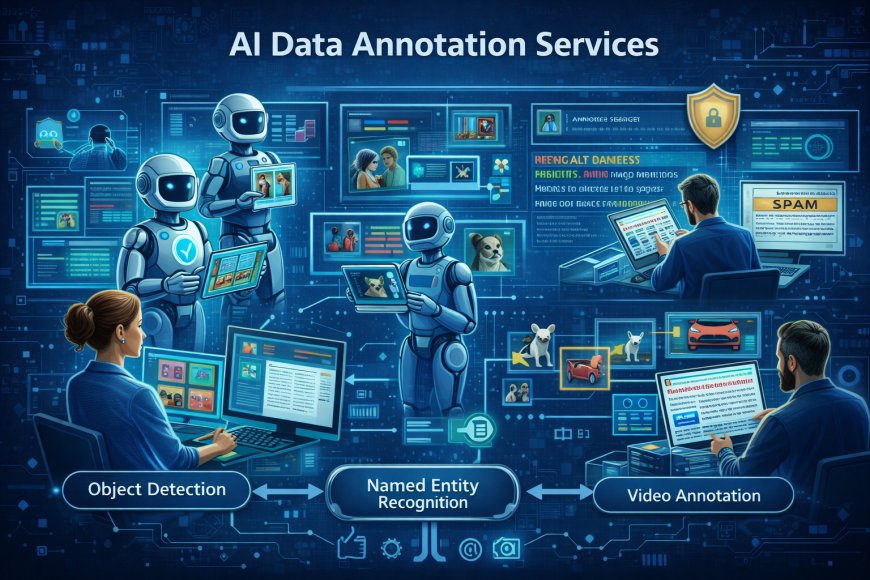
Artificial intelligence is becoming more powerful, more accessible, and more deeply integrated into everyday life. From smart healthcare systems and conversational assistants to automated business workflows and predictive technologies, AI is shaping how industries operate and how people interact with digital systems.
Yet behind every intelligent AI model lies a layer that rarely receives public attention data annotation.
In 2026, businesses are beginning to understand that AI success is not determined only by algorithms or computing power. Instead, it depends heavily on the quality of the data used to train those systems. This growing realization is placing AI data annotation services at the center of AI development and innovation.
As organizations aim to create more ethical, accurate, and human-focused AI, annotation is emerging as the invisible intelligence layer that makes these systems truly functional.
Human-centered AI does not begin with automation—it begins with understanding data correctly.
What Makes Human-Centered AI Different?
Traditional AI systems were often designed primarily for efficiency and automation. Human-centered AI, however, focuses on creating systems that work alongside people and deliver trustworthy outcomes.
Human-centered AI emphasizes:
-
Transparency
-
Fairness
-
Accuracy
-
Ethical decision-making
-
Improved user experiences
These systems are designed not only to process information but also to understand human context and behavior.
Whether it is a healthcare diagnostic model or an AI-powered customer support assistant, the goal is the same building AI that aligns with human needs.
This is where AI data annotation services become essential.
Without properly labeled and contextualized data, AI systems cannot understand the nuances of human communication, visual environments, or decision-making patterns.
What Are AI Data Annotation Services?
AI data annotation services involve labeling raw information so machine learning models can understand and learn from it.
Raw data alone has limited meaning to AI systems.
Annotation provides the context.
This process transforms unstructured information into machine-readable datasets that support intelligent learning.
Different annotation types include:
Image Annotation
Used for:
-
Computer vision
-
Object recognition
-
Medical imaging
-
Facial detection
Images are labeled so AI systems can recognize shapes, objects, and patterns.
Text Annotation
Supports:
-
Chatbots
-
Language models
-
Sentiment analysis
-
Intelligent search systems
Text is tagged to identify meaning, intent, and emotion.
Audio Annotation
Important for:
-
Speech recognition
-
Voice assistants
-
Conversational AI
-
Call analytics
Audio files are transcribed and categorized.
Video Annotation
Used in:
-
Autonomous systems
-
Motion tracking
-
Security technologies
-
Behavioral analysis
Frames and activities are labeled for AI training.
Through these methods, AI data annotation services turn information into AI-ready intelligence.
Why Are AI Data Annotation Services Becoming More Important in 2026?
The AI industry is moving rapidly toward what experts call data-centric AI.
For years, businesses focused heavily on developing larger and more sophisticated algorithms. While algorithms remain important, companies now realize that model improvements alone cannot solve every AI challenge.
High-quality data is becoming the real competitive advantage.
Industry research consistently shows that poor-quality datasets remain one of the leading reasons AI projects fail or underperform.
Common problems include:
-
Inconsistent labeling
-
Biased datasets
-
Missing contextual information
-
Poor data diversity
-
Weak quality control
These issues reduce AI accuracy and limit scalability.
This explains why organizations are investing more heavily in AI data annotation services than ever before.
The future of AI is shifting from algorithm-centric development toward data intelligence.
How Do Annotation Services Improve AI Accuracy?
AI systems learn from examples.
If those examples are inaccurate or poorly labeled, the model learns incorrect patterns.
Reliable annotation improves AI in several ways.
Better Patt
ern Recognition
Well-labeled data helps AI understand relationships and detect patterns more accurately.
This improves:
-
Object detection
-
Language understanding
-
Prediction quality
-
Decision-making
Studies suggest that stronger training data can improve AI performance by up to 30–40% in many applications.
Reduced Errors and Hallucinations
AI hallucinations and incorrect outputs often result from weak datasets.
Annotation reduces ambiguity by:
-
Adding context
-
Clarifying meaning
-
Improving consistency
This creates more dependable AI systems.
Faster Model Development
Structured datasets allow AI systems to learn faster.
Benefits include:
-
Reduced training time
-
Lower computational costs
-
Faster deployment
Organizations can launch AI solutions more efficiently.
Accurate AI begins with accurate annotation.
What Role Does an AI Data Collection Company Play?
Annotation depends on reliable source data.
An ai data collection company helps businesses gather datasets needed for machine learning.
These providers collect:
-
Multilingual datasets
-
Industry-specific information
-
Geographic and demographic data
-
Images, text, audio, and video
This stage is critical because poor collection practices create weak datasets that annotation alone cannot repair.
A professional ai data collection company supports:
Data Diversity
Broader representation improves AI fairness.
Authentic Real-World Examples
AI performs better when trained on realistic scenarios.
Scalable Data Pipelines
Growing AI systems require ongoing data collection.
Together, data collection and annotation create a strong foundation for human-centered AI.
Why Is AI Data Collection for Healthcare Driving Innovation?
Healthcare is one of the most data-sensitive industries using AI today.
AI data collection for healthcare is expanding rapidly because medical systems require extremely accurate and reliable datasets.
Healthcare AI depends on:
-
Medical imaging
-
Clinical notes
-
Electronic health records
-
Wearable device information
-
Diagnostic reports
When properly annotated, these datasets support powerful medical AI applications.
Earlier Disease Detection
AI can identify abnormalities more efficiently.
Improved Clinical Decisions
Doctors gain stronger decision-support tools.
Personalized Healthcare
Treatment plans become more precise.
Reduced Diagnostic Errors
Structured data improves medical reliability.
This highlights an important truth.
Human-centered healthcare AI is impossible without high-quality medical data and expert annotation.
How Is AI-Assisted Annotation Changing the Industry?
Annotation itself is evolving.
Modern platforms increasingly use AI-assisted workflows to improve efficiency.
AI tools now help:
-
Pre-label datasets
-
Detect inconsistencies
-
Improve workflow speed
-
Reduce repetitive tasks
However, automation alone is not enough.
Human oversight remains essential.
Human reviewers help:
-
Validate accuracy
-
Understand context
-
Correct errors
-
Maintain ethical standards
AI can support annotation, but human intelligence still protects data quality.
Why Is Ethical AI Increasing Demand for Annotation?
As AI adoption grows, businesses face greater pressure to build responsible systems.
Bias and unfair outcomes remain serious concerns.
Reliable annotation helps reduce these risks.
Key practices include:
-
Diverse datasets
-
Consistent labeling standards
-
Multi-layer validation
-
Ongoing quality audits
These safeguards help create AI systems that are:
-
Fairer
-
More transparent
-
More trustworthy
This is particularly important in sectors like healthcare, finance, and public services.
Ethical AI starts with ethical data preparation.
What Challenges Do Businesses Face Without Reliable Annotation?
Organizations that underestimate annotation quality often face major setbacks.
Poor AI Performance
Incorrect labels create unreliable predictions.
Increased Costs
Low-quality data leads to repeated retraining.
Reduced Scalability
Weak datasets limit long-term AI growth.
Loss of Trust
Users quickly lose confidence in unreliable AI systems.
These challenges show why annotation is no longer viewed as a secondary task.
It is becoming a strategic investment.
Final Thoughts
Artificial intelligence is moving toward a future where systems are expected to be smarter, more transparent, and more aligned with human needs.
Achieving this vision requires more than powerful algorithms.
It requires reliable, structured, and context-rich data.
AI data annotation services are becoming the intelligence layer that quietly shapes the success of modern AI systems. By transforming raw information into meaningful training data, annotation enables AI to learn, adapt, and serve people more effectively.
When supported by an ai data collection company and strengthened through specialized ai data collection for healthcare workflows, annotation becomes a powerful driver of innovation.
The AI systems leading tomorrow will not be defined only by how advanced their algorithms are, but by how intelligently their data is prepared today.
FAQs
Why are AI data annotation services important for human-centered AI?
They help AI systems understand context, meaning, and human behavior through structured and accurately labeled datasets.
How does an ai data collection company support AI development?
An ai data collection company gathers diverse and scalable datasets that serve as the foundation for annotation and model training.
Why is ai data collection for healthcare essential?
Healthcare AI requires accurate medical datasets to support diagnostics, patient care, and clinical decision-making.
Can AI systems function without annotated data?
No. Without annotation, AI models struggle to recognize patterns and interpret information correctly.
How do annotation services improve AI reliability?
They improve consistency, reduce errors, and provide contextual understanding that supports better AI performance.
Is AI-assisted annotation replacing human annotators?
No. Automation improves efficiency, but human expertise remains critical for contextual accuracy and ethical validation.