Virtual Desktop Infrastructure (VDI) Market Challenges | Growth Reach US$ 22.87 billion by 2031
 Raymond10
Virtual Desktop Infrastructure (VDI) refers to the technology that hosts desktop environments on centralized servers and delivers them to end-users over a network. Instead of relying on physical desktops, organizations use virtual machines to provide secure, scalable, and flexible desktop experiences. This model has gained strong traction with the rise of remote work, cloud computing, and digital transformation initiatives. Enterprises increasingly rely on VDI to ensure business continuity, improve data security, and simplify IT management across distributed workforces.
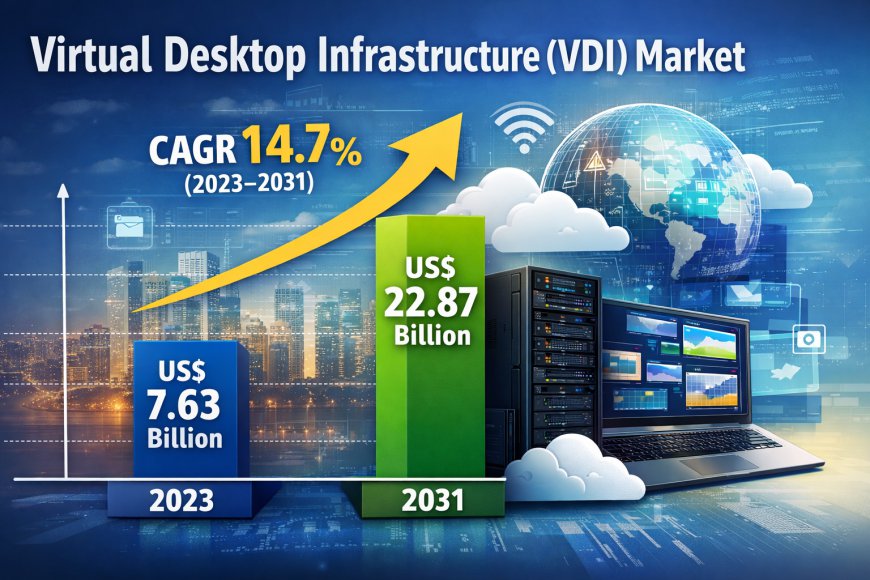
According to The insight Partners, The virtual desktop infrastructure (VDI) market size is projected to reach US$ 22.87 billion by 2031 from US$ 7.63 billion in 2023. The market is expected to register a CAGR of 14.7% during the forecast period from 2023 to 2031. This growth is driven by advancements in virtualization technologies, increasing cloud adoption, and rising cybersecurity concerns across enterprises worldwide.
Key Drivers Fueling the VDI Market Growth
The growing demand for remote work infrastructure remains one of the primary drivers of the VDI market. Organizations are increasingly adopting hybrid work environments, requiring secure and scalable solutions that enable employees to access corporate systems from any location. VDI ensures that data remains centralized, reducing the risk of data breaches and unauthorized access.
Another significant driver is the increasing focus on cybersecurity. With rising cyber threats and data breaches, enterprises are prioritizing solutions that offer enhanced security features such as encryption, multi-factor authentication, and centralized data storage. VDI minimizes endpoint vulnerabilities by storing sensitive data in secure data centers rather than on local devices.
Virtual Desktop Infrastructure (VDI) Market Challenges
The Virtual Desktop Infrastructure (VDI) Market Challenges primarily revolve around infrastructure complexity, high initial deployment costs, and performance limitations in bandwidth-constrained environments. While VDI offers long-term cost benefits, the upfront investment in servers, storage, and networking infrastructure can be significant, especially for small organizations. Additionally, ensuring consistent performance for remote users can be challenging in regions with limited internet connectivity. Organizations must also address issues related to user experience, latency, and application compatibility to maximize the effectiveness of VDI deployments.
What Are the Key Challenges Hindering VDI Adoption?
One of the major challenges in VDI adoption is the high initial cost of implementation. Setting up a VDI environment requires investment in servers, storage systems, virtualization software, and networking infrastructure. For many organizations, particularly SMEs, these costs can act as a barrier to entry despite the long-term benefits.
Another challenge is the complexity of deployment and management. VDI environments require skilled IT professionals to configure, monitor, and maintain the infrastructure. Managing virtual desktops, ensuring security compliance, and troubleshooting performance issues can be resource-intensive.
User experience is another critical concern. Poor network connectivity or insufficient bandwidth can lead to latency issues, affecting productivity. Organizations must ensure robust network infrastructure to deliver seamless virtual desktop experiences to remote users.
Get Sample PDF @ https://www.theinsightpartners.com/sample/TIPRE00011555
Segmentation Analysis
The Virtual Desktop Infrastructure (VDI) market is segmented based on component, deployment type, organization size, and industry vertical.
By component, the market includes hardware, software, and services. Software solutions dominate the market due to increasing demand for virtualization platforms and management tools. Services such as consulting, integration, and support are also witnessing significant growth.
Based on deployment type, the market is divided into on-premise and cloud-based solutions. Cloud-based VDI is expected to witness the highest growth due to its scalability, flexibility, and cost-effectiveness.
By organization size, the market is segmented into small and medium-sized enterprises and large enterprises. Large enterprises currently hold a significant market share due to their extensive IT infrastructure and higher adoption rates.
In terms of industry verticals, the market spans BFSI, healthcare, IT and telecom, education, government, and others. The BFSI and healthcare sectors are leading adopters due to their stringent data security requirements.
Regional Analysis
North America holds the largest share of the Virtual Desktop Infrastructure (VDI) market, driven by advanced IT infrastructure, high adoption of cloud technologies, and strong presence of key market players. The region continues to lead in innovation and early adoption of virtualization solutions.
Europe follows closely, with increasing adoption of VDI solutions across industries such as finance, healthcare, and government. The region's focus on data protection and regulatory compliance is driving demand for secure virtual desktop solutions.
The Asia Pacific region is expected to witness the highest growth during the forecast period. Rapid digital transformation, increasing internet penetration, and growing adoption of remote work are key factors contributing to market expansion in countries such as China, India, and Japan.
Latin America and the Middle East and Africa are also experiencing steady growth, supported by increasing investments in IT infrastructure and rising awareness of virtualization technologies.
Top Players in the VDI Market
The Virtual Desktop Infrastructure (VDI) market is highly competitive, with several key players driving innovation and growth.
- Amazon.com, Inc
- Cisco Systems, Inc.
- IBM Corporation
- Microsoft Corporation
- VMware, Inc.
- Fujitsu Limited
- Dell Technologies Inc.
- Citrix Systems, Inc.
- Hewlett Packard Enterprise Development LP (HPE)
- Huawei Technologies Co., Ltd.
These companies are focusing on strategic partnerships, product innovations, and mergers and acquisitions to strengthen their market position and expand their global presence.
Future Outlook of the VDI Market
The future of the Virtual Desktop Infrastructure (VDI) market looks promising, with continued advancements in cloud computing, artificial intelligence, and edge computing. As organizations increasingly adopt hybrid work models, the demand for secure and scalable virtual desktop solutions is expected to grow significantly.
About The Insight Partners
The Insight Partners delivers market intelligence and consulting services to help clients make informed decisions. The firm covers industries such as Aerospace and Defense, Automotive and Transportation, Semiconductor and Electronics, Biotechnology, Healthcare IT, Manufacturing, Medical Devices, Technology, Media, and Chemicals and Materials.
Contact Us
Email: sales@theinsightpartners.com
Website: www.theinsightpartners.com
Phone: +1-646-491-9876
Also Available in :
Korean German Japanese French Chinese Italian Spanish