

3D Printing in Hobart: Reducing Manufacturing Delays with Custom Parts
Introduction
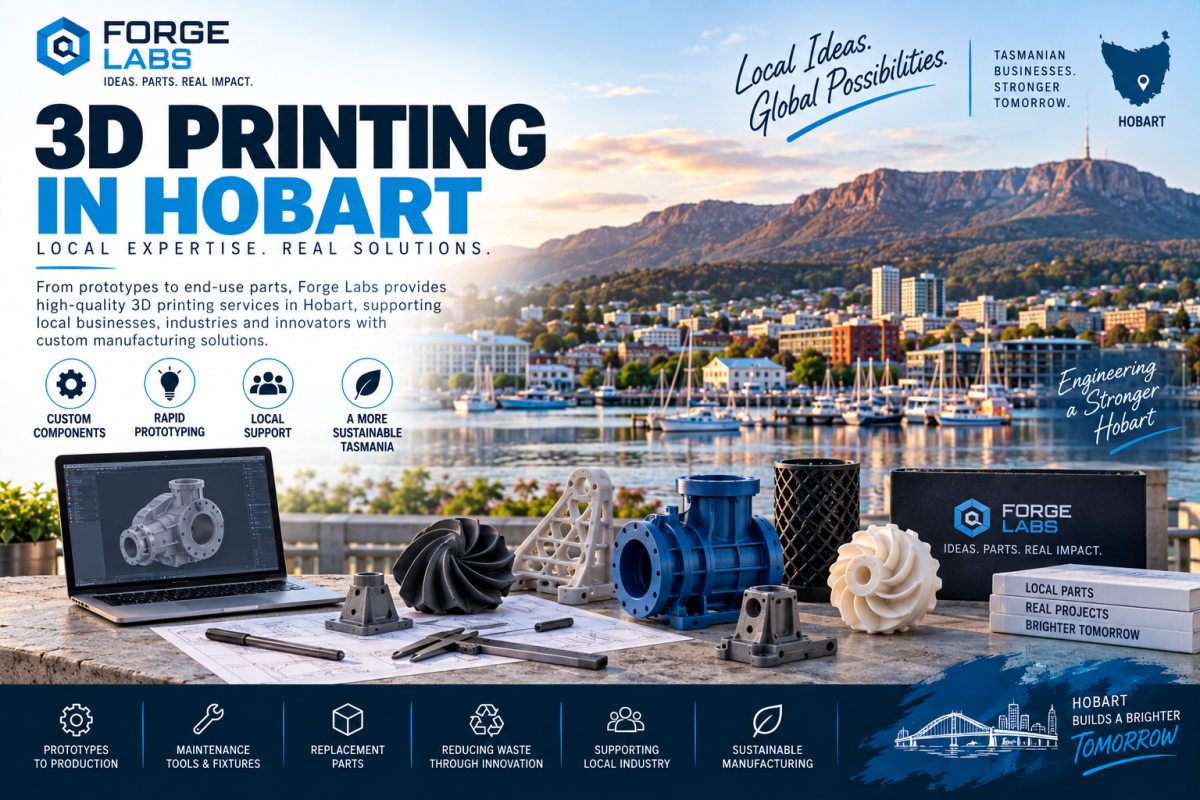
Manufacturing projects often depend on parts that are difficult to source, expensive to produce or unavailable in the required dimensions. For businesses facing these challenges, 3D printing in Hobart offers a flexible way to create prototypes, replacement components and customised products without relying entirely on conventional manufacturing methods.
By converting digital designs into physical objects, 3D printing can help businesses respond to changing requirements, test new ideas and produce small quantities more efficiently. It is suitable for a wide range of applications, from engineering and marine projects to product development, education and research.
Solving Common Manufacturing Challenges
Traditional manufacturing can involve tooling costs, minimum order quantities and long production timelines. These factors may create difficulties when a business only needs a small number of parts or is still developing a product.
3D printing provides an alternative for projects that require:
- One-off components
- Custom dimensions
- Rapid design changes
- Small production quantities
- Complex shapes
- Replacement parts
- Functional prototypes
- Specialised tools and fixtures
Instead of producing a large batch immediately, businesses can manufacture only what is required. This can be especially useful for maintenance teams, workshops and product developers working with limited budgets or tight schedules.
Developing Replacement Parts
Equipment downtime can become costly when a small component fails and the original replacement is difficult to obtain. A 3D-printed replacement may be a practical option when the part is suitable for additive manufacturing.
A replacement component can be developed using an existing CAD file, measurements from the original part or a 3D scan. The design can then be adjusted to improve fit, strength or usability.
Examples of potentially suitable replacement parts include:
- Protective covers
- Brackets and mounts
- Spacers and guides
- Equipment housings
- Knobs and handles
- Cable-management components
- Custom connectors
- Non-critical machine accessories
The final material and printing technology should always be selected according to the operating environment and performance requirements.
Improving Product Development
Product development often involves several rounds of testing. A design that looks correct on a computer screen may not perform as expected when assembled or handled.
3D printing allows designers to produce physical versions of a concept and assess important details before moving to final production. A prototype can help identify:
- Poor component alignment
- Uncomfortable shapes
- Insufficient clearance
- Weak connection points
- Assembly difficulties
- Incorrect dimensions
- Unwanted weight
- Surface or appearance issues
After testing, the digital model can be revised and printed again. This iterative process helps teams improve their designs through practical evaluation rather than relying only on digital simulations.
Custom Fixtures and Workshop Tools
Workshops and engineering teams frequently require tools or fixtures that are not available as standard products. A custom-printed fixture can be designed around a specific task, machine or component.
Possible applications include:
- Assembly guides
- Drill templates
- Positioning jigs
- Inspection fixtures
- Protective tool holders
- Custom clamps
- Measurement aids
- Organisational inserts
These items can be designed to improve repeatability and make routine tasks easier. Their usefulness depends on selecting a material that can withstand the expected pressure, heat, friction and handling conditions.
Supporting Marine and Industrial Projects
Hobart’s connection to marine, engineering, research and industrial activities creates demand for components designed for specialised environments. 3D printing can support these projects by producing custom models, prototypes, housings and project-specific parts.
For marine-related applications, designers may need components with unusual dimensions or specific mounting requirements. In engineering environments, a printed part may be used to test a mechanical concept before a stronger production material is selected.
For research projects, 3D printing can help create experimental equipment, custom holders, test models and other components that may not be available through standard suppliers.
Selecting the Correct Material
Material selection is an important part of the printing process. A part intended for display will have different requirements from one used in a workshop or operating environment.
Important factors include:
Strength
The component must be able to withstand the expected load, impact or pressure.
Flexibility
Some applications require a part that can bend or absorb movement rather than remain completely rigid.
Heat Resistance
Parts used near machinery, engines or heat-producing equipment may require materials with suitable thermal performance.
Chemical Resistance
Exposure to oils, cleaning agents or other chemicals may affect the suitability of certain materials.
Surface Finish
Visual prototypes and presentation models may require a smoother finish, while functional components may prioritise strength and dimensional accuracy.
Dimensional Stability
Parts that need to fit with other components must maintain accurate dimensions during and after production.
The Role of CAD Design
Computer-aided design plays a central role in successful 3D printing. A well-prepared CAD model helps ensure that the part can be manufactured accurately and used as intended.
Before production, the design may need to be reviewed for:
- Wall thickness
- Overhangs
- Support requirements
- Tolerances
- Print orientation
- Internal cavities
- Moving connections
- Fastener locations
- Material limitations
A manufacturing partner can help identify design changes that may improve print quality, reduce material use or make the finished component more functional.
Forge Labs for 3D Printing Projects
Forge Labs supports businesses seeking industrial manufacturing solutions, including 3D printing, CAD design, 3D scanning and other production services. Its range of capabilities can help customers explore different approaches depending on the complexity, quantity and intended use of a component.
For businesses searching for 3D printing in Hobart, Forge Labs can be considered when a project requires more than a basic printed model. From prototype development to custom components and low-volume manufacturing, the appropriate process can be selected according to the project’s technical requirements.
Using a manufacturing partner with multiple production capabilities may also be useful when a project later moves from a printed prototype to CNC machining, scanning or another manufacturing method.
A Step-by-Step Approach
A successful 3D printing project generally begins with a clear understanding of the intended application.
Step 1: Identify the Purpose
Define whether the part is required for visual review, functional testing, replacement use or small-scale production.
Step 2: Provide the Design
Share a CAD file, drawing, measurements or an existing component that can be used as a reference.
Step 3: Review Technical Requirements
Consider dimensions, strength, temperature, flexibility, surface finish and operating conditions.
Step 4: Choose the Printing Process
Select the most suitable technology based on detail, production quantity, material and performance needs.
Step 5: Produce the Component
The approved design is manufactured using the selected printing method.
Step 6: Inspect and Refine
The finished part is checked for fit, appearance and function. If changes are required, the design can be updated for another production cycle.
Benefits for Hobart Businesses
Businesses using 3D printing may gain greater flexibility in how they approach design and manufacturing. The technology can help organisations:
- Test products before large-scale production
- Create customised components
- Reduce dependence on standard parts
- Produce small quantities
- Respond to replacement-part requirements
- Experiment with complex designs
- Make design changes more easily
- Reduce the risk of committing to unsuitable tooling
These benefits are most valuable when the project requires customisation, rapid iteration or limited production quantities.
Conclusion
3D printing in Hobart provides a practical solution for businesses that need custom parts, functional prototypes, workshop tools or small production runs. By combining digital design with suitable materials and manufacturing technologies, organisations can develop products and components that match their specific requirements.
Whether the project involves replacing a difficult-to-source part, testing a new product or creating a specialised fixture, 3D printing can offer a flexible path from concept to finished component. With support from Forge Labs, businesses can explore additive manufacturing and other production options to identify an approach suited to their technical and commercial goals.
At forgelabs, we provide professional 3D printing services in Australia for businesses, startups, engineers, and creators. We help turn ideas into real products with clean, accurate, and reliable results. We offer FDM 3D printing, resin printing, nylon parts, metal 3D printing, and full support services like CAD design, 3D scanning, and reverse engineering. From rapid prototyping to custom parts and small batch production, we handle every project with care and attention to detail. forgelabs proudly serves Melbourne, Sydney, and all of Australia. Our clients trust us for fast turnaround, strong materials, fair pricing, and clear communication. If you are looking for the best 3D printing services in Australia, then you are at right place






Comments (0)