

3D Printing in Hobart: Custom Marine and Aquaculture Solutions for Tasmania
Introduction
Tasmania's connection with the marine sector creates ongoing demand for specialised equipment, custom components, vessel modifications, aquaculture technology, and engineering solutions. Marine businesses rarely operate with identical requirements. Components often need to fit particular vessels, equipment layouts, environmental conditions, or monitoring systems.
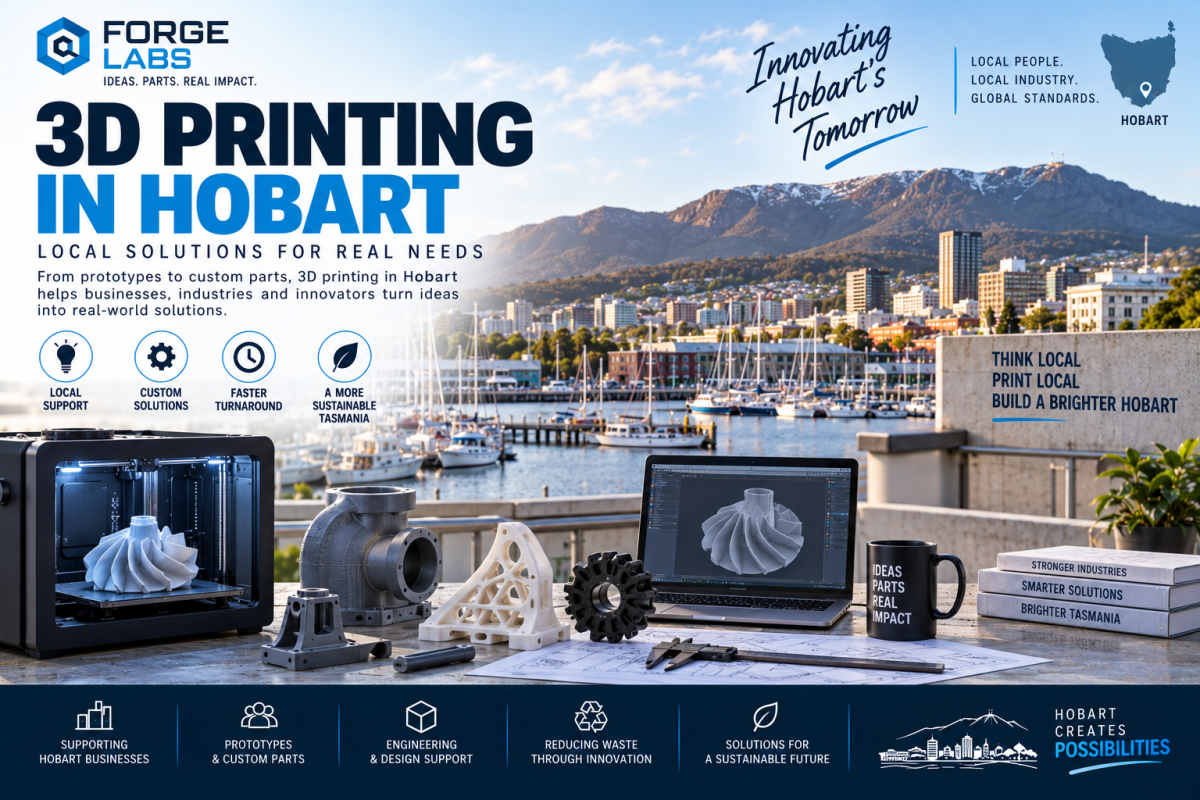
This makes 3D printing in Hobart a useful option for selected marine and aquaculture applications.
Additive manufacturing allows businesses to develop physical components directly from digital designs. Instead of ordering large quantities of standard parts, companies can produce customised components in small numbers, create prototypes rapidly, and modify designs as projects develop.
For Hobart businesses, this can provide a practical way to access specialist manufacturing without establishing every industrial production capability internally.
Why Marine Businesses Need Custom Components
Boats, research vessels, aquaculture systems, and marine equipment can all contain components designed for very specific applications.
A standard commercial part may not fit because of:
- Restricted installation space
- Unique equipment dimensions
- Existing vessel modifications
- Special mounting requirements
- Unusual cable routing
- Custom monitoring equipment
3D printing allows engineers to design components around these constraints.
Potential applications include:
- Equipment brackets
- Sensor mounts
- Instrument housings
- Protective covers
- Cable guides
- Custom fittings
- Equipment organisers
- Prototype components
Developing Custom Boat Components
Boat builders and marine repair businesses frequently work with limited installation space.
A custom component can be designed around the vessel's existing geometry.
3D printing can support prototypes for:
- Switch-panel surrounds
- Instrument mounts
- Electronics brackets
- Storage components
- Cable-management parts
- Equipment holders
- Protective housings
Instead of modifying an existing boat extensively to accommodate a standard part, the component itself can be designed around the vessel.
Supporting Aquaculture Equipment
Aquaculture operations depend on monitoring, feeding, water-management, communications, and other specialised equipment.
These systems may require components that are specific to a particular farm or installation.
3D printing can support:
- Sensor mounts
- Monitoring-device housings
- Equipment brackets
- Protective enclosures
- Cable-routing components
- Custom fixtures
- Prototype mechanisms
The ability to rapidly modify designs can be valuable when equipment is tested in real operating conditions.
Designing Around Harsh Marine Environments
Marine environments are challenging for many materials.
Components may encounter:
- Saltwater
- Salt-laden air
- High humidity
- UV exposure
- Temperature changes
- Vibration
- Impact
- Chemical exposure
Material selection therefore needs to be based on the actual application.
A prototype used inside a workshop may have very different requirements from a component installed permanently on a vessel.
Selecting Suitable Materials
Potential materials for selected marine applications can include:
- PETG
- ASA
- Nylon
- TPU
- Engineering resins
- Specialist polymers
- Metal additive manufacturing materials
ASA may be considered for certain outdoor applications where UV exposure is important. Nylon can be useful for selected durable engineering components, while TPU can provide flexibility where required.
The correct material depends on mechanical loads, environmental exposure, temperature, chemical contact, and expected service life.
3D Printing for Marine Electronics
Modern vessels increasingly rely on electronic systems, sensors, communication equipment, cameras, and monitoring devices.
These systems often require custom physical support.
3D printing can help develop:
- Electronics housings
- Sensor brackets
- Control-device mounts
- Cable guides
- Camera holders
- Protective covers
- Equipment interfaces
A prototype can be produced around the actual electronics, allowing engineers to test access to buttons, displays, connectors, and cables.
Creating Custom Sensor Housings
Sensor technology is increasingly important in marine and aquaculture operations.
A sensor may need to be installed in a location where standard housings are not practical.
A custom enclosure can be designed with:
- Specific mounting points
- Cable-entry features
- Internal supports
- Protective walls
- Equipment access
- Custom dimensions
The design can then be printed and tested before a final manufacturing decision is made.
Supporting Marine Research
Hobart has strong links to marine and scientific research. Research teams often develop equipment specifically for a particular experiment or field environment.
3D printing can help researchers create:
- Instrument mounts
- Experimental fixtures
- Sensor supports
- Equipment housings
- Prototype mechanisms
- Sample-handling components
- Testing apparatus
Research designs frequently change as experiments progress, making rapid manufacturing particularly useful.
Prototyping Underwater Equipment
Underwater systems can require highly customised mechanical designs.
3D printing can support early development of:
- Sensor mounts
- Instrument housings
- Testing components
- Equipment brackets
- Research fixtures
A prototype can allow researchers to examine fit, dimensions, assembly, and equipment integration before selecting a final production method.
Any component intended for actual underwater pressure or critical operation should undergo suitable engineering analysis and testing.
Replacing Discontinued Marine Parts
Older vessels may remain in service even after their original component suppliers have stopped manufacturing specific parts.
This can make relatively simple replacement components difficult to find.
For suitable non-critical parts, 3D scanning and reverse engineering can provide an alternative.
The original item can be:
Measured → Scanned → Rebuilt in CAD → Reviewed → Printed → Tested
The resulting digital model can also be stored for future production.
This provides a more sustainable way to manage selected legacy components.
The Importance of 3D Scanning
Marine equipment can have complicated shapes, particularly where components must follow the contours of a vessel or existing installation.
3D scanning can capture this geometry and provide useful information for digital design.
Scanning can support:
- Replacement-part development
- Custom vessel modifications
- Equipment integration
- Reverse engineering
- Restoration
- Retrofit projects
The ability to work from the actual physical environment can help reduce errors caused by relying solely on old drawings or approximate measurements.
Creating Custom Maintenance Tools
Marine technicians often perform specialised maintenance activities that require equipment-specific tooling.
3D printing can support the creation of:
- Alignment guides
- Positioning fixtures
- Inspection tools
- Assembly aids
- Drill templates
- Component holders
- Protective inserts
A custom tool can make a repetitive maintenance task easier to perform consistently.
Because its design is digital, the tool can also be revised after technicians test it.
Supporting Boat Restoration
Older vessels can present many of the same challenges as classic machinery. Original components may be unavailable or difficult to reproduce.
3D printing can be useful for selected:
- Interior components
- Equipment covers
- Mounting brackets
- Trim prototypes
- Instrument housings
- Decorative fittings
3D scanning can capture an original component before it is converted into a digital model.
This provides a way to preserve the geometry even when the physical part becomes damaged.
Rapid Prototyping for Marine Technology Companies
Marine technology businesses often need multiple hardware iterations before finalising a product.
A development process might follow:
Concept → CAD → Prototype → Vessel Testing → Redesign → New Prototype
This allows companies to test physical hardware under realistic conditions.
Potential products include:
- Monitoring systems
- Navigation accessories
- Marine sensors
- Communication equipment
- Autonomous systems
- Vessel technology
3D printing can make the early hardware-development stage more flexible.
Supporting Autonomous Marine Systems
Autonomous vessels and robotic marine platforms require a combination of electronics, sensors, mechanics, and software.
Custom printed parts can support prototype development for:
- Sensor mounts
- Electronics housings
- Camera brackets
- Antenna supports
- Cable-management components
- Mechanical interfaces
These projects often involve repeated changes to equipment positioning, making rapid prototyping particularly valuable.
Lightweighting Marine Components
Weight can be an important consideration for marine equipment.
3D printing allows designers to investigate:
- Hollow structures
- Thin-wall designs
- Internal ribs
- Lattice structures
- Integrated features
These approaches can reduce unnecessary material in appropriate components.
However, reducing weight should never compromise the required mechanical performance or safety of the part.
Supporting Small-Batch Marine Manufacturing
Marine suppliers frequently operate in specialised markets where production quantities can be relatively low.
A company may require only a few units of a particular custom component.
3D printing can provide a practical manufacturing option for:
- Specialist fittings
- Prototype products
- Equipment accessories
- Custom mounts
- Replacement parts
- Limited production runs
This avoids automatically requiring large tooling investments for small orders.
Designing for Additive Manufacturing
Marine components intended for 3D printing should be designed around the characteristics of the selected process.
Important considerations can include:
- Wall thickness
- Print orientation
- Layer direction
- Support requirements
- Tolerances
- Fastener placement
- Material properties
- Post-processing
The design may also be modified to consolidate several components into a single printed assembly where technically appropriate.
Plastic or Metal for Marine Applications
Not every marine component requires metal.
Engineering plastics can be suitable for selected:
- Sensor housings
- Covers
- Brackets
- Fixtures
- Cable-management components
- Prototype parts
Metal additive manufacturing may be considered for specialised components where greater mechanical performance is required.
The decision should consider load, corrosion, environmental exposure, temperature, wear, cost, and required service life.
Prototyping Custom Equipment Mounts
One of the simplest marine applications for additive manufacturing is developing equipment mounts.
A custom mount can be designed around:
- The vessel surface
- Equipment dimensions
- Existing fastener positions
- Cable locations
- Accessibility requirements
A printed prototype can be fitted to the vessel before a final component is manufactured.
This helps identify interference or clearance problems early.
Improving Marine Product Development Through Testing
Physical testing provides valuable information that CAD alone cannot always provide.
A prototype can reveal:
- Poor access
- Incorrect dimensions
- Equipment interference
- Difficult installation
- Excessive weight
- Cable-routing issues
The design can then be updated and printed again.
This reduces the chance of discovering major problems after final manufacturing.
Professional 3D Printing Services in Hobart
Marine and aquaculture businesses may not have access to industrial additive manufacturing equipment internally.
Professional 3D printing services in Hobart can provide access to:
- Industrial FDM
- SLA
- SLS
- MJF
- Metal 3D printing
- 3D scanning
- Reverse engineering
- CAD development
- CNC machining
- Post-processing
Forge Labs supports Hobart and Tasmanian businesses with these manufacturing capabilities through its mainland production facilities and delivery network.
Why Forge Labs Can Support Marine Projects
Marine projects can require more than a single printed component.
A project may involve:
3D Scanning → Reverse Engineering → CAD Development → 3D Printing → Machining → Finishing
Forge Labs offers multiple manufacturing processes, allowing businesses to select a suitable combination according to their project requirements.
This can be particularly useful for custom marine products, obsolete components, and engineering prototypes.
What to Provide for a Marine 3D Printing Project
A business does not necessarily need to provide a fully completed engineering package.
Useful information includes:
- CAD files
- Photos
- Sketches
- Measurements
- Original components
- Required quantity
- Material requirements
- Operating environment
- Delivery deadline
Providing information about saltwater exposure, mechanical loading, temperature, and UV exposure can help determine the appropriate manufacturing route.
Frequently Asked Questions
Can 3D printing be used for marine components in Hobart?
Yes. Selected marine components, prototypes, housings, brackets, fixtures, and accessories can be manufactured using suitable additive manufacturing processes.
Can old boat parts be recreated?
Suitable obsolete or damaged components can potentially be recreated using measurement, 3D scanning, CAD development, and reverse engineering.
Is 3D printing suitable for aquaculture equipment?
Yes. It can support custom sensor mounts, equipment housings, protective components, fixtures, and prototypes.
Can Forge Labs provide 3D printing services to Hobart?
Yes. Forge Labs supports Tasmanian customers through its mainland manufacturing facilities and provides industrial 3D printing and related services to Hobart.
What material should be used for marine applications?
There is no single material suitable for every marine application. Selection depends on exposure to saltwater, UV, temperature, chemicals, mechanical loads, and required service life.
Conclusion
3D printing in Hobart provides marine, aquaculture, research, and engineering businesses with a flexible way to develop specialised components and prototypes.
From custom sensor housings and equipment mounts to obsolete replacement parts, maintenance fixtures, and research hardware, additive manufacturing can help businesses address requirements that standard products may not satisfy.
The combination of 3D printing with scanning, reverse engineering, and CAD development creates an efficient path from an existing physical component or new design concept to a manufactured solution.
Forge Labs gives Hobart and Tasmanian businesses access to industrial additive manufacturing and complementary technologies, supporting projects from initial prototype development through to suitable low-volume production.
As Tasmania's marine and aquaculture sectors continue to develop specialised equipment and technology, 3D printing in Hobart can play an important role in creating customised, adaptable, and digitally manufactured solutions.

At forgelabs, we provide professional 3D printing services in Australia for businesses, startups, engineers, and creators. We help turn ideas into real products with clean, accurate, and reliable results. We offer FDM 3D printing, resin printing, nylon parts, metal 3D printing, and full support services like CAD design, 3D scanning, and reverse engineering. From rapid prototyping to custom parts and small batch production, we handle every project with care and attention to detail. forgelabs proudly serves Melbourne, Sydney, and all of Australia. Our clients trust us for fast turnaround, strong materials, fair pricing, and clear communication. If you are looking for the best 3D printing services in Australia, then you are at right place




Comments (0)