Sage Intacct to QuickBooks Conversion
Discover the complete Sage Intacct to QuickBooks Conversion process, benefits, migration steps, best practices, FAQs, and expert tips for a successful accounting transition.
 numerawisesolution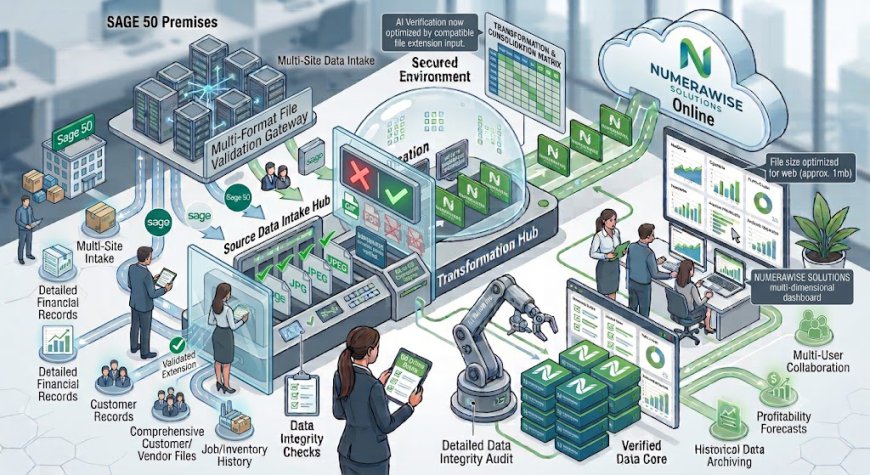
Managing business finances efficiently requires accounting software that aligns with your organization's goals and operational needs. While Sage Intacct is a powerful cloud-based financial management platform, many businesses decide to move to QuickBooks because of its affordability, user-friendly interface, extensive integrations, and flexible deployment options. A successful Sage Intacct to QuickBooks Conversion helps organizations transfer financial records securely while maintaining the accuracy of their accounting data.
Whether your business is simplifying its accounting system, reducing software expenses, or looking for a solution that is easier for internal teams to manage, a well-planned migration can make the transition seamless. This guide explains everything you need to know about Sage Intacct to QuickBooks Conversion, including the benefits, services included, migration steps, challenges, best practices, and frequently asked questions.
What is Sage Intacct to QuickBooks Conversion?
The process of moving accounting data from Sage Intacct to QuickBooks Online or QuickBooks Desktop is known as Sage Intacct to QuickBooks Conversion. Businesses move critical accounting data while maintaining data integrity and financial correctness rather than manually recreating financial records.
Customer records, vendor information, a chart of accounts, invoices, bills, payments, journal entries, account balances, and previous financial transactions are usually included in the conversion process. A well-managed transfer reduces disruption and guarantees that companies can confidently carry on with their regular accounting processes.
Why Opt for QuickBooks Conversion from Sage Intacct?
Because QuickBooks offers a user-friendly accounting experience with robust financial capabilities appropriate for small and medium-sized enterprises, many companies choose to convert Sage Intacct to QuickBooks.
Among the causes of switching are:
Reduced maintenance and software expenses
User-friendly accounting interface
Adaptable desktop and cloud alternatives
Features for automated bookkeeping
Real-time financial data
Quicker training for employees
Smooth bank integrations
Broad compatibility with business apps from third parties
Certified QuickBooks experts and a robust support network
These benefits make it easier for companies to manage their finances while increasing production.
Who Needs to Convert Sage Intacct to QuickBooks?
Converting Sage Intacct to QuickBooks is appropriate for:
Small companies
Expanding startups
Expert service companies
Retail companies
E-commerce businesses
Manufacturing companies
Nonprofit institutions
Bookkeeping companies
Accounting experts
Businesses trying to cut expenses on accounting software
QuickBooks is frequently a great option for companies looking for a more straightforward accounting system without compromising crucial financial capabilities.
Important Features
Reliable financial data transmission is ensured by a number of significant aspects provided by the migration procedure.
Safe data transfer
Precise account mapping
Transfer of vendor and customer records
Migration of historical transactions
Verification of financial reports
Validation of the opening balance
Support for bank account reconciliation
Verifying errors and ensuring quality
Help with QuickBooks setup
After-migration assistance
Every element makes the migration process dependable and seamless.
Advantages
There are many long-term benefits to converting Sage Intacct to QuickBooks.
makes daily bookkeeping easier
Improved financial reporting
minimizes the need for manual data entry
allows for automatic banking
improves the handling of invoices
enhances cooperation with accountants
provides adaptable cloud accessibility
promotes the expansion of businesses
lowers operating expenses
makes staff onboarding simpler.
provides financial reports that can be customized
increases the overall effectiveness of accounting
These advantages enable companies to concentrate less on administrative accounting duties and more on expansion.
Sage Intacct to QuickBooks Conversion Types
Companies can select the migration solution that best suits their operational needs.
QuickBooks Online with Sage Intacct
Perfect for companies that need mobile accounting, cloud accessibility, remote collaboration, and automatic upgrades.
QuickBooks Desktop and Sage Intacct
Ideal for businesses that require industry-specific capabilities, comprehensive task costing, local company file storage, and sophisticated inventory management.
The size of the company, workflow, reporting requirements, and plans for future growth all influence the choice of QuickBooks version.
Included Services and Data
Expert Sage Integration with QuickBooks Essential financial records are typically migrated as part of conversion services.
Data that is frequently sent comprises:
Details about the company
Accounting Chart
Records of customers
Details about the vendor
Goods and services
Initial balances
Receivables
Payable Accounts
Invoices for sales
Purchase invoices
Receipts and payments
Journal entries
Details of a bank account
The general ledger
Accounting records
Accounting transactions from the past
When relevant, tax settings
The QuickBooks edition and the intricacy of the initial Sage Intacct company file determine the precise extent of the migration.
Methodical Procedure
Step 1: Assess Current Financial Information
Examine your Sage Intacct company file to find obsolete transactions, unreconciled bank accounts, duplicate data, and inactive accounts. Prior to migration, financial data should be organized to increase overall correctness.
Step 2: Make a backup of your accounting documents
Prior to starting the conversion, always make a full backup of your Sage Intacct data. Backups offer extra security and enable recovery in the event of unforeseen problems.
Step 3: Set up QuickBooks
Before importing financial data, set up your QuickBooks business by inputting company information, fiscal year settings, tax choices, user rights, banking details, and reporting options.
Step 4: Provide Financial Data
Importing customer records, vendor details, chart of accounts, invoices, bills, payments, balances, and other supported accounting data into QuickBooks is the first step in converting Sage Intacct to QuickBooks.
Step 5: Confirm Data Conversion
Examine the following to thoroughly compare the two accounting systems:
The balance sheet
Statement of Profit and Loss
Trial Equilibrium
Consumer balances
Balances from vendors
Receivables and Payables
Balances in bank accounts
Before use QuickBooks for everyday accounting, fix any discrepancies.
Step 6: Evaluate Everyday Activities
Make example invoices, keep track of spending, balance bank accounts, produce reports, and confirm user rights. Testing verifies that the converted QuickBooks business operates as intended.
Typical Difficulties
Businesses may encounter a number of difficulties, despite the fact that converting Sage Intacct to QuickBooks is usually simple.
Disparities in data mapping
Reproduction of a custom report
Records that are duplicates
Changes in multiple currencies
Synchronization of inventory
Configuring payroll
Setting up sales tax
Updates for third-party integration
Modifications to user permissions
These problems can be reduced by collaborating with knowledgeable migration experts.
The Best Methods
For a successful relocation, adhere to following suggestions:
Before exporting, make sure your financial records are clean.
Eliminate redundant clients and suppliers.
All bank accounts should be reconciled.
Check the balances of inventory.
Make several backups.
After migration, compare financial reports.
Accounting workflows should be tested.
Plan the migration during a time when business is sluggish.
Save old reports for future use.
Before completing the migration, speak with your accountant.
These standard procedures decrease post-conversion problems and increase migration accuracy.
Typical Errors to Avoid
The relocation procedure goes much more smoothly when typical blunders are avoided.
Migrating without a backup
Disregarding redundant financial records
Ignoring the verification of reports
Neglecting to balance bank balances
Ignoring tax settings
Not testing QuickBooks following the migration
Bringing in unfinished financial data
Not educating staff members about the new system
The chance of accounting errors is greatly decreased by careful planning.
Advice Before Beginning
Think about these useful suggestions before starting your Sage Intacct to QuickBooks conversion:
Examine your accounting goals.
Choose between QuickBooks Desktop and Online.
Save any old records that aren't needed.
Update vendor and customer data.
Check the balances of your accounts.
Inform your accounting staff of the planned move.
Give post-conversion testing enough time.
A quicker and more dependable relocation is the result of careful planning.
Why Opt for Expert Services?
Expert Sage Integration with QuickBooks Conversion services offer knowledge that reduces risk and increases migration precision. Experts are knowledgeable with QuickBooks configuration, account mapping, financial validation, and data integrity. To make sure reports correspond with the original accounting data, they also carry out post-conversion testing. Relying on seasoned experts during the migration process helps businesses save important time, minimize manual labor, and prevent expensive mistakes.
Conclusion
A successful Sage Intacct to QuickBooks Conversion enables businesses to simplify accounting operations while preserving valuable financial information. QuickBooks offers an intuitive interface, automation features, detailed reporting, and flexible deployment options that support businesses across many industries. By preparing your data carefully, following a structured migration process, verifying financial reports, and testing your accounting workflows, you can complete the transition with confidence. Investing in professional migration services further improves data accuracy and minimizes business disruption, allowing your organization to take full advantage of QuickBooks' powerful accounting capabilities.
Frequently Asked Questions
1. What is Sage Intacct to QuickBooks Conversion?
Sage Intacct to QuickBooks Conversion is the process of securely transferring financial records, customers, vendors, invoices, account balances, and other accounting information from Sage Intacct into QuickBooks Online or QuickBooks Desktop while maintaining data accuracy.
2. How long does the migration process take?
Migration time depends on the size of the company file, transaction history, and data complexity. Small businesses may complete the process within several hours, while larger organizations with extensive financial records may require additional time for validation and testing.
3. Can historical financial data be migrated?
Yes. Most professional conversion services transfer historical transactions, chart of accounts, customer and vendor records, invoices, payments, balances, and journal entries, depending on compatibility between the two accounting systems.
4. Will my financial reports remain accurate?
Yes. After proper validation, reports such as the Balance Sheet, Profit and Loss Statement, Trial Balance, Accounts Receivable, and Accounts Payable should closely match your original Sage Intacct records.
5. Should I choose QuickBooks Online or Desktop?
QuickBooks Online is suitable for businesses needing cloud access and remote collaboration, while QuickBooks Desktop is better for organizations requiring advanced inventory management, job costing, and local company file storage.
6. Why should I hire professional migration specialists?
Professional specialists ensure accurate account mapping, secure data transfer, financial validation, reduced downtime, and post-conversion support. Their expertise helps minimize errors and creates a smoother migration experience.
7. What should I do after the migration is complete?
Review all financial reports, reconcile bank accounts, verify customer and vendor balances, test invoicing and payment workflows, and create a fresh QuickBooks backup. Proper post-migration testing ensures your accounting system is fully operational.