AI Brand Visibility: Complete Guide to Improving Visibility in AI Search Engines
Discover how to dominate AI search engines. Learn proven strategies, use top AI visibility tools, and master Generative Engine Optimization (GEO) to boost your AI brand visibility today.
 yashu2
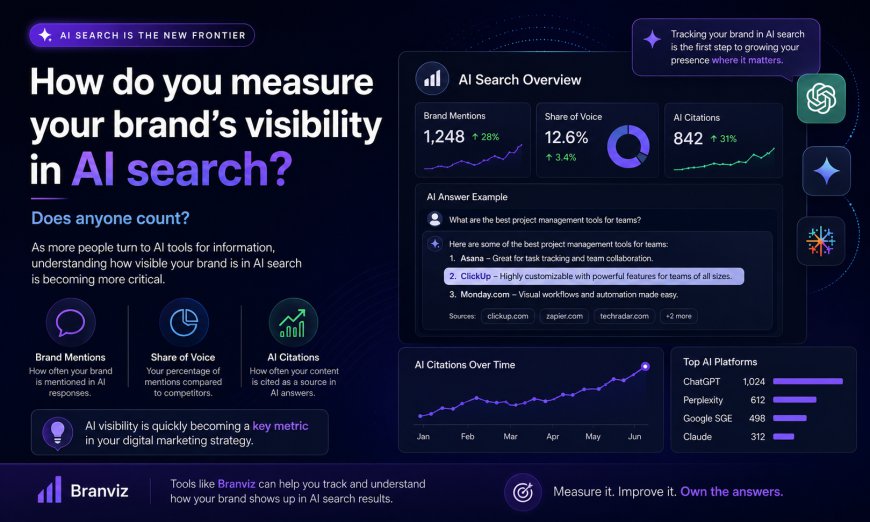
AI Brand Visibility: Complete Guide to Improving Visibility in AI Search Engines
The digital landscape is undergoing its most radical transformation since the birth of the commercial internet. Traditional search engine results pages (SERPs)—with their familiar "10 blue links"—are no longer the sole gatekeepers of online information. Instead, users are increasingly turning to conversational AI models and generative engines to get direct, curated answers.
For businesses, this shift introduces a critical digital marketing mandate: optimizing for AI brand visibility. If your company, product, or service is not actively discovered, synthesized, and recommended by Large Language Models (LLMs) and conversational assistants, you risk becoming invisible to a massive and fast-growing segment of your target audience.
This comprehensive guide breaks down exactly how to improve brand visibility in AI search `engines, why you must track your presence across these platforms, and how to master the new frontier of Generative Engine Optimization (GEO).
What Is AI Brand Visibility?
Featured Snippet Optimization Answer Block:
AI brand visibility refers to how frequently, accurately, and prominently a brand is mentioned, cited, or recommended in answers generated by AI search engines and Large Language Models (LLMs) like ChatGPT, Google AI Overviews, Gemini, and Perplexity when users input industry-related queries.
To fully understand this concept, you must realize that AI engines do not view the web as a list of independent URLs. Instead, they process information through a framework known as an Entity Graph. In the eyes of an LLM, your brand is an "entity"—a unique, identifiable concept with specific attributes, relationships, and associations.
[ Your Brand (Entity) ] ──( relationship )──> [ Specific Industry / Product Category ]
│
├──( attribute )──> [ Positive Customer Sentiments ]
│
└──( relationship )──> [ Trusted Third-Party Citations / Reviews ]
When a user asks an AI engine for a recommendation, the model searches its training data and real-time web retrieval indexes to identify which entities best fit the user's intent. AI brand visibility is the measurable metric of how often your entity is selected as the right answer. It is not just about ranking first on a screen; it is about being woven into the narrative fabric of an AI's synthesized response.
Why AI Brand Visibility Matters in 2026
Featured Snippet Optimization Answer Block:
AI brand visibility matters because modern consumers utilize conversational AI to make complex purchasing decisions. Missing out on LLM recommendations means your brand is eliminated from the buyer's consideration set before they ever visit a traditional website.
The consumer journey has fractured. In 2026, the pathway to a purchase rarely looks like a straight line from a Google search bar to a landing page. Instead, the buyer's journey often starts or ends within an AI interface.
Consider how a modern B2B buyer or a high-intent consumer behaves today. Instead of typing "best project management software" into a traditional search engine and spending hours reading through ten different blogs, they type a highly contextual prompt into an AI assistant:
"I run a remote digital marketing agency with 25 employees. We need a project management tool that integrates with Slack, handles complex agile sprints, and costs under $15 per user. Give me the top three options and compare them."
If your software fits this description perfectly, but your ai search visibility is poor, the AI will not mention you. The user will choose from the three options provided, and you will have lost a highly qualified prospect without ever knowing they were looking for a product like yours. Achieving strong brand visibility in ai search ensures that your company is on the digital "shortlist" when critical buying decisions are being made.
Why Should You Track AI Brand Visibility?
Featured Snippet Optimization Answer Block:
You should track AI brand visibility to protect your market share, identify gaps where competitors are outperforming you in LLM responses, correct algorithmic misinformation, and measure the direct ROI of your Generative Engine Optimization (GEO) efforts.
Understanding why should i track ai brand visibility comes down to maintaining control over your brand's digital reputation. Unlike traditional search tracking, where you simply check your position for a specific keyword, AI tracking requires monitoring both quantitative presence and qualitative sentiment.
Here are the primary reasons why tracking this metric is vital for your business:
-
Identifying Gaps Against Competitors: Tracking reveals the exact prompts where your competitors are being recommended but your brand is left out. This provides a clear roadmap for your content development.
-
Correcting Misinformation: LLMs can hallucinate or rely on outdated web data. Regular monitoring allows you to see if an AI is telling users that your product lacks a feature that you actually launched last year.
-
Measuring "Share of Voice" in Conversational Tech: It allows you to calculate what percentage of industry-specific recommendations you own compared to your primary rivals.
-
Optimizing Referral Traffic: By tracking which of your pages are cited as sources by platforms like Perplexity or Google AI Overviews, you can double down on the specific content formats that AI engines prefer to link to.
How AI Search Engines Discover and Mention Brands
Featured Snippet Optimization Answer Block:
AI search engines discover and mention brands by analyzing their internal training data, parsing real-time web indexes via Retrieval-Augmented Generation (RAG), and identifying high-authority entity connections, structured schemas, and consistent third-party brand citations across the web.
Different conversational engines utilize distinct mechanisms to find, synthesize, and display your brand. Understanding these nuances is critical for effective optimization.
ChatGPT
OpenAI’s ChatGPT relies on a mix of its foundational training data and real-time web browsing capabilities (powered by integrations and web crawlers like GPTBot). When a user asks for a recommendation, ChatGPT uses its semantic understanding to pull relevant information, frequently summarizing user reviews, forums like Reddit, and top-tier digital PR mentions to form its responses.
Google AI Overviews
integrated directly at the top of Google Search results, AI Overviews rely heavily on Google’s massive, established Knowledge Graph. It synthesizes information from top-ranking organic pages. If your site already possesses strong traditional SEO indicators, structured data, and high-quality internal linking, it is highly likely to be extracted and featured within an AI Overview box.
Gemini
Google’s Gemini model is deeply tied to Google’s live ecosystem. It excels at pulling real-time operational data, Google Business Profile information, maps, and YouTube content. For local and e-commerce brands, Gemini visibility is strongly influenced by your aggregate review scores and the freshness of your structured data.
Perplexity
Perplexity functions as a dedicated answer engine. It relies heavily on Retrieval-Augmented Generation (RAG). When a prompt is entered, Perplexity searches the live web, selects an array of high-authority source links, and writes a synthesized answer heavily backed by inline citations. To appear here, your content must be structured to answer specific queries directly, making it easy for the engine to lift your text as a source.
Claude
Anthropic’s Claude is known for its advanced reasoning and long context windows. While it can browse the web via specific integrations, it heavily prioritizes deeply analytical, high-quality information. Claude looks for comprehensive, expert-level whitepapers, nuanced industry guides, and clear, logically sound documentation when formulating brand associations.
AI Brand Visibility vs Traditional SEO
Featured Snippet Optimization Answer Block:
While traditional SEO focuses on optimizing specific URLs to rank for targeted keyword queries on a search page, AI brand visibility focuses on establishing entity authority, semantic context, and comprehensive third-party mentions so LLMs recommend the brand across conversational prompts.
To succeed in this new era, you must understand how traditional SEO tactics evolve into geo seo (Generative Engine Optimization).
|
Optimization Attribute |
Traditional SEO |
AI Brand Visibility (GEO) |
|
Primary Target |
Search Engine Web Crawlers (e.g., Googlebot) |
LLMs, RAG Systems, and Knowledge Graphs |
|
Success Metric |
Keyword Rankings, Organic Traffic, CTR |
AI Visibility Score, Share of Voice, Mentions |
|
Content Focus |
Keyword Optimization & Search Volume |
Entity Authority, Sentiment, Direct Answers |
|
Link Strategy |
Hyperlinked Anchor Text & PageRank |
Contextual Citations, Brand Mentions, Entity Co-occurrence |
|
User Intent |
Fragmented Keywords (e.g., "CRM software") |
Conversational Prompts (e.g., "What CRM is best for real estate?") |
How to Improve Brand Visibility in AI Search Engines
Featured Snippet Optimization Answer Block:
To improve brand visibility in AI search engines, you must execute a multi-pronged strategy centered on building clear schema data, earning authoritative digital PR mentions, publishing expert-driven content, and securing consistent brand citations across trusted industry nodes.
Improving your presence within conversational systems requires moving away from pure on-page keyword placement and moving toward a holistic entity-building framework. Here is how to improve brand visibility in ai search engines using core pillars:
Content Optimization & Direct Answers
AI models prefer content that gets straight to the point. Structure your articles with clear, declarative headers followed immediately by concise, factual, 40-to-60-word answer blocks. Use lists, bullet points, and clean formatting that RAG parsers can easily extract without needing to sift through unnecessary fluff.
Entity Building & Structured Data
Help AI search engines map your brand accurately by implementing advanced structured data (Schema markup). Ensure your website uses explicit Organization, Product, Author, and SameAs schemas. The SameAs tag is highly critical; it explicitly tells search models that your website belongs to the same entity found on your official Wikipedia page, LinkedIn profile, Crunchbase account, and official social channels.
HTML
<script type="application/ld+json">
{
"@context": "https://schema.org",
"@type": "Organization",
"name": "Your Brand Name",
"url": "https://www.yourbrand.com",
"logo": "https://www.yourbrand.com/logo.png",
"sameAs": [
"https://www.wikidata.org/wiki/Q12345",
"https://www.linkedin.com/company/yourbrand",
"https://twitter.com/yourbrand"
]
}
</script>
</script>
Digital PR and Unlinked Brand Mentions
LLMs gather data from across the web. If prominent industry publications, news sites, and blogs frequently mention your brand alongside your primary keywords, AI engines learn that your brand is an authority in that space. Interestingly, an unlinked text mention (e.g., "We recommend Brand X for cloud security") is highly valuable for AI training models, even if traditional SEO algorithms historically preferred a hard hyperlink.
Topical Authority & Expert Content (E-E-A-T)
Build deep clusters of content around your core expertise. Instead of writing single articles on broad topics, create interconnected content hubs that thoroughly map out a subject area. Ensure your content clearly showcases real-world experience, expert authorship, and credible references. AI search algorithms are trained to recognize and prioritize content that exhibits strong human experience and expert authority over generic, surface-level summaries.
Strategic Internal Linking & Citations
Ensure your site has a logical, crawlable internal link structure that groups related topics together. Furthermore, always back up your claims with high-quality external citations to trusted research data, whitepapers, and academic sources. When an AI engine sees that your content is well-researched and structured, it views your domain as a safe, highly reliable source to cite in its own responses.
What Strategies Improve Brand Visibility in AI Search Engines?
Featured Snippet Optimization Answer Block:
Successful strategies to improve brand visibility in AI search engines include auditing your current LLM footprint, building a robust entity graph through targeted digital PR, optimizing content for conversational long-tail prompts, and tracking your programmatic visibility over time.
To systematically increase your share of recommendations across conversational engines, execute this reproducible step-by-step framework:
Step 1: Benchmark and Audit Your Current Footprint
Before making changes, you need to know where you stand. Use a specialized ai visibility checker to run industry-relevant prompts through major LLMs. Document whether your brand appears, what context it is placed in, and which competitors are currently winning those recommendations.
Step 2: Optimize for Intent-Based Conversational Prompts
Analyze the exact conversational phrasing your audience uses. Instead of optimizing solely for "project management tool," build pages or sections that answer long-tail prompt variants, such as "How to manage software development sprints with remote teams." Ensure these answers are easy for AI models to parse.
Step 3: Launch an Aggressive Entity-Linked Digital PR Campaign
Secure placements, reviews, and mentions on authoritative, third-party platforms that AI models frequently use as core citation sources (such as G2, Trustpilot, major news networks, and niche-specific publications). The more your brand co-occurs with relevant industry terms on external sites, the tighter the AI’s entity association becomes.
Step 4: Implement Comprehensive Schema and Knowledge Graph Alignment
Deploy advanced schema markup across your entire site to clearly define your organizational structure, products, and authors. Ensure your listings on public reference databases (like Wikidata) are accurate, fully filled out, and completely aligned with your on-site messaging.
Step 5: Monitor, Refine, and Close Competitor Gaps
Consistently analyze your visibility reports. Look for "opportunity prompts"—queries where your competitors are being cited but your brand is missing. Refresh your existing content, add missing data points, and build out new authoritative assets to systematically close those competitive gaps.
AI Brand Visibility Tracking: What Should You Measure?
Featured Snippet Optimization Answer Block:
When tracking AI brand visibility, you must measure quantitative metrics like total brand mentions, the volume of source citations, your relative AI visibility score, direct referral traffic from AI engines, and your overall conversational share of voice.
Tracking your presence within conversational engines requires a specific set of key performance indicators (KPIs) tailored to generative search behavior.
|
Metric Name |
What It Measures |
Why It Matters |
|
Brand Mentions |
The total number of times your brand name is included in AI-generated text answers across target prompts. |
Indicates your overall mindshare and presence within the LLM's generative knowledge base. |
|
Citations |
The number of times an AI engine explicitly links to or names your website as a source for its answer. |
Directly drives high-intent referral traffic and proves the AI trusts your content as an authority. |
|
AI Visibility Score |
A relative score (usually 0–100) comparing your brand's presence against competitors across an industry prompt set. |
Provides an executive-level benchmark to measure the aggregate success of your GEO strategies over time. |
|
Referral Traffic |
The volume of actual website visitors originating from AI engines (tracked via platforms like GA4). |
Demonstrates the tangible bottom-line business value and conversion pipeline driven by AI search. |
|
Share of Voice (SoV) |
The percentage of total recommendations your brand secures within a specific cluster of industry-specific prompts. |
Reveals whether your brand dominates conversational search or if competitors are taking market share. |
How to See Brand Visibility in ChatGPT
Featured Snippet Optimization Answer Block:
To see brand visibility in ChatGPT, you can manually input specific, non-branded buyer prompts to check if your brand is recommended, or utilize automated AI visibility tracking tools to programmatically analyze your conversational market presence at scale.
While enterprise tracking requires automated tools, you can easily conduct a manual audit of your chatgpt visibility to understand how OpenAI's models perceive your business. Follow this quick diagnostic process:
1. Open a Clean, Unlogged Incognito Session
To get an unbiased, unpersonalized response, open a fresh browser window where your previous chat history will not influence the model's current outputs.
2. Input a Non-Branded, Commercial Intent Prompt
Do not ask "What is [Your Brand Name]?" Instead, simulate a real user looking for a solution. Use a structured, multi-variable prompt that mirrors a true buyer's query.
Example prompt: "I need a marketing analytics platform that handles multi-touch attribution, sets up in under an hour, and works well for e-commerce stores. Which top 3 tools should I look at?"
3. Analyze the Output Text and Citations
Look closely at the generated response. Is your brand listed? If yes, read the description carefully:
-
Are the features mentioned accurate?
-
Is the sentiment positive, neutral, or negative?
-
Did ChatGPT include an active link to your domain via its web browsing features?
4. Check for Gaps and Competitive Context
If your competitors are listed instead of you, look at why they were chosen. Did the AI mention a specific review site, a case study, or a particular feature? This gives you immediate insight into the content or third-party validation assets you need to build out to earn that recommendation in future chats.
How to Audit Brand Visibility on LLMs
Featured Snippet Optimization Answer Block:
Auditing brand visibility on LLMs involves defining a core set of customer prompts, querying major AI engines, assessing the accuracy and sentiment of the responses, and using a structured checklist to systematically identify and correct optimization gaps.
Conducting a thorough llm visibility audit ensures your brand remains competitive across all major generative search architectures. Use this structured approach to keep your brand aligned with conversational engine guidelines.
The Audit Process
[ Step 1: Define Prompts ] ──> [ Step 2: Run Across LLMs ] ──> [ Step 3: Analyze Sentiment/Links ] ──> [ Step 4: Map Gaps ]
-
Define Your Core Prompt Set: Compile a list of 50 to 100 high-value, non-branded conversational queries that your ideal clients ask when researching your industry. -
Execute Across Multiple Engines: Run these prompts programmatically or systematically across ChatGPT, Google AI Overviews, Gemini, Perplexity, and Claude.
-
Analyze Sentiment and Link Integrity: Grade each response based on whether your brand is mentioned, if your website is cited, whether the description is accurate, and if the overall tone is favorable.
-
Map Competitive Gaps: Note which platforms or queries completely exclude your brand while favoring competitors.
The Visibility Audit Checklist
-
[ ] Checked brand mentions for top 50 commercial industry prompts.
-
[ ] Verified that all listed product features and pricing models are completely accurate.
-
[ ] Checked that active links point to functioning, optimized landing pages.
-
[ ] Assessed if tone and sentiment are positive and aligned with brand values.
-
[ ] Confirmed that Organization and Product Schema markups are error-free.
-
[ ] Evaluated competitor presence on prompts where your brand is currently missing.
-
[ ] Audited key third-party review sites to ensure positive aggregate ratings.
Common Audit Mistakes to Avoid
-
Auditing Only Branded Queries: Searching only for your company name will show you what the AI knows about you, but it won't show you if you are appearing when unbranded users are actively looking for solutions in your space.
-
Ignoring the Contextual Sentiment: Simply appearing in an answer isn't enough. If an LLM includes your brand but frames it as "difficult to set up compared to Competitor Y," your visibility is actually harming your conversion funnel.
-
Relying Entirely on Single Manual Checks: LLM outputs fluctuate based on model updates, location data, and temporal variables. A single manual query doesn't represent your true programmatic average visibility score.
Best AI Brand Visibility Tools
Featured Snippet Optimization Answer Block:
The best AI brand visibility tools automate prompt tracking across multiple language models, calculate your share of voice, highlight competitive gaps, and identify the exact web pages LLMs crawl and cite most frequently as sources.
To scale your ai brand visibility tool stack, you need software that moves past traditional search tracker tools and focuses specifically on generative engine behavior.
|
Tool Name |
Key Features |
Best For |
Pricing |
|
Semrush AI Search Visibility Checker |
Tracks presence across ChatGPT, Gemini, and Google AI Overviews; provides an overall AI Visibility Score (0-100); reveals competitor visibility comparisons and identifies high-volume prompt opportunities. |
Full-scale marketing teams looking for an integrated dashboard to manage conversational SEO and competitor gaps. |
Available via Semrush subscription tiers (Free basic features available). |
|
Ahrefs Brand Radar |
Features a massive, search-backed prompt database; tracks real-time brand mentions and citations across ChatGPT, Perplexity, Copilot, and Gemini; provides comprehensive "Cited Pages" reports. |
SEO professionals and brand managers who require deep, un-synthetic data on exact citation sources and sub-topic associations. |
Included in Ahrefs advanced packages; free basic web checker available. |
|
AI Visibility Toolkit |
Focuses on multi-platform tracking, international visibility distribution graphs, and detailed semantic analysis of generated text to evaluate brand sentiment. |
Enterprise companies needing to monitor global brand reputation and sentiment variations across multiple LLM frameworks. |
Custom enterprise pricing depending on tracked prompt volume. |
AI Visibility Tool vs AI Visibility Checker
Featured Snippet Optimization Answer Block:
An AI visibility checker is typically a free or lightweight, point-in-time diagnostic tool used to quickly inspect a domain's current presence, while an AI visibility tool is an enterprise-grade platform built for continuous tracking, historical analytics, and competitor gap mapping.
Understanding the difference between an ai visibility tool and an ai visibility checker is essential for correctly budgeting your marketing resources.
|
Feature Attribute |
AI Visibility Checker |
AI Visibility Tool |
|
Primary Purpose |
Instant, single-session diagnostic snapshot. |
Ongoing tracking, historical trends, and strategy design. |
|
Data Scope |
Analyzes a limited set of basic industry prompts. |
Tracks hundreds or thousands of highly customized prompts. |
|
Competitor Analysis |
Basic, surface-level competitor presence check. |
In-depth historical share of voice and gap analysis matrices. |
|
Reporting & Alerts |
No automated reporting or real-time alert systems. |
Custom executive dashboards, automated alerts, and API exports. |
|
Ideal User |
Small business owners and curious marketing beginners. |
Professional SEO strategists, agency leaders, and enterprises. |
Common Mistakes That Reduce AI Brand Visibility
Featured Snippet Optimization Answer Block:
Common mistakes that reduce AI brand visibility include using dense, poorly structured web layouts, neglecting structured schema markup, allowing outdated product information to persist online, and ignoring third-party review platforms that LLMs use as primary citation sources.
Avoid these major pitfalls to prevent your brand from being filtered out by conversational discovery models:
-
Burying Answers in Thin, Fluffy Content: If your content requires reading through 800 words of background history before reaching a direct answer, an AI web crawler will likely skip your page and pull a cleaner, more direct answer from a competitor's site.
-
Neglecting Your Third-Party Footprint: Many brands focus entirely on their own website while completely ignoring platforms like Reddit, Quora, G2, and specialized industry forums. Because LLMs heavily scrape these user-generated spaces to understand true consumer sentiment, a poor presence on these forums will directly damage your AI visibility.
-
Blocking Essential AI Bots via Robots.txt: While protecting content copyright is a valid business concern, overzealous blocking of crawlers like GPTBot, Google-Extended, or PerplexityBot means your brand cannot be indexed for real-time answers, resulting in a complete loss of real-time conversational search share.
-
Failing to Maintain Consistent NAP Data: If your Name, Address, Phone number, and core product descriptions vary wildly across your website, Google Business Profile, and social directories, LLMs will struggle to reconcile your data into a single, trusted entity, lowering your authority score.
Future of AI Search and Brand Visibility
Featured Snippet Optimization Answer Block:
The future of AI search points toward highly personalized, multi-modal conversational ecosystems where AI agents handle transactions end-to-end based on a brand's verified trust data, authoritative real-time web citations, and contextual entity alignment.
As we move forward, generative engines will evolve far past simply displaying text responses with links. The integration of advanced multi-modal models means that AI search tools will seamlessly process text, voice, code, images, and live video feeds simultaneously to solve user problems.
Furthermore, we are moving toward an era dominated by Autonomous AI Agents. Instead of a human user simply reading a list of brand recommendations, they will task their personal AI assistant with executing actions: "Find the best email marketing tool that matches my tech stack, open a trial account, and connect it to my calendar."
In this agent-driven economy, your brand’s survival relies entirely on its established footprint within the underlying AI frameworks. Winning this future requires maintaining a clean, highly authorized, and structurally optimized entity footprint that makes it incredibly easy for AI agents to verify your credibility, select your service, and confidently recommend your brand to the end-user.
Final Thoughts
The emergence of conversational engines does not mean traditional SEO is dead. Rather, it means SEO is expanding into a more sophisticated, entity-driven practice: AI brand visibility and Generative Engine Optimization.
By structuring your content for quick extraction, building a flawless structured schema framework, earning strong third-party digital PR mentions, and utilizing advanced tools like Semrush and Ahrefs to continuously monitor your market presence, you ensure that your brand remains prominent, authoritative, and frequently recommended across the conversational search landscape. Start auditing your conversational footprint today to claim your share of voice in the rapidly growing world of AI search.
FAQ
How can I improve brand visibility in AI search engines?
To improve visibility, publish expert, human-first content that answers user questions directly with clear, scannable structures. Implement detailed schema markups (Organization, Product, SameAs) to clarify your entity associations, and build authoritative brand mentions on trusted external review sites and news platforms that AI models scrape for sources.
What is the best AI visibility checker?
The best tools for tracking your generative search footprint include the Semrush AI Search Visibility Checker (excellent for overall visibility grading and gap analysis) and Ahrefs Brand Radar (ideal for mapping out real-world citations, tracking cited pages, and analyzing multi-platform LLM responses at scale).
How do I track AI brand visibility?
You can track visibility programmatically by defining a core set of customer-intent prompts and uploading them into an AI visibility tool. Monitor quantitative metrics like your total brand mentions, link citations, and relative AI visibility scores, while analyzing qualitative signals like sentiment alignment and information accuracy.
How can I see if ChatGPT mentions my brand?
To manually check your presence, open a clean, unlogged incognito browser session and enter non-branded queries that a prospective buyer would use when seeking solutions in your niche. Analyze the output text to see if your brand is recommended, check for active source links, and evaluate the overall accuracy and sentiment of the response.
Why is AI brand visibility important for SEO?
It is crucial because conversational AI search engines are fundamentally changing how users discover products and information. Traditional keyword rankings are no longer the only way to drive organic discovery; if your brand is not integrated into the synthesized answers generated by LLMs, you miss out on high-intent consumers during critical decision-making stages.