Aircraft Nacelle System Industry Analysis Reveals US$ 13,936.87 Million Market Potential by 2033
Aircraft nacelle systems are aerodynamic structures that surround and support aircraft engines. They are designed to improve airflow management, protect engine components, reduce noise, and support thrust reversal during landing.
 raajblog
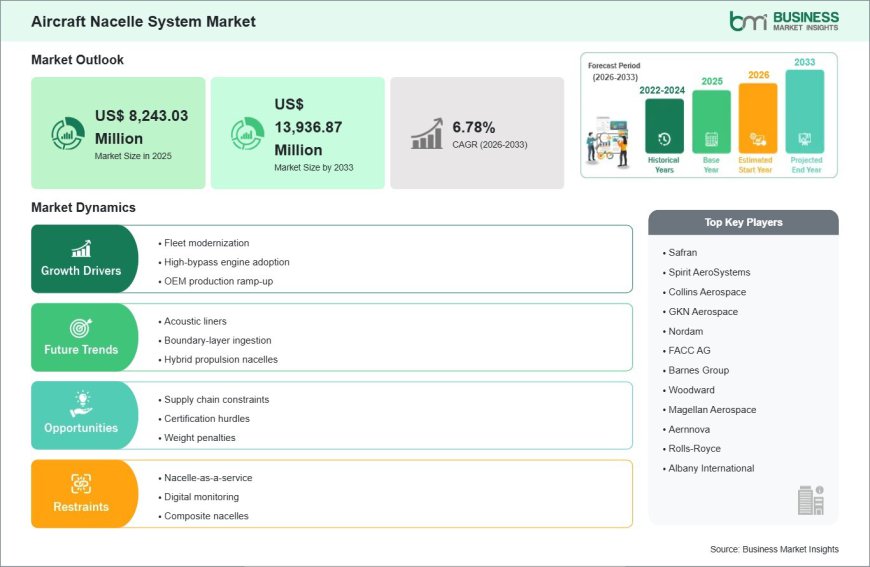
As modern commercial air carriers and military defense sectors increasingly prioritize lightweight composites, acoustic liners, and advanced thrust reversers to lower operating costs and satisfy strict regional noise regulations, a steady wave of program rollouts is driving growth across the aircraft nacelle system sector.
This steady expansion is substantiated by Business Market Insights, which highlights that the global Aircraft Nacelle System Market is on track to record a 6.78% CAGR between 2026 and 2033, rising significantly from US$ 8,243.03 Million in 2025 to US$ 13,936.87 Million by 2033.
Technological advancements in lightweight composites, aerodynamic design, acoustic treatment, predictive maintenance, and digital monitoring are reshaping the Aircraft Nacelle System Market. Manufacturers are increasingly focusing on materials and structures that reduce weight, improve durability, lower noise, and support more efficient propulsion systems. As aviation continues to prioritize sustainability and operational performance, demand for advanced nacelle systems is expected to rise further.
Download Sample Report : https://www.businessmarketinsights.com/sample/BMIPUB00035517
What Are Aircraft Nacelle Systems?
Aircraft nacelle systems are aerodynamic structures that surround and support aircraft engines. They are designed to improve airflow management, protect engine components, reduce noise, and support thrust reversal during landing. These systems include key parts such as inlet cowls, fan cowls, thrust reversers, and exhaust systems, each serving an important role in aircraft performance and safety.
Nacelle systems are used across commercial, military, and general aviation platforms. They must balance lightweight design with structural strength, thermal resistance, and maintainability. As aircraft become more advanced and environmental regulations become stricter, nacelle systems are increasingly being engineered for better fuel efficiency, lower emissions, and improved lifecycle performance.
Market Drivers
A major driver of the Aircraft Nacelle System Market is the increasing demand for fuel-efficient and lightweight aircraft structures. Airlines and aircraft manufacturers are under pressure to reduce fuel consumption and improve performance, which is encouraging the use of advanced nacelle systems built from composites and other lightweight materials. These systems help minimize drag while supporting engine protection and noise reduction.
Another important growth factor is the development of next-generation aircraft programs. New commercial and military aircraft designs require advanced nacelle architectures that improve durability, reduce maintenance requirements, and support more efficient propulsion systems. The growing emphasis on sustainability and environmental compliance is also encouraging the adoption of low-noise and fuel-optimized nacelle technologies.
The market is further supported by fleet modernization and rising aircraft deliveries. Commercial operators continue to invest in new aircraft and retrofit programs, while defense organizations are upgrading aircraft platforms to improve mission readiness. These trends are creating stable demand for both original equipment and replacement nacelle components.
Market Segmentation
By Component
- Inlet Cowl: Supports airflow management and engine protection during flight operations.
- Fan Cowl: Provides access for maintenance while protecting critical engine components.
- Thrust Reverser: Helps aircraft decelerate during landing and improves operational safety.
- Exhaust System: Manages engine exhaust flow, heat, and noise reduction requirements.
By Aircraft Type
- Commercial: Represents significant demand due to passenger traffic growth and fleet expansion.
- Military: Utilized in defense aircraft requiring high durability and advanced performance.
- General Aviation: Supports business aviation and private aircraft operations.
By Engine Type
- Turbofan: Widely adopted in commercial aircraft due to fuel efficiency and performance advantages.
- Turboprop: Commonly used in regional and specialized aviation applications.
The report indicates that thrust reversers and fan cowls account for significant market shares because of their essential role in aircraft operation, safety, and maintenance. Commercial aircraft represent a major share of market demand because of ongoing passenger traffic growth and fleet expansion. Turbofan engines continue to dominate demand due to their widespread use in modern passenger aircraft.
Regional Insights
- North America remains a mature market supported by a strong aerospace manufacturing ecosystem, advanced aircraft development programs, and extensive maintenance infrastructure. The United States continues to lead regional demand through commercial aviation, military procurement, and major aerospace suppliers.
- Europe represents another important market driven by aircraft production capabilities, environmental compliance requirements, and ongoing fleet modernization efforts. Countries such as France, Germany, and the United Kingdom maintain strong aerospace industries and continue investing in advanced aircraft programs.
- Asia-Pacific is supported by aircraft manufacturing activity, fleet expansion, and rising aviation demand across major markets.
- Middle East & Africa and South & Central America are also contributing through aviation infrastructure and fleet modernization initiatives.
Top Players in the Aircraft Nacelle System Market
The market is competitive, with leading companies focusing on lightweight design, maintenance efficiency, aerodynamic performance, and advanced materials to strengthen their positions.
- Safran
- Spirit AeroSystems
- Collins Aerospace
- GKN Aerospace
- Nordam
- FACC AG
- Barnes Group
- Woodward
- Magellan Aerospace
- Aernnova
- Rolls-Royce
- Albany International
- PPG Industries
- Amphenol
- Gill Corporation
These companies continue to invest in advanced composite nacelles, thrust reverser systems, acoustic technologies, and maintenance solutions to meet the evolving requirements of commercial and military aviation.
Technological Innovations
Technological innovation is transforming the Aircraft Nacelle System Market through advanced composite materials, thermoplastic structures, and acoustic technologies. These developments are helping manufacturers reduce weight, improve durability, and lower aircraft noise while supporting fuel-efficient operations.
Digital maintenance technologies and predictive monitoring are also becoming more important. These tools help operators improve reliability, reduce downtime, and manage nacelle performance more effectively across commercial and military fleets. As aircraft systems become more data-driven, nacelle support solutions are evolving alongside them.
Next-generation aircraft programs are encouraging further innovation in aerodynamic optimization and system integration. As sustainable aviation and advanced propulsion concepts develop, nacelle systems are expected to play a larger role in improving efficiency and environmental performance.
Future Market Outlook
The future outlook for the Aircraft Nacelle System Market remains positive. Rising aircraft production, fleet modernization, sustainable aviation programs, and the growing need for lightweight and efficient aircraft structures are expected to support steady growth through 2033.
Companies that focus on composite materials, noise reduction, digital maintenance, and next-generation aircraft compatibility are likely to capture the strongest opportunities. With aviation operators continuing to prioritize efficiency and sustainability, nacelle systems will remain an important part of future aircraft design and performance.
Frequently Asked Questions (FAQs)
What is the projected size of the Aircraft Nacelle System Market by 2033?
The market is projected to reach US$ 13,936.87 Million by 2033, rising from US$ 8,243.03 Million in 2025.
What is the CAGR for the Aircraft Nacelle System Market?
The market is expected to grow at a CAGR of 6.78% from 2026 to 2033.
Which component segments hold significant shares?
Thrust reversers and fan cowls hold significant market shares.
Which aircraft type dominates the market?
Commercial aircraft represent a major share of the market.
Which engine type dominates the market?
Turbofan engines continue to dominate market demand.
Browse More Reports:
https://www.businessmarketinsights.com/reports/air-traffic-control-equipment-market
https://www.businessmarketinsights.com/reports/airborne-surveillance-market
https://www.businessmarketinsights.com/reports/aircraft-cabin-lighting-market
About Us
Business Market Insights is a market research platform that provides subscription service for industry and company reports. Our research team has extensive professional expertise in domains such as Electronics & Semiconductor; Aerospace & Defense; Automotive & Transportation; Energy & Power; Healthcare; Manufacturing & Construction; Food & Beverages; Chemicals & Materials; and Technology, Media, & Telecommunications.
Contact Us
If you have any questions about this report or would like further information, please contact us:
Contact person: Ankit Mathur
Email: sales@businessmarketinsights.com
Phone: +16467917070