Best AutoML Tools Students Should Learn for AI Projects in 2026
Explore the best AutoML tools for students in 2026. Compare Auto-Sklearn, H2O AutoML, TPOT, AutoGluon, Google Vertex AI, and Azure ML.
 clairemiller069
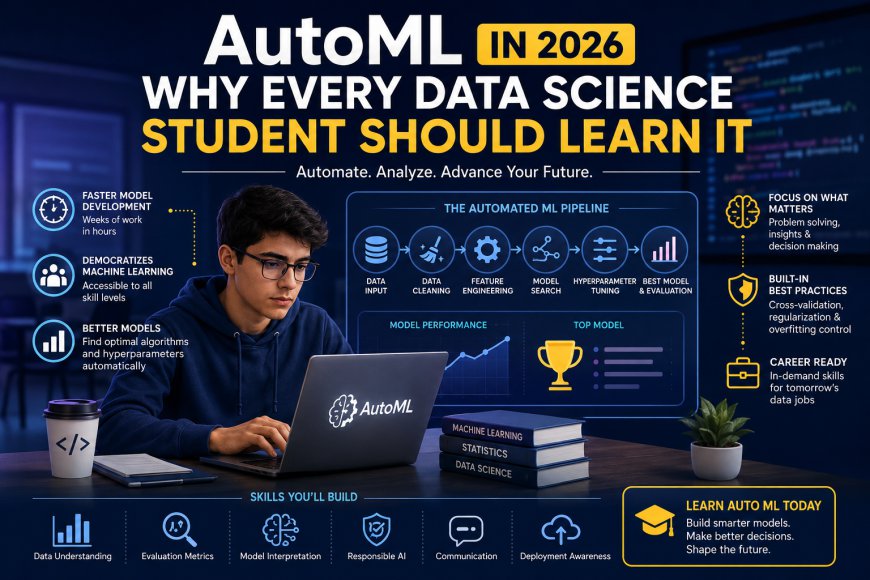
Artificial intelligence is transforming every industry, from healthcare and finance to retail and manufacturing. At the center of this transformation is Automated Machine Learning, commonly known as AutoML. Once considered a tool for speeding up experiments, AutoML has become an essential part of modern machine learning workflows. For students planning careers in data science, learning AutoML is no longer optional—it is becoming a competitive advantage.
AutoML allows users to automate complex stages of machine learning development, including feature engineering, algorithm selection, hyperparameter tuning, and model evaluation. Instead of spending weeks building models manually, students can generate high-quality baseline models within hours while focusing on understanding the data and improving business outcomes.
AutoML Is Reshaping the Role of Data Scientists
Many people assume AutoML will replace data scientists, but the reality is very different.
Automation removes repetitive technical work while increasing the importance of human judgment. Modern data scientists spend less time testing hundreds of algorithms and more time identifying business opportunities, improving data quality, validating predictions, and ensuring responsible AI practices.
This shift changes what employers expect from graduates.
Companies want professionals who understand both machine learning technology and the real-world problems that AI is designed to solve.
Faster Development Means More Innovation
One of AutoML's biggest strengths is speed.
Traditional machine learning projects often require multiple rounds of preprocessing, model selection, parameter tuning, testing, and comparison. These activities can consume days or even weeks.
AutoML platforms automate these repetitive tasks, allowing students to evaluate several machine learning approaches in a single afternoon.
Imagine preparing for an important exam. Instead of solving only one practice paper because of time limitations, you can now solve ten different papers, compare your mistakes, and improve much faster. AutoML provides the same advantage by allowing students to experiment with many machine learning models in significantly less time.
This faster workflow encourages creativity because learners spend more time exploring ideas instead of repeating technical procedures.
Data Quality Has Become More Important Than Coding
Although AutoML automates model development, it cannot repair poor-quality datasets.
Missing values, duplicate records, incorrect labels, biased samples, and inconsistent formatting continue to reduce prediction accuracy regardless of the platform being used.
That is why successful students learn data preparation before AutoML.
Understanding data cleaning, feature selection, normalization, and exploratory data analysis remains one of the most valuable skills in modern machine learning.
Organizations increasingly recognize that reliable data creates reliable AI systems. Automation simply makes that truth more visible.
Explainable AI Is Driving New Learning Priorities
Building accurate models is only one part of responsible AI development.
Businesses also need to understand why models make specific predictions.
Healthcare providers must explain medical recommendations.
Banks must justify lending decisions.
Insurance companies need transparent risk assessments.
Because of these requirements, universities now place greater emphasis on explainable AI alongside AutoML education.
Students should understand feature importance, model interpretation techniques, evaluation metrics, fairness, and bias detection. These topics prepare graduates to build trustworthy AI systems rather than simply accurate ones.
AutoML Platforms Every Student Should Explore
The AutoML ecosystem continues to grow, offering students many opportunities to gain practical experience.
Open-source platforms such as Auto-Sklearn, TPOT, AutoGluon, and H2O AutoML allow learners to build complete machine learning pipelines while understanding how different algorithms perform.
Cloud platforms have also become increasingly important.
Google Vertex AI AutoML and Microsoft Azure Automated ML provide intuitive interfaces that simplify machine learning development without requiring extensive programming knowledge.
Learning multiple AutoML platforms helps students adapt quickly during internships, research projects, and professional careers because each platform offers unique capabilities while following similar machine learning principles.
Classroom Learning Is Becoming More Practical
Modern data science courses are changing to reflect industry needs.
Instead of grading students only on coding ability, instructors increasingly evaluate problem-solving, model interpretation, communication, and project documentation.
Students may be asked to compare manually developed models with AutoML-generated pipelines, explain why one model performs better, and recommend improvements based on business objectives.
These assignments encourage deeper understanding rather than memorization.
When learners need support understanding AutoML workflows, interpreting evaluation metrics, or improving project documentation, Expertsmind.com's subject expert network can help clarify difficult concepts while strengthening practical machine learning knowledge.
AutoML Opens More Career Opportunities
The rapid adoption of AutoML across industries is creating demand for graduates who understand automated machine learning systems.
Healthcare organizations use AutoML to predict patient outcomes.
Banks improve fraud detection and credit analysis.
Retail companies forecast demand and personalize customer experiences.
Manufacturers optimize production planning through predictive analytics.
Because AutoML accelerates development, businesses can apply machine learning to more problems than ever before. This creates new opportunities for data scientists, AI engineers, machine learning specialists, business analysts, and MLOps professionals.
Graduates who understand automated workflows while maintaining strong machine learning fundamentals will remain highly competitive in this growing job market.
Looking Ahead
AutoML is not replacing data science education—it is redefining it.
Students still need statistics, programming, data analysis, and machine learning fundamentals. The difference is that automation now allows them to apply those skills more efficiently while concentrating on higher-value tasks such as critical thinking, communication, ethics, and business strategy.
The future of AI belongs to professionals who know how to combine intelligent automation with sound judgment. Students who embrace AutoML today will be better prepared to solve tomorrow's most challenging data science problems.