Can RFID and Computer Vision Revolutionize Athlete Analytics?
Fatigue is a major issue in any sport. In this blog, we have talked about the use of RFID along with AI vision to boost the performance of sportspeople. Read the complete write-up to learn more.
 christyevangeline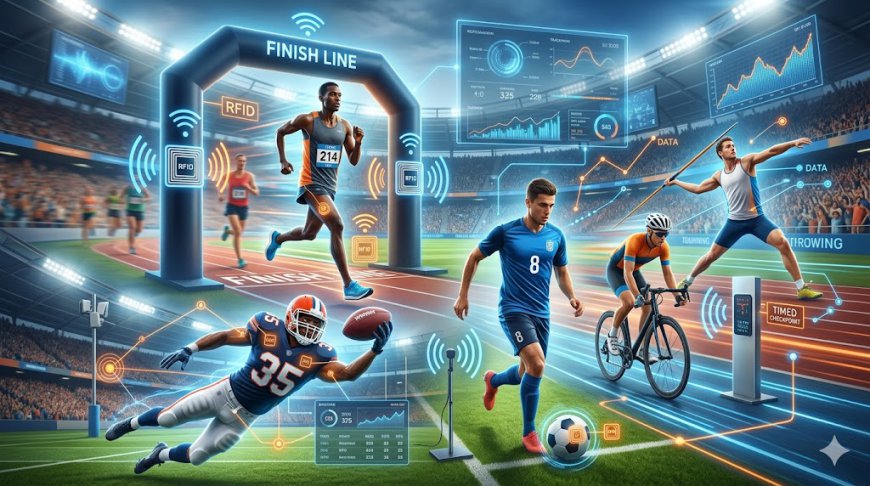
Days have passed when coaching personnel used stopwatches and clipboards as the only tools. As the crowd is roaring with the final score, the game is now being won in the data room. This is because nowadays, passive RFID technology is combined with AI-based computer vision to bring the analytics of athletes past the finish line and into a centimeter-accurate realm.
Choosing an Invisible Tracker
The initial level of this technological revolution is the equipment. Passive RFID chips, which are small, battery-free microchips, are currently being integrated into jerseys, shoulder pads, and even the soles of cleats seamlessly. RFID retail has become quite popular in the US. You can also use the same technology for personal or professional reasons.
a) Their mechanism
These chips do not require batteries. Activated scanners around the field/court send a unique identifier.
b) The Precision
Passive RFID provides location information with centimeter-accuracy, unlike GPS, which may fail to work indoors or lose precision. We are not only following the progress of whether a player is at the 50-yard line; we can tell whether he transferred the weight to the left foot and then cut.
A Combination of Computer Vision and AI
RFID can inform you about the location of a player, whilst computer vision, which is driven by AI, can inform you of what they are doing there. Cameras with high frames per second record all movements, and neural networks process the biomechanics on the fly.
You put these two sets of data together, and the magic will occur:
1. RFID gives the geospatial finger (X and Y positions).
2. Vision gives the biomechanical background (angle of the joints, posture).
What Does the Data Tell?
Such synergy enables the analysts to go beyond the simplistic top speed metrics and venture into predictive analytics and fatigue management.

a) Neuromuscular Fatigue Detection
AI can measure the length of the stride (through RFID positioning) compared to the limb angle (through computer vision) to determine when a player is losing stamina before he or she experiences exhaustion. A little reduced stride or slower bounce back following a sprint will be a tip-off that fatigue is present, causing coaches to initiate a replacement to avoid harm.
b) Tactical Heat Maps
No more abstract heat maps. We are now able to observe the speed at which pressure is being applied. This indicator monitors not only the location of a player, but the aggressiveness of that player in closing on an opponent with reference to the acceleration statistics at that particular moment in the field of play. Similar to RFID solutions for warehouse, we can choose the same tech for sports and analytics.
a) Load Management
It is possible to determine the actual mechanical load on the body of a player by summing up the high-intensity sprints (RFID) with the impact force of each stride (vision analysis).
How to Implement the System?
When considering the incorporation of this degree of analytics into your organization, remember the following:
1) Timing is the Key
Make sure that there is perfect synchronization between your RFID timing gates and camera systems. The delay of 100 milliseconds may make the data accurate to centimeters useless.
2) Put the Data into Context
Do not simply look at the numbers. A player may be slower in running due to performing a particular tactical task (i.e., holding a line), and not due to being fatigued. Always superimpose information on the game video.
3) Concentrate on the Why
The statistics will inform you that a player is slowed down. The coach needs to know why. Is it strategic or is it physiological? Diagnose the why using computer vision.
We are shifting away from describing what happened (after the game analysis) and to predicting what will happen. We are not only enhancing performance by measuring the micro-movement of the athletes in centimeter accuracy, but we are in fact extending the careers.
The end of the analysis is no longer the finish line; it is merely a point in the quest for perfection in athletics.