Cost of 3D Printing Services in Australia (2026 Complete Guide)
3D printing services in Australia are widely used for prototyping, custom parts, and manufacturing.
 struxis
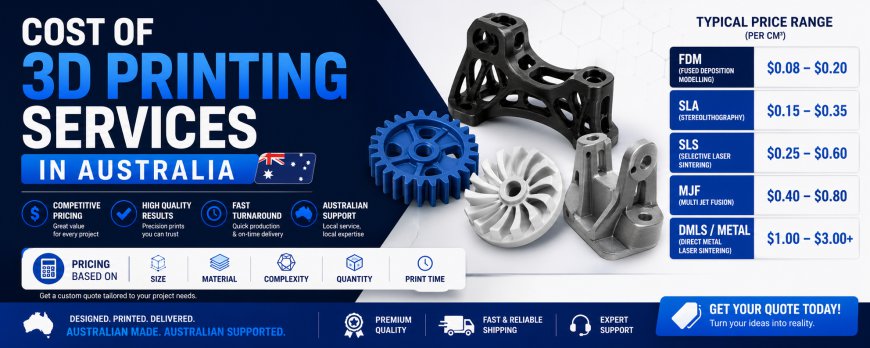
3D printing services in Australia are widely used for prototyping, custom parts, and manufacturing. However, one of the most common questions is: how much does 3D printing cost? The answer varies based on several factors such as size, material, technology, and complexity. This guide will help you understand realistic pricing and how to estimate your project cost.
Average Cost of 3D Printing in Australia
The cost of 3D printing in Australia can range from a few dollars to thousands depending on the project. Typical price ranges include:
- Small parts: $30 – $150
- Medium parts: $120 – $450
- Large or complex parts: $300 – $1,500+
- Industrial SLS parts: $300 – $10,000+
- Metal 3D printing: Starts around $300 and can go much higher
Overall, most 3D printing jobs fall between $3 and $10,000+, depending on requirements.
Cost by 3D Printing Technology
1. FDM (Fused Deposition Modeling)
FDM is the most affordable and widely used method.
- Cost: $30 – $500 per part
- Best for: Prototypes and basic functional parts
2. SLA (Stereolithography)
SLA offers high detail and smooth finishes.
- Cost: $50 – $1,500 per part
- Best for: Detailed models and visual prototypes
3. SLS (Selective Laser Sintering)
SLS produces strong and durable parts.
- Cost: $300 – $1,500+ per part
- Best for: Functional and industrial components
4. Metal 3D Printing
Used for high-performance applications.
- Cost: $300 – $10,000+
- Best for: Aerospace, automotive, and engineering
Key Factors That Affect Cost
1. Material Selection
Different materials come with different costs:
- PLA/ABS → Low cost
- Resin → Medium cost
- Nylon/engineering plastics → High cost
- Metal → Premium cost
2. Size and Volume
Larger parts require more material and longer print time, increasing cost significantly.
3. Print Time
Professional services often charge $30 – $150 per hour, depending on machine type and complexity.
4. Design Complexity
Complex designs take longer to print and may require supports, increasing both time and cost.
5. Post-Processing
Additional finishing such as sanding, painting, or assembly can add significant cost, sometimes equal to the printing cost itself.
6. Quantity
Bulk orders reduce cost per unit, making large production runs more economical.
Cost Calculation Methods
3D printing companies in Australia typically use different pricing models:
- Per hour: $30 – $150
- Per gram: $0.10 – $0.30 (FDM materials)
- Per volume: $0.50 – $3.00 per cm³
These are often combined to generate final quotes.
Cost-Effective 3D Printing with Struxis

Choosing the right provider can significantly impact your overall cost. Struxis offers efficient and scalable solutions by optimizing material usage, reducing print time, and providing high-quality results.
With advanced technologies like FDM, SLA, and SLS, Struxis ensures precision while maintaining cost-effectiveness. Its end-to-end services—from design to production—help businesses avoid unnecessary expenses and improve efficiency.
How to Reduce 3D Printing Costs
To optimize your budget, consider the following tips:
- Simplify your design to reduce material usage
- Choose the right technology (avoid overpaying for precision)
- Print in bulk for lower per-unit cost
- Use cost-effective materials where possible
- Provide print-ready files to avoid extra charges
Conclusion
The cost of 3D printing services in Australia depends on multiple factors including technology, material, size, and finishing requirements. While basic prototypes are affordable, industrial and metal parts can require a higher investment.
By understanding these cost factors and working with reliable providers like Struxis, businesses can achieve high-quality results while keeping costs under control.