What Is the Difference Between Early Development Clinical Trials and Late-Phase Trials?
Learn the key differences between Early Development Clinical Trials and late-phase trials, including objectives, participant numbers, safety assessments, efficacy testing, and regulatory outcomes.
 scientiaclinicalresearch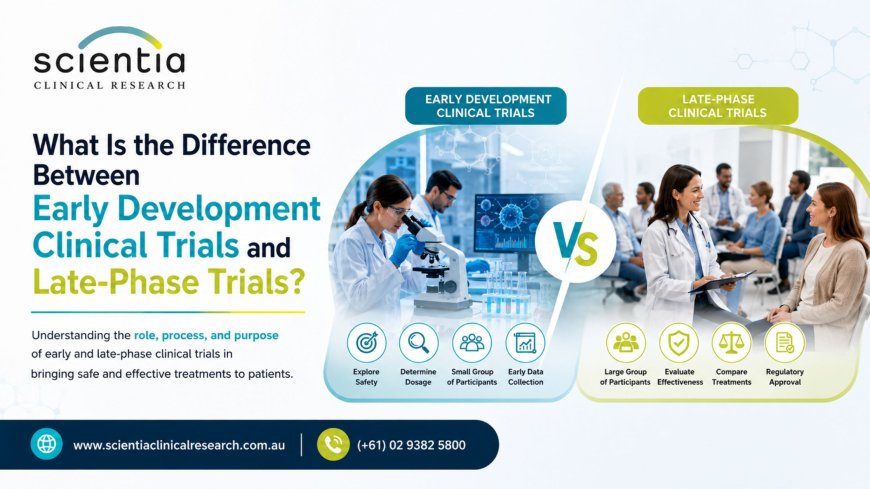
Introduction
Bringing a new medicine from the laboratory to patients is a long and carefully regulated process. Before a treatment can receive approval for widespread use, it must pass through several stages of clinical research designed to evaluate safety, effectiveness, dosage, and long-term outcomes.
One of the most common questions asked by sponsors, researchers, and trial participants is: What separates Early Development Clinical Trials from late-phase studies? Understanding these differences is essential because each stage plays a unique role in determining whether a new therapy can successfully reach the market.
At Scientia Clinical Research, these early-stage studies are a critical part of advancing medical innovation while ensuring participant safety and scientific integrity.
Understanding the Clinical Trial Journey
Clinical trials are typically divided into four main phases:
-
Phase I – Safety and dosage evaluation
-
Phase II – Initial efficacy assessment
-
Phase III – Large-scale confirmation of effectiveness
-
Phase IV – Post-market monitoring
Generally, Phase I and many Phase II studies are considered part of Early Phase Development, while Phase III and Phase IV studies are categorized as late-phase trials. Each phase answers different scientific and regulatory questions before a treatment becomes widely available.
What Are Early Development Clinical Trials?
Early Development Clinical Trials focus on determining whether a new treatment is safe for humans and understanding how it behaves in the body.
These studies often involve:
-
First-in-human testing
-
Safety and tolerability assessments
-
Dose escalation studies
-
Pharmacokinetic (PK) analysis
-
Pharmacodynamic (PD) analysis
-
Identification of potential side effects
Researchers closely monitor participants to understand how the investigational product is absorbed, distributed, metabolized, and eliminated. The primary goal is not to prove effectiveness but to establish a foundation for future research.
Key Objectives of Early Clinical Development
In the early stages of clinical development, researchers aim to fix issues like:
-
Is the treatment safe?
-
What dose should be used?
-
How does the body process the treatment?
-
Are there any immediate adverse effects?
-
Is there early evidence that the therapy may work?
Because these studies are exploratory, participant numbers are generally small, often ranging from 20 to 100 individuals.
What Are Late-Phase Clinical Trials?
Late-phase studies are conducted after sufficient safety information has been collected during earlier stages.
The purpose of these trials is to confirm that a treatment is effective and performs better—or at least as well as—existing therapies. These studies involve much larger participant populations and often take place across multiple research sites and countries.
Main Goals of Late-Phase Trials
Late-phase trials focus on:
-
Confirming clinical effectiveness
-
Comparing treatments against current standards of care
-
Identifying less common side effects
-
Evaluating long-term outcomes
-
Generating data required for regulatory approval
Phase III studies may enroll hundreds or even thousands of participants to provide robust evidence for regulatory authorities.
Early Development vs. Late-Phase Trials: Key Differences
1. Primary Objective
Early-stage studies
-
Focus on safety and dosage
-
Assess how the treatment behaves in the body
-
Identify initial side effects
Late-phase studies
-
Focus on effectiveness
-
Compare treatment outcomes
-
Support approval decisions
2. Number of Participants
Early studies
-
Typically involve 20–100 participants
Late-phase studies
-
Can involve hundreds to thousands of participants
Larger populations help researchers detect rare side effects and confirm treatment benefits across diverse patient groups.
3. Data Collection Focus
In Early Development Clinical Trials, data collection centers on:
-
Safety
-
Tolerability
-
Dose selection
-
Biological activity
Late-phase studies emphasize:
-
Clinical outcomes
-
Comparative effectiveness
-
Risk-benefit analysis
-
Long-term safety
4. Trial Complexity
Early-stage trials often require intensive monitoring, frequent blood sampling, and detailed pharmacological assessments.
Late-phase studies are generally larger and operationally more complex, involving multiple sites, broader patient populations, and extensive regulatory oversight.
5. Regulatory Impact
Early-stage research helps determine whether a treatment should continue development.
Late-phase trials provide the evidence regulators use when deciding whether a treatment can be approved for public use. Successful Phase III results often form the cornerstone of regulatory submissions.
Why Early-Stage Research Is So Important
Many new treatments never make it past the initial phases of research and development.This makes high-quality early-phase research essential for identifying the most promising treatments before larger investments are made.
Benefits of strong early-stage research include:
-
Improved participant safety
-
Better dose selection
-
Reduced development risks
-
Faster decision-making
-
More efficient progression to later phases
Without rigorous safety and dosage assessments, later-stage trials would face significantly greater uncertainty.
The Role of Scientia Clinical Research
As a leading clinical research organization, Scientia Clinical Research specializes in conducting high-quality studies that support the advancement of innovative therapies.
With experienced clinical teams, advanced research facilities, and a commitment to participant safety, Scientia helps sponsors navigate the complex requirements of both early and late-stage clinical development. From first-in-human studies to larger clinical programs, the organization contributes valuable expertise throughout the research journey.
Conclusion
Understanding the distinction between Early Development Clinical Trials and late-phase trials is essential for anyone involved in clinical research. Early-stage studies focus on safety, dosage, and biological activity, while later phases confirm effectiveness, evaluate long-term outcomes, and support regulatory approval.
Together, these phases create a structured pathway that helps ensure new therapies are both safe and effective before reaching patients. As innovation continues to transform healthcare, organizations such as Scientia Clinical Research play a vital role in advancing medical discoveries through every stage of clinical development.