Digital Twin Market Size, Growth, Latest Insights and Forecast 2026-2034
The digital twin market forecast indicates sustained and accelerating global expansion through 2034,
 torylanez27
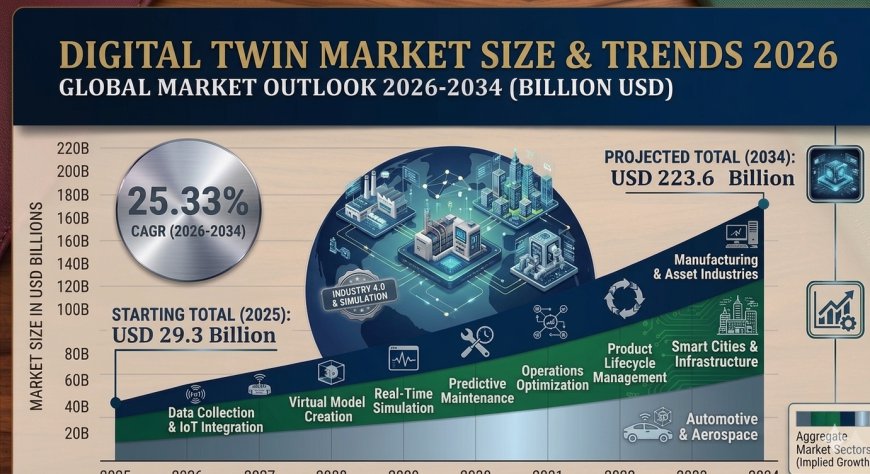
According to a research report by IMARC Group, the global digital twin market was valued at USD 29.3 Billion in 2025. The market is projected to reach USD 223.6 Billion by 2034, exhibiting a compound annual growth rate (CAGR) of 25.33% during 2026–2034. The market is driven by rapid Industry 4.0 adoption, surging demand for predictive maintenance, and the convergence of IoT, AI, and cloud computing.
Market at a Glance
|
Report Attribute |
Key Statistics |
|
Base Year |
2025 |
|
Forecast Years |
2026–2034 |
|
Historical Years |
2020–2025 |
|
Market Size in 2025 |
USD 29.3 Billion |
|
Market Forecast in 2034 |
USD 223.6 Billion |
|
Market Growth Rate (CAGR) |
25.33% |
|
Largest Region (2025) |
North America (34.6%) |
|
Fastest Growing Region |
Asia Pacific (~28% CAGR) |
Request for a Sample Report for Detailed Evaluation: https://www.imarcgroup.com/digital-twin-market/requestsample
Key Digital Twin Market Trends Driving Expansion
Industry 4.0 and Smart Manufacturing Surge
One of the biggest drivers for the growth in the digital twin market is the global adoption of Industry 4․0․ Manufacturing firms spent $102 billion on Industry 4․0 technology in 2021‚ or 20% of total spending on manufacturing technology․ Central to the development is the digital twin․ Applications of digital twins include real time shop floor monitoring‚ virtual commissioning and autonomous production optimization․ Digital twins are being deployed as part of zero-downtime and carbon-neutral factory initiatives․ They are particularly strong in global automotive‚ aerospace‚ semiconductor‚ and heavy industries․
Predictive Maintenance Demand
The cost of unplanned equipment shutdowns to industrial companies is USD 50 billion per year (2024)․ Digital twins enable condition-based maintenance through continuously comparing the asset's digital twin with real-time data from sensors to detect anomalies and anticipate equipment failures․ In predictive maintenance use cases‚ digital twins have been shown to limit unplanned outages by as much as 30%‚ leading to meaningful operational savings․ In the energy‚ utilities‚ transportation‚ and heavy manufacturing markets‚ this is the biggest driver of digital twin adoption globally․
5G and IIoT Proliferation
The spread of 5G and IIoT is helping bring real-time networking to the production of digital twins․ Global 5G connections passed the 2․7 billion mark in 2025‚ enabling ultra-low-latency twin synchronization at scale‚ a prerequisite for high-speed simulation environments․ More than 1․4 billion consumer and 13․3 billion enterprise IoT devices worldwide continuously generate streams of operational data to feed digital twin models‚ accurate virtual replicas of physical assets and systems․
Emergence of Generative AI-Powered Autonomous Twins
Generative AI is leading to self-evolving digital twins․ For example‚ the simulation model can self-update based on operational data flowing in․ In 2024‚ Microsoft integrated GPT-4 into its Azure cloud platform to considerably reduce the time required to retrain a model for industrial deployment․ This will have an outsized impact on aerospace and energy‚ where environments are rapidly changing․ Generative AI and digital twin platforms will create new opportunities across industries to automate decisions‚ optimize designs and gain new operational intelligence by responding to changes in real time․
Digital Twins of Organizations (DTO) and Smart Cities
Businesses and governments are working on digital twins of entire organizations‚ including supply chain‚ labor‚ financials‚ and even cities as interconnected digital systems‚ with over 1000 smart city programs continuing across the world․ Digital twin urban modeling is one of the highest value public sector applications․ Landmark system level deployments are Singapore's Virtual Singapore and the UK's National Digital Twin Programme which both cover the entire scale of cities or urban areas and enable data driven urban planning‚ emergency and infrastructure management․
Digital Twin Market Segmentation Analysis
By Type
Product Digital Twin, Process Digital Twin, System Digital Twin
Product digital twin holds the dominant position with a 46.5% market share in 2025, reflecting broad deployment in automotive, aerospace, and consumer electronics manufacturing for virtual product development and lifecycle management. These twins replicate individual physical products, enabling virtual testing, design iteration, and field performance monitoring from design through decommissioning.
By Technology
IoT and IIoT, AI and Machine Learning, Big Data Analytics, AR/VR/MR, 5G, Blockchain
IoT and IIoT technologies dominate with a 29.6% market share (2025) as the foundational data layer for all digital twin implementations. AI and Machine Learning follows at 24.8%, providing the cognitive layer that transforms sensor data into predictive insights. Big Data Analytics (18.4%) underpins the data management infrastructure critical to twin operation at enterprise scale.
By End Use
Manufacturing, Aerospace & Defense, Healthcare & Life Sciences, Energy & Utilities, Smart Cities, Automotive, Others
Manufacturing commands the largest end-use share, driven by the sector's scale of industrial asset deployment and its critical need for operational efficiency. Healthcare digital patient twins represent the fastest growing end-use segment, with a projected CAGR of approximately 34% through 2034, as personalized medicine, surgical simulation, and clinical trial acceleration become commercially viable applications.
By Region
North America, Asia Pacific, Europe, Middle East & Africa, Latin America
North America leads the global digital twin market with a 34.6% revenue share in 2025, supported by heavy U.S. federal investment in smart manufacturing under the CHIPS Act, including $285 million in federal funding announced in May 2024 for digital twin programs in the semiconductor industry. Asia Pacific follows as the most dynamic region with a projected CAGR of approximately 28%, driven by China's industrial digitization under 'Made in China 2025' and India's National Digital Twin initiative. Europe maintains a 22.6% share, underpinned by Germany's Industrie 4.0 framework and the EU Digital Compass 2030 policy agenda.
Connect for Detailed Segmentation Analysis - Speak to an Analyst: https://www.imarcgroup.com/request?type=report&id=4774&flag=C
Competitive Landscape in the Digital Twin Industry
The global digital twin market is moderately consolidated at the enterprise platform level. The top five vendors — Siemens, GE Vernova, Microsoft, IBM, and PTC — collectively command approximately 38–42% of global market revenues in 2025. Leading players are enhancing their product portfolios, adopting advanced AI and IoT technologies, and forging strategic partnerships with industrial clients to reinforce their competitive advantage. Platform breadth, AI integration depth, and vertical-specific expertise are the three primary competitive differentiators.
Key Digital Twin Market Players Include:
- Siemens AG (Siemens Xcelerator)
- GE Vernova
- Microsoft Corporation (Azure Digital Twins)
- IBM Corporation (IBM Maximo)
- Dassault Systèmes (3DEXPERIENCE)
- ANSYS Inc. / Synopsys (Ansys Twin Builder)
- ABB Ltd (ABB Ability)
- Accenture Plc
- AVEVA Group plc (Schneider Electric)
- PTC Inc. (ThingWorx)
Key Regional Insight: North America's Strategic Position
North America is the dominant and most mature digital twin market, sustained by a high-investment industrial technology culture, substantial federal funding, and a sophisticated enterprise cloud infrastructure. The United States, in particular, has seen significant federal commitment to digital twin programs — the Biden administration announced $285 million in funding in May 2024 to create a semiconductor-focused digital twin institute, signaling government recognition of twin technology as a strategic national asset.
The CHIPS Act's broader USD 52.7 billion funding envelope provides further tailwind for smart manufacturing twin deployments across semiconductor fabrication, defense manufacturing, and advanced materials production. Canada contributes incremental regional demand through digital twin adoption in oil sands operations and energy sector applications. Increasing platform sophistication, the growth of cloud-native twin architectures, and the integration of generative AI capabilities are further shaping North American purchasing behavior and investment priorities.
Market Drivers, Challenges & Opportunities
Major Market Drivers:
- Consistent rise in Industry 4.0 investments and smart manufacturing transformation programs globally
- Growing demand for predictive maintenance solutions to reduce unplanned equipment downtime costing approximately USD 50 billion annually
- Proliferation of 5G and IIoT connectivity enabling real-time digital twin synchronization at scale
- Convergence of AI, cloud computing, and advanced simulation platforms expanding digital twin capabilities
Key Challenges:
- High implementation complexity and cost — enterprise-wide deployments typically require USD 5–15 million in initial investment
- Data security and cybersecurity risks, with over 900 million cyberattacks recorded globally in 2025
- Skilled talent scarcity in data science and IoT engineering constraining implementation pace
- Regulatory and data sovereignty complexities under GDPR, PIPL, and emerging data localization laws
Emerging Opportunities:
- Healthcare digital patient twins growing at a CAGR of approximately 34% through 2034, enabling personalized medicine and clinical trial acceleration
- Smart city digital twin deployments across 1,000+ cities globally pursuing urban infrastructure digitization
- Integration of generative AI to enable autonomous, self-updating digital twin models
- Untapped growth potential in Asia Pacific and Middle East markets accelerating under national digitization programs
Conclusion: Digital Twin Market Outlook to 2034
The digital twin market forecast indicates sustained and accelerating global expansion through 2034, supported by Industry 4.0 manufacturing investments, the proliferation of IIoT and 5G infrastructure, and continued convergence of AI, cloud, and simulation technologies. As enterprises across manufacturing, healthcare, energy, and urban planning increasingly deploy digital twins to optimize operations and reduce costs, the market is transitioning from early-adopter deployments to mainstream enterprise adoption.
With North America leading the market and Asia Pacific emerging as the highest-growth region, the global digital twin market size and growth outlook remain strongly positive — positioning the industry for continued long-term expansion fuelled by national digitization agendas, AI integration, and the deepening commercial case for virtual-physical convergence across every major industry vertical.
About the Author:
IMARC Group is a leading global market research company providing data-driven insights and expert consulting services to businesses seeking to achieve their strategic objectives. With a multi-disciplinary team of industry experts, IMARC delivers thorough, reliable market intelligence across sectors including Technology, Construction, Healthcare, Energy, Food & Beverages, and more.
Media & Sales Contact:
IMARC Group
United States: +1-201-971-6302
India: +91-120-433-0800
United Kingdom: +44-753-714-6104