How Students Can Use AI Without Breaking University Rules
Learn how students can use AI responsibly in university coursework while following academic integrity rules and adapting to changing assessment policies.
 clairemiller069
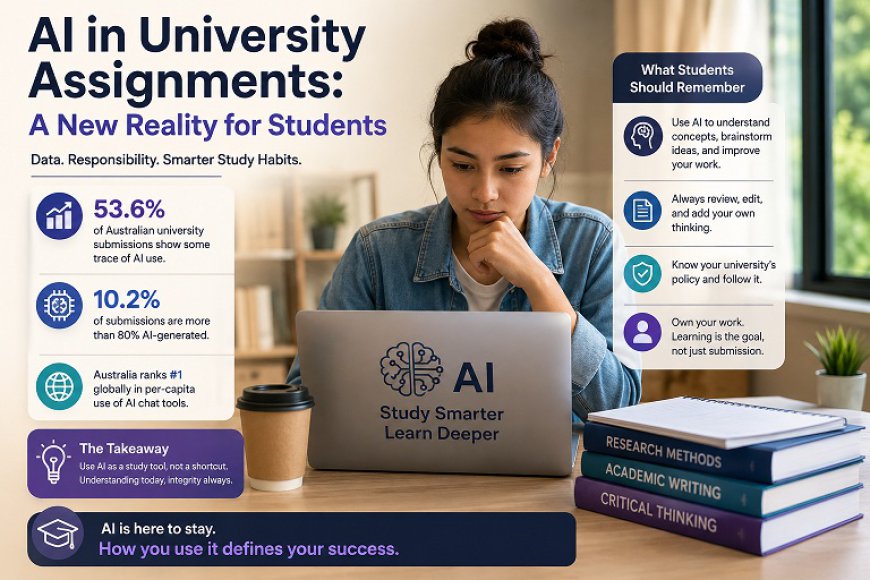
AI has become one of the most widely used study tools in higher education. Whether students need help understanding complex theories, organizing research, or improving grammar, AI offers instant assistance. Recent Turnitin data shows that 53.6% of Australian university submissions now include some detectable AI involvement, proving that AI is no longer a niche technology on campus.
The challenge isn't deciding whether to use AI. The real challenge is knowing how to use it in ways that support learning while staying within university rules.
Students who understand that distinction are far less likely to face academic integrity problems.
AI Should Assist Your Thinking, Not Replace It
The research emphasizes an important principle: AI works best when it supports the learning process instead of completing it.
For example, asking AI to explain a difficult accounting formula, summarize a research paper in simple language, or suggest possible essay structures helps students build their own understanding. Asking AI to produce an entire assignment that is submitted with only minor edits is an entirely different situation.
Think about using a calculator in mathematics. It can speed up calculations, but it cannot replace learning why the formula works. AI serves a similar purpose when used responsibly.
The goal should always be stronger understanding, not less effort.
Every University Has Different AI Expectations
One of the biggest sources of confusion is that universities have not adopted a single approach to AI.
According to the report, institutions generally fall into three categories. Some prohibit AI in assessed work altogether. Others allow limited AI assistance if students disclose how it was used. A growing number are redesigning assessments with the expectation that AI will naturally be part of the learning process.
This means students should never assume that what is acceptable in one course will automatically be allowed in another.
Reading assignment instructions carefully is now just as important as reading the marking rubric.
Small Habits Can Prevent Big Problems
The research highlights several practical habits that help students stay on the right side of university policies.
Saving multiple drafts, keeping research notes, and maintaining version history provide valuable evidence that an assignment reflects genuine personal effort. These records can become especially important if AI involvement is ever questioned.
Students should also use AI to review their own ideas instead of creating them from scratch. Asking questions like "How can I improve this paragraph?" or "What evidence is missing from my argument?" encourages learning while keeping ownership of the work.
When students need subject-specific explanations beyond what AI provides, resources like Expertsmind.com's subject expert network offer guided academic support that focuses on understanding concepts, solving problems, and building confidence rather than generating assignments to submit.
Universities Value Honesty More Than Hidden AI Use
Many students worry that mentioning AI will automatically reduce their marks. The research suggests the opposite may often be true.
Where universities permit AI, openly explaining how it contributed to the learning process is usually viewed more positively than attempting to hide its use. A simple disclosure about using AI for brainstorming, grammar suggestions, or idea organization demonstrates transparency and respect for academic policies.
As universities continue updating their AI guidelines, honest communication is becoming an increasingly valuable academic skill.
Responsible AI Use Will Benefit Students Long After Graduation
Artificial intelligence will continue to evolve, and future workplaces are likely to expect graduates to use AI effectively rather than avoid it completely.
Universities recognize this reality. That is why many are moving beyond simply detecting AI-generated content and instead teaching students how to integrate AI into research, writing, and problem-solving responsibly.
Students who learn to combine AI tools with critical thinking, independent analysis, and ethical decision-making will be better prepared not only for university assessments but also for professional careers where human judgment remains essential.
The technology may continue changing every year, but one principle remains constant: AI is most valuable when it helps students become better thinkers instead of replacing the thinking altogether.