Logistics Software Market Forecast 2034: Driving Global Supply Chain Efficiency through Digital Transformation
As global trade routes become more complex and consumer expectations for rapid delivery intensify, software solutions have shifted from being a back-office luxury to a critical operational necessity.
 monicascott9133
The global logistics landscape is undergoing a radical transformation as businesses transition from traditional supply chain models to digitally integrated ecosystems. By 2034, the logistics software market is projected to reach unprecedented heights, fueled by the demand for real time visibility, automated warehousing, and predictive analytics. As global trade routes become more complex and consumer expectations for rapid delivery intensify, software solutions have shifted from being a back-office luxury to a critical operational necessity.
Market Dynamics and Growth Drivers
The trajectory of the logistics software market Growth is defined by a consistent shift toward cloud-based infrastructures. Enterprises are moving away from on premise legacy systems in favor of Software as a Service (SaaS) models. This shift allows for greater scalability, lower upfront capital expenditure, and the ability to integrate disparate functions such as transportation management, warehouse operations, and last mile delivery into a single cohesive platform.
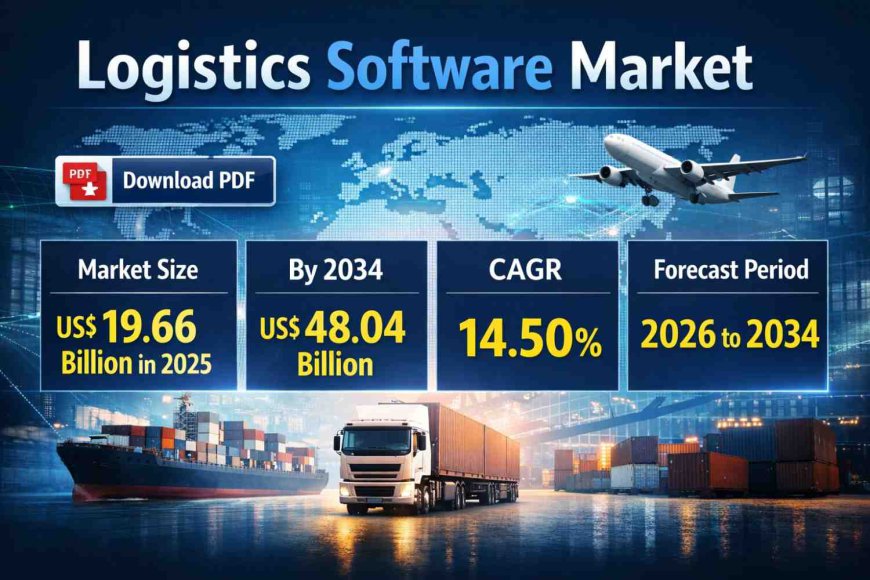
The global Logistics Software Market size is projected to reach US$ 48.04 billion by 2034 from US$ 19.66 billion in 2025. The market is anticipated to register a CAGR of 14.50% during the forecast period 2026–2034.
One of the primary catalysts for growth is the exponential rise of e commerce. With the democratization of global retail, even small to medium enterprises require sophisticated logistics software to manage cross border regulations, inventory tracking, and reverse logistics. The push for omnichannel distribution has forced companies to invest in software that can synchronize inventory across physical stores, warehouses, and online marketplaces in real time.
Key Market Trends Shaping 2034
Several transformative trends are expected to dominate the market landscape over the next decade.
1. Artificial Intelligence and Predictive Logistics
By 2034, AI will no longer be an experimental feature but the backbone of logistics software. Machine learning algorithms are now capable of analyzing historical data to predict demand surges, optimize routing to avoid traffic congestion, and suggest preemptive maintenance for fleet vehicles. This transition from reactive to proactive logistics significantly reduces operational waste and improves fuel efficiency.
2. Autonomous Operations and Robotics Integration
The integration of Warehouse Management Systems (WMS) with autonomous mobile robots (AMRs) is a major growth area. Software is evolving to orchestrate fleets of robots that handle picking, sorting, and packing with minimal human intervention. As labor shortages persist in various regions, the reliance on software driven automation is expected to surge.
3. Blockchain for Transparency and Security
Transparency is a major currency in modern logistics. Blockchain technology is being integrated into logistics software to create immutable records of transactions and movement. This is particularly vital for the pharmaceutical and food industries, where maintaining the integrity of the cold chain and verifying the provenance of goods is mandatory.
4. Sustainability and Green Logistics
Environmental regulations and corporate social responsibility goals are driving the adoption of "Green Logistics" software. Modern platforms now include modules to calculate carbon footprints, optimize loads to reduce the number of trips, and manage the transition to electric vehicle fleets. By 2034, sustainability metrics will be a standard KPI within any logistics software suite.
Download Sample PDF Report@ https://www.theinsightpartners.com/sample/TIPRE00015847
Market Segmentation and Regional Analysis
The market is generally segmented by software type, deployment mode, and end user industry. Transportation Management Systems (TMS) and Warehouse Management Systems (WMS) continue to hold the largest market shares. However, the Fleet Management and Data Analytics segments are witnessing the fastest Compound Annual Growth Rate (CAGR).
Geographically, North America and Europe remain dominant due to early adoption of advanced technologies and the presence of major software vendors. However, the Asia Pacific region is expected to experience the most significant growth through 2034. Rapid industrialization in countries like India, Vietnam, and Indonesia, coupled with massive investments in infrastructure, is creating a fertile ground for logistics software providers.
Top Players in the Logistics Software Market
The competitive landscape is characterized by a mix of established enterprise resource planning (ERP) giants and specialized logistics tech innovators. Key players leading the market include:
- SAP SE: A global leader providing comprehensive supply chain execution and EWM (Extended Warehouse Management) solutions.
- Oracle Corporation: Known for its robust Cloud SCM (Supply Chain Management) applications that offer end to end visibility.
- Blue Yonder (formerly JDA Software): A specialist in AI driven supply chain management and retail planning.
- Manhattan Associates: A frontrunner in warehouse management and omni channel commerce.
- Körber AG: Providing advanced technologies for warehouse automation and software integration.
- Descates Systems Group: Focused on logistics and supply chain connectivity through its Global Logistics Network.
- WiseTech Global: A leading provider of software solutions to the logistics execution industry globally through its CargoWise platform.
These organizations are focusing on strategic acquisitions and heavy R&D investment to ensure their platforms can handle the data loads of the future.
Strategic Growth Analysis
To remain competitive by 2034, software providers are focusing on "Hyper Orchestration." This involves the ability to manage not just a company's internal assets but also those of third party logistics (3PL) providers and fourth party logistics (4PL) partners. The goal is a "Glass Pipeline" where every stakeholder has access to the same data point at the same time.
Furthermore, the rise of the Internet of Things (IoT) is providing a massive influx of data. Future logistics software will need to process billions of data points from sensors on pallets, containers, and vehicles. The ability to turn this "Big Data" into actionable insights will be the primary differentiator between market leaders and laggards.
Future Outlook
Looking toward 2034, the logistics software market is set to become the central nervous system of global commerce. We will see a shift toward completely autonomous supply chains where software not only suggests actions but executes them independently based on pre set parameters. The boundary between physical movement and digital management will continue to blur. As 5G and eventually 6G networks become ubiquitous, the latency in data transmission will vanish, allowing for truly instantaneous global coordination.
The Insight Partners provides comprehensive syndicated and tailored market research services in the healthcare, technology, and industrial domains. Renowned for delivering strategic intelligence and practical insights, the firm empowers businesses to remain competitive in ever-evolving global markets.
• Email: sales@theinsightpartners.com
• Website: theinsightpartners.com
• Phone: +1-646-491-9876