Office Furniture Market Size 2026: Share, Industry Trends and Forecast to 2034
The office furniture market is expected to reach USD 90.0 Billion by 2034, exhibiting a CAGR of 3.19% from 2026-2034.
 torylanez27
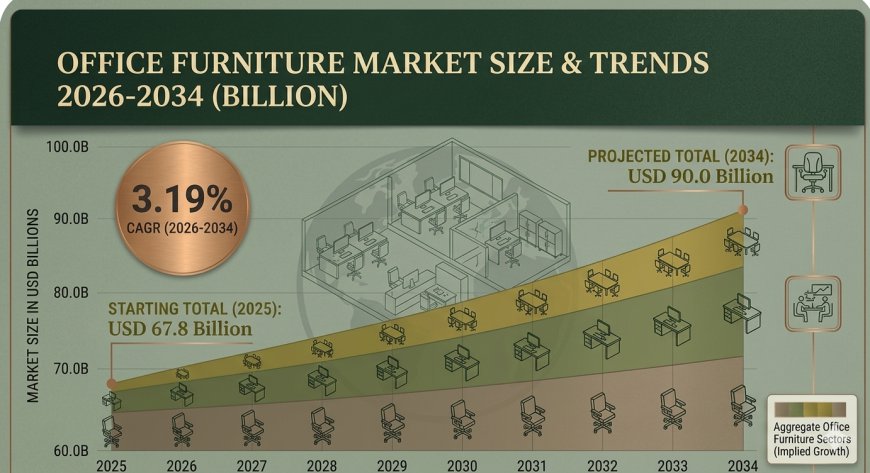
According to a research report by IMARC Group, the global office furniture market size was valued at USD 67.8 Billion in 2025. The market is projected to reach USD 90.0 Billion by 2034, exhibiting a growth rate (CAGR) of 3.19% during 2026–2034. The market is primarily driven by the growing emphasis on employee comfort and productivity, the rise of hybrid and remote work models, increasing corporate expansion, and the emergence of co-working spaces worldwide.
Market at a Glance
|
Report Attribute |
Key Statistics |
|
Base Year |
2025 |
|
Forecast Years |
2026–2034 |
|
Historical Years |
2020–2025 |
|
Market Size in 2025 |
USD 67.8 Billion |
|
Market Forecast in 2034 |
USD 90.0 Billion |
|
Market Growth Rate (CAGR) |
3.19% |
Key Office Furniture Market Trends Driving Expansion
Increase in Corporate Expansion and Entrepreneurship
Increasing globalization and the expansion of companies and entrepreneurs have also fueled the growth of the market worldwide․ The U․S․ is home to over 75‚600 startups‚ the largest measured startup ecosystem in the world․ New startups keep springing up daily‚ and in this‚ equipped offices play a fundamental role․ Ergonomic office furniture improves workplace productivity and creativity․ Musculoskeletal disorder-related conditions are reduced by up to 72% with an ergonomically optimized office to improve employee health and productivity․ Companies like Herman Miller continue to release products that are suitable for today's office environment‚ including the Passport Worktable‚ a compact height-adjustable mobile desk for home and hybrid workplaces․
Rising Emphasis on Employee Well-being and Ergonomics
In contemporary work settings‚ the total physical health of the employee and the role ergonomic furniture can play in preventing pain and health problems related to prolonged sitting are increasingly stressed․ Employers are making use of mobile seating‚ sit/stand workstations and other ergonomics-related practices․ The share of the world population working from home rose from 20 per cent in 2020 to 28 per cent in 2023․ Germany has been an early mover in the production of sustainable ergonomic office furniture‚ high-quality swivel chairs and communication zone furniture that also foster healthy forms of sitting․
Growing Environmental Awareness and Sustainability
An increasing priority in the office furniture marketplace is sustainable design‚ reflected in furniture constructed from recycled materials‚ such as reclaimed wood‚ bamboo‚ and recycled metal‚ and sustainable manufacturing processes․ IBM has found that 80% of North American customers want information about where products come from‚ and that 69% are willing to pay more for recycled products․ Therefore manufacturers are producing green products to satisfy the global agenda of sustainability and also to satisfy consumers who are aware of their social impact.
Digital Transformation in Sales and Distribution
Digital transformation has affected the marketing‚ sales and distribution of office furniture․ The rise of e-commerce has allowed for direct access to potential customers as well as an improved shopping experience․ In 2024‚ global e-commerce sales were 26․8 Trillion USD and they are forecast to grow to 214․5 Trillion USD by 2033․ Companies such as Durham Furniture Inc․ are using 3D technologies to create better e-commerce and in-store shopping experiences with tools to visualize e-commerce products and configure spatial environments․
Office Furniture Market Segmentation Analysis
By Product Type
- Seating Furniture
- Modular Systems
Seating leads the market with 35.3% market share in 2025 - driven by the demand for chairs, stools, and ergonomic solutions designed to provide comfort and support for extended work periods. Ergonomically designed seating that adjusts to individual needs continues to dominate this segment.
By Material Type
- Wood
- Metal
- Plastic and Fiber
- Glass
- Others
Wood leads the market with 53.2% market share in 2025 - valued for its natural aesthetic, durability, and availability in various forms including hardwood and softwood. The increasing use of wood-based panels for commercial building interiors is further fueling this segment's dominance.
By Distribution Channel
- Direct Sales
- Specialist Store
- Non-Specialist Stores
- Online
- Others
Direct sales leads the market with 42.1% market share in 2025 - allowing manufacturers to sell directly to customers through on-site showrooms or sales representatives, enabling greater customization and cost benefits without intermediaries.
By Price Range
- Low
- Medium
- High
Low price range leads the market with 44.8% market share in 2025 - driven by demand from budget-conscious buyers and businesses seeking temporary or cost-effective office furniture solutions made from plastic or budget-friendly wood composites.
By Region
- North America
- Europe
- Asia Pacific
- Latin America
- Middle East and Africa
Asia Pacific leads the market with the largest share of 36.5% in 2025 - fueled by increasing construction of commercial zones and IT parks, the growing number of fashion brands with online presence, and a rising focus on aesthetically pleasing and environmentally friendly office furniture. E-commerce platforms like Alibaba and Lazada have further expanded regional access to diverse furniture products.
Key Regional Insight: Asia Pacific's Strategic Position
Asia Pacific is the dominant region in the global office furniture market, accounting for over 36% of total market share in 2025. The region's growth is propelled by rapid commercial real estate development, rising IT sector investments, and a growing culture of entrepreneurship. E-commerce marketplaces such as Alibaba and Lazada are providing consumers with unprecedented access to diverse office furniture options. Increasing government investments in smart city infrastructure across countries like China, India, and Japan are further supporting long-term market expansion in the region.
Competitive Landscape in the Office Furniture Industry
The global market for office furniture is led by multinational companies and regional office furniture suppliers‚ with innovators launching smart electric height adjustable desks‚ built-in charging areas‚ and tracking software to monitor health․ Smart chairs with sensors are also being developed‚ which track posture and give real-time feedback․ Companies also make multi-functional furniture from eco-friendly materials‚ such as reclaimed wood‚ bamboo and seagrasses to lower carbon footprint and appeal to an environmentally conscious consumer base․ Augmented reality and 3D printing technology are used to supply customized‚ aesthetically pleasing and functional furniture․
Key Office Furniture Market Players Include:
- Herman Miller (MillerKnoll)
- Steelcase Inc.
- HNI Corporation
- Haworth Inc.
- Kimball International
- Knoll Inc.
- IKEA
- Bene AG
Market Drivers, Challenges & Opportunities
Major Market Drivers:
- Growing number of corporate offices, co-working spaces, and startups globally.
- Rising demand for ergonomic furniture to boost employee health and productivity.
- Rapid adoption of hybrid and remote work models driving home office furniture demand.
- Sustainability trends pushing demand for eco-friendly and recyclable materials.
Key Challenges:
- High upfront costs of premium ergonomic and smart furniture limiting adoption among SMEs.
- Supply chain disruptions impacting raw material availability and production timelines.
Emerging Opportunities:
- Smart furniture innovations integrating IoT, sensors, and mobile connectivity.
- Growing co-working space ecosystem creating sustained demand for modular furniture.
- Rising e-commerce and AR tools enabling personalized furniture purchase experiences.
- Government green manufacturing subsidies incentivizing sustainable product development.
Conclusion: Office Furniture Market Outlook to 2034
The office furniture market forecast indicates sustained global expansion through 2034, supported by ergonomic innovation, growing corporate investment in workplace design, and the rapid rise of hybrid working models. As organizations increasingly prioritize employee well-being, environmental responsibility, and technological integration, manufacturers are adapting through smart product development and sustainable material sourcing.
With Asia Pacific driving volume growth and mature markets in North America and Europe investing in premium and eco-friendly segments, the global office furniture market size and growth outlook remain strongly positive — positioning the industry for continued long-term expansion worldwide.
About Author:
IMARC Group is a leading global market research company providing data-driven insights and expert consulting services to businesses seeking to achieve their strategic objectives. With a multi-disciplinary team of industry experts, IMARC delivers thorough, reliable market intelligence across sectors including Energy, Chemicals and Materials, Construction and Manufacturing, Healthcare, Technology and Media, and more.
Media & Sales Contact:
IMARC Group
United States: +1-201-971-6302
India: +91-120-433-0800
United Kingdom: +44-753-714-6104