Orthopedic 3D Scanners Market Size, Share, Future Trends, Industry Analysis 2026–2034
The Orthopedic 3D Scanners Market is anticipated to expand at a CAGR of 21.4% from 2026 to 2034.
 Dipaksharma
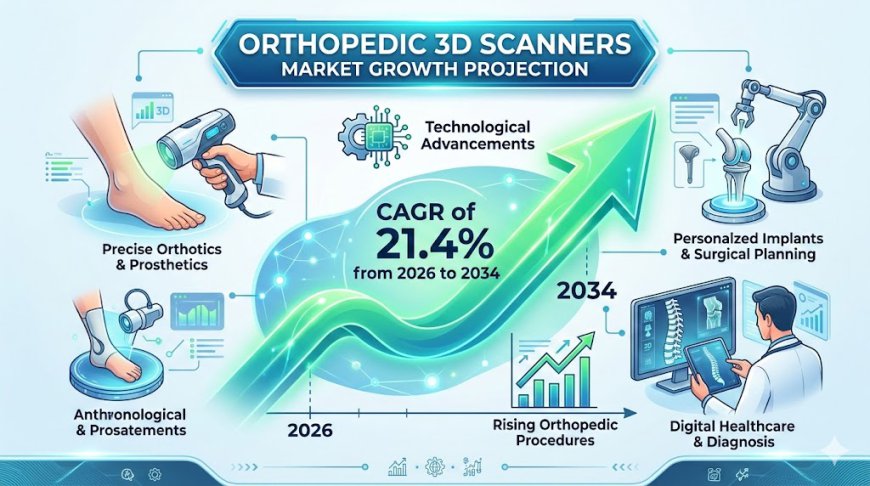
The Orthopedic 3D Scanners offer a modern approach to analyzing skeletal structures with speed and precision. These systems assist clinicians in improving diagnostic accuracy and optimizing treatment outcomes.
Orthopedic 3D Scanners Market Overview
The Orthopedic 3D Scanners Market is anticipated to expand at a CAGR of 21.4% from 2026 to 2034, indicating strong growth potential over the coming years. Increasing adoption of digital technologies in healthcare is transforming the way orthopedic procedures are planned and executed. Orthopedic 3D scanners enable medical professionals to capture precise anatomical structures and convert them into detailed digital models. These models help surgeons improve surgical planning, enhance treatment accuracy, and develop patient specific medical solutions.
Healthcare organizations are gradually integrating advanced imaging technologies into clinical workflows. As a result, orthopedic 3D scanners are becoming essential tools in hospitals, orthopedic clinics, and specialized medical centers. The growing need for improved surgical outcomes and faster diagnostic procedures is further contributing to the adoption of these systems across the healthcare sector.
Segmentation Analysis
The industry is segmented based on type and application, which helps stakeholders understand the diverse usage of orthopedic scanning technologies.
By type, the market includes scanning systems, accessories, and consumables. Scanning systems represent the primary equipment used to capture three dimensional anatomical data with high accuracy. Accessories and consumables support the operational efficiency of these systems and ensure consistent imaging performance.
By application, the market covers orthopedic, spine, ENT, cosmetic, maxillofacial, dental, neurological, and other healthcare segments. Orthopedic and spine applications account for a significant share due to the increasing number of surgeries and the demand for precise anatomical visualization during treatment planning.
Orthopedic 3D Scanners Market Growth, Demand, Drivers, Analysis
Several important factors are contributing to the rapid growth of the orthopedic 3D scanners industry.
One of the major drivers is the rising incidence of orthopedic surgeries. Procedures such as joint replacements, fracture repairs, and spinal surgeries require highly accurate imaging for better surgical planning. Three dimensional scanning technologies provide detailed visualization of bones and tissues, which helps surgeons perform complex procedures with improved accuracy.
Another important driver is the aging global population. Older individuals are more prone to musculoskeletal disorders such as osteoarthritis, osteoporosis, and spinal degeneration. As the number of elderly patients increases worldwide, the demand for advanced diagnostic and imaging technologies continues to rise.
The growing demand for customized medical solutions also supports market expansion. Orthopedic 3D scanners allow healthcare providers to design personalized orthotics and prosthetics that match the exact anatomical structure of each patient. This customization improves patient comfort, enhances treatment effectiveness, and supports better rehabilitation outcomes.
Emerging Market Trends
Technological advancements continue to shape the evolution of orthopedic scanning technologies. Improvements in scanning accuracy, speed, and software integration are making these devices more efficient and accessible for healthcare providers.
Portable scanners and advanced imaging software are expanding the scope of orthopedic applications. Healthcare professionals can now capture high quality scans quickly and integrate the data with digital modeling tools. This enhances surgical planning and allows medical teams to simulate procedures before actual surgery.
Another major trend is the increasing adoption of three dimensional imaging for diagnosis and treatment planning. Three dimensional visualization provides detailed insight into complex anatomical structures, enabling surgeons to make more informed clinical decisions. As awareness of these benefits grows among healthcare providers, the adoption of orthopedic 3D scanning technologies is expected to accelerate.
Download Sample PDF @ https://www.theinsightpartners.com/sample/TIPRE00017457
Market Opportunities
-
Increasing demand for customized orthotics and prosthetic devices
-
Growing adoption of digital scanning in orthopedic clinics and hospitals
-
Rising investment in research and development for advanced medical imaging
-
Integration of 3D scanning with computer aided design technologies
-
Expansion of healthcare infrastructure in emerging economies
-
Growing use of digital modeling and rapid prototyping for medical devices
Regional Insights
From a regional perspective, Asia Pacific is expected to witness the highest growth during the forecast period. Rapid improvements in healthcare infrastructure, growing medical tourism, and increasing awareness of advanced diagnostic technologies are driving regional adoption.
Countries such as China, India, and Japan are investing heavily in healthcare modernization and digital medical technologies. In addition, the growing number of orthopedic procedures and rising healthcare expenditure in these countries are creating favorable conditions for industry expansion.
Key Players in the Orthopedic 3D Scanners Market
Several companies are actively contributing to technological innovation and product development in this industry.
-
Delcam Plc
-
Allied OSI Labs
-
SCANNY3D S.r.l.
-
AGE Solutions S.r.l.
-
Orthopaedic Innovation Centre
-
Diasu Health Technologies
-
Europrotesica
-
Willow Wood
-
Mile High Orthotics Labs
-
Vorum
These companies are focusing on product innovation, partnerships, and technological development to strengthen their competitive position and expand their global presence.
Future Outlook
The future outlook for the orthopedic 3D scanners industry remains highly positive. Increasing emphasis on personalized healthcare solutions and precision medicine will continue to drive demand for advanced scanning technologies. Continuous improvements in imaging accuracy, software integration, and digital modeling capabilities are expected to enhance the overall performance of these systems.
Moreover, increasing investments in research and development and the integration of artificial intelligence with imaging technologies may further transform orthopedic treatment planning. As healthcare providers continue to adopt digital medical technologies, orthopedic 3D scanners are expected to play a critical role in improving diagnostic accuracy, surgical outcomes, and patient specific care in the years ahead.
Browse Trending Reports:
Bone Replacements Devices Market
About Us -
The Insight Partners provides comprehensive syndicated and tailored market research services in the healthcare, technology, and industrial domains. Renowned for delivering strategic intelligence and practical insights, the firm empowers businesses to remain competitive in ever-evolving global markets.
Contact Information -
Email: sales@theinsightpartners.com
Phone: +1-646-491-9876
Also Available in : Korean| German| Japanese| French| Chinese| Italian| Spanish