How Retrieval-Augmented Generation (RAG) Is Powering the Next Generation of AI Companion Platforms
Why memory-aware AI systems, scalable vector databases, and personalized retrieval pipelines are becoming essential for AI companion startups in 2026
 tripleminds
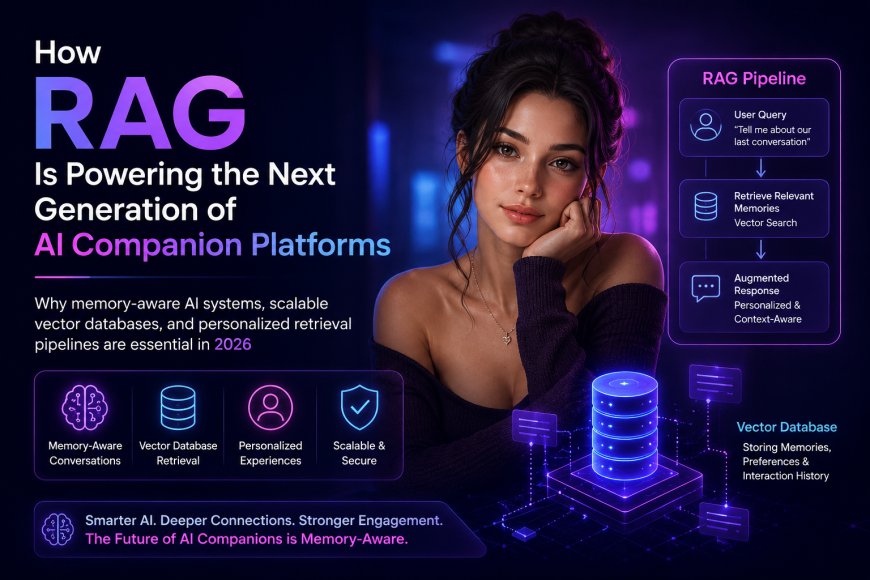
The AI companion industry is becoming significantly more advanced in 2026, and one of the biggest technologies shaping this evolution is Retrieval-Augmented Generation (RAG).
Earlier AI companion systems relied heavily on stateless conversational models that generated responses based primarily on temporary context windows. While these systems could simulate interaction reasonably well, they often struggled with long-term continuity, personalization, and memory persistence.
Modern AI companion platforms are increasingly solving this challenge through RAG-based architectures.
Retrieval-Augmented Generation allows AI systems to retrieve contextual memory, user history, preferences, and interaction patterns dynamically before generating responses. This enables AI companions to maintain stronger continuity, deeper personalization, and more consistent engagement over time.
As the AI girlfriend app market size continues expanding globally, retention and personalization are becoming increasingly important competitive factors. Startups are discovering that memory-aware AI systems often create significantly better engagement outcomes than generic conversational models alone.
At the same time, deployment-ready infrastructure such as the Candy AI Clone solution is helping startups integrate scalable conversational memory systems without building every component independently.
The result is a major shift toward AI ecosystems powered by persistent memory, retrieval systems, and highly personalized interaction pipelines.
What Is Retrieval-Augmented Generation (RAG)?
Retrieval-Augmented Generation is an AI architecture that combines language generation with external knowledge retrieval.
Instead of relying entirely on a model’s immediate context window, RAG systems retrieve relevant information from external data sources before generating responses.
These external knowledge sources may include:
- vector databases
- user interaction history
- conversational memory systems
- structured knowledge repositories
- behavioral preference datasets
The retrieved information is then injected into the AI generation pipeline, allowing the model to produce more context-aware and personalized responses.
Within AI companion platforms, this technology is becoming increasingly important because users expect interactions that feel persistent and emotionally continuous.
Why Traditional AI Chat Systems Struggle With Continuity
Standard conversational AI systems often face limitations related to:
- short memory windows
- inconsistent personalization
- context loss across sessions
- repetitive interaction patterns
Without persistent retrieval systems, AI companions may forget important details about users between conversations.
This weakens emotional continuity and reduces long-term engagement quality.
As AI companion platforms become more competitive, users increasingly expect AI systems capable of:
- remembering preferences
- maintaining interaction continuity
- adapting conversational behavior
- evolving over time
This is one reason why RAG-based architectures are rapidly becoming foundational within modern AI companion ecosystems.
Why RAG Improves Retention
Retention has become one of the most important metrics within the AI companion industry.
Many startups can acquire users through marketing campaigns, but long-term growth depends heavily on whether users continue engaging consistently over time.
RAG systems improve retention because they allow AI companions to create:
- stronger conversational continuity
- more personalized interaction
- evolving relationship dynamics
- context-aware responses
This deeper personalization increases emotional engagement significantly.
The expanding AI girlfriend app market size reflects how strongly users are responding to AI systems capable of maintaining personalized interaction continuity across long-term engagement.
Vector Databases Are Becoming Core Infrastructure
One of the most important components powering RAG systems is vector databases.
Vector databases allow AI platforms to store and retrieve conversational memory efficiently using semantic similarity search.
Modern AI companion ecosystems increasingly rely on vector databases for:
- long-term memory retrieval
- personality adaptation
- contextual conversation continuity
- preference tracking
- interaction history indexing
As AI companion platforms scale, vector search infrastructure becomes essential for maintaining personalized experiences across millions of interactions.
Without scalable retrieval systems, personalization quality often declines rapidly as user activity grows.
AI Companion Platforms Are Becoming Memory-Aware Systems
Earlier AI companion products functioned more like temporary chat interfaces.
Modern platforms are evolving into memory-aware AI ecosystems capable of maintaining persistent user interaction histories.
This shift allows AI companions to:
- recall previous conversations
- maintain emotional consistency
- personalize engagement dynamically
- adapt behavior over time
The stronger the memory layer becomes, the more immersive the AI experience feels.
Many startups now view conversational memory infrastructure as one of the most important components influencing user retention and monetization.
AI-Generated Media Is Expanding Through Contextual Retrieval
RAG systems are also influencing AI-generated media workflows.
Modern AI companion platforms increasingly integrate:
- AI-generated avatars
- contextual image generation
- dynamic visual personalization
- multimedia interaction pipelines
Many platforms use systems powered by an NSFW image generation API to generate personalized visual content dynamically using contextual retrieval.
For example, retrieval systems may influence:
- visual style preferences
- interaction history continuity
- character consistency
- personalized media generation prompts
This creates significantly more immersive and context-aware multimedia experiences.
Why White-Label Infrastructure Is Accelerating RAG Adoption
Building scalable RAG infrastructure independently remains technically demanding.
Modern RAG-powered AI companion systems require:
- vector database infrastructure
- retrieval orchestration pipelines
- scalable AI inference systems
- conversational memory indexing
- cloud scaling architecture
- subscription monetization systems
Developing these systems internally can dramatically increase both infrastructure costs and deployment timelines.
This is one reason many startups are increasingly using the Candy AI Clone to accelerate deployment while integrating scalable conversational infrastructure.
White-label systems allow businesses to focus more heavily on:
- personalization optimization
- engagement strategy
- retention growth
- monetization scaling
instead of backend infrastructure engineering.
Monetization Is Becoming Personalization-Driven
As AI companion systems become more memory-aware, monetization strategies are evolving as well.
Modern AI companion platforms increasingly use personalization to support:
- premium AI experiences
- exclusive interaction tiers
- enhanced memory features
- advanced personalization layers
- contextual multimedia access
Many startups are integrating scalable payment infrastructure and monetization strategies directly into deployment architecture to support retention-focused recurring revenue systems.
This approach helps platforms:
- improve subscription conversion
- increase customer lifetime value
- strengthen recurring engagement
- reduce monetization friction
Personalization and monetization are becoming increasingly interconnected within the AI companion ecosystem.
Scalability Challenges in RAG-Based AI Systems
As conversational memory systems grow larger, scalability becomes increasingly important.
RAG-powered AI ecosystems must support:
- large vector database indexing
- real-time retrieval pipelines
- low-latency conversational generation
- persistent personalization systems
- high concurrent interaction volumes
Without optimized retrieval infrastructure, response quality and platform responsiveness may decline significantly during growth phases.
This is why scalable backend architecture is becoming one of the most important operational priorities for AI companion startups.
Why Investors Are Paying Attention to Memory-Aware AI
Investor interest in AI companion platforms is increasingly focused on personalization depth and retention quality rather than chatbot novelty alone.
Several factors make RAG-powered AI ecosystems commercially attractive:
- stronger user retention
- deeper personalization
- recurring monetization opportunities
- scalable engagement systems
- long-term interaction continuity
Businesses capable of maintaining persistent conversational relationships often achieve stronger monetization predictability and improved subscription stability.
As a result, memory-aware AI infrastructure is becoming one of the most strategically valuable components within the industry.
The Future of RAG-Powered AI Companion Platforms
Several emerging trends are expected to shape the future of memory-aware AI ecosystems.
Persistent Long-Term AI Memory
Future systems will likely maintain increasingly sophisticated interaction histories.
Emotion-Aware Retrieval Systems
AI models may dynamically retrieve emotional context to improve conversational continuity.
Multimodal Retrieval Pipelines
Future systems may combine text, voice, image, and behavioral retrieval simultaneously.
Cross-Platform AI Identity
AI companions may eventually maintain persistent personalities across multiple applications and devices.
These innovations are expected to make AI companion ecosystems significantly more immersive and retention-focused.
Conclusion
Retrieval-Augmented Generation is rapidly becoming one of the foundational technologies shaping the future of AI companion platforms in 2026.
By combining scalable memory systems, vector retrieval infrastructure, and personalized conversational generation, RAG architectures are helping AI companion startups create deeper engagement and stronger retention.
The growing AI girlfriend app market size reflects increasing demand for personalized AI ecosystems capable of sustaining long-term interaction continuity.
At the same time, deployment-ready systems such as the Candy AI Clone solution are helping startups accelerate infrastructure deployment while reducing technical complexity.
Combined with scalable payment infrastructure and monetization strategies, these technologies are enabling businesses to build highly personalized recurring-revenue AI ecosystems powered by persistent conversational intelligence.
As AI technology continues evolving, memory-aware retrieval systems are likely to become one of the defining infrastructure layers behind the next generation of AI companion platforms.