Turnstile Speed Gates for Healthcare Facilities in Qatar
 TekYousuf26
Turnstile Speed Gates are rapidly becoming the access control standard of choice for hospitals, medical cities, and healthcare campuses across Qatar and the wider Gulf Cooperation Council. Modern healthcare facilities demand an access infrastructure that simultaneously secures restricted clinical zones, manages the high throughput of patients, visitors, staff, and contractors, and satisfies the stringent infection control and dignified patient experience standards that define world-class healthcare delivery in the GCC.
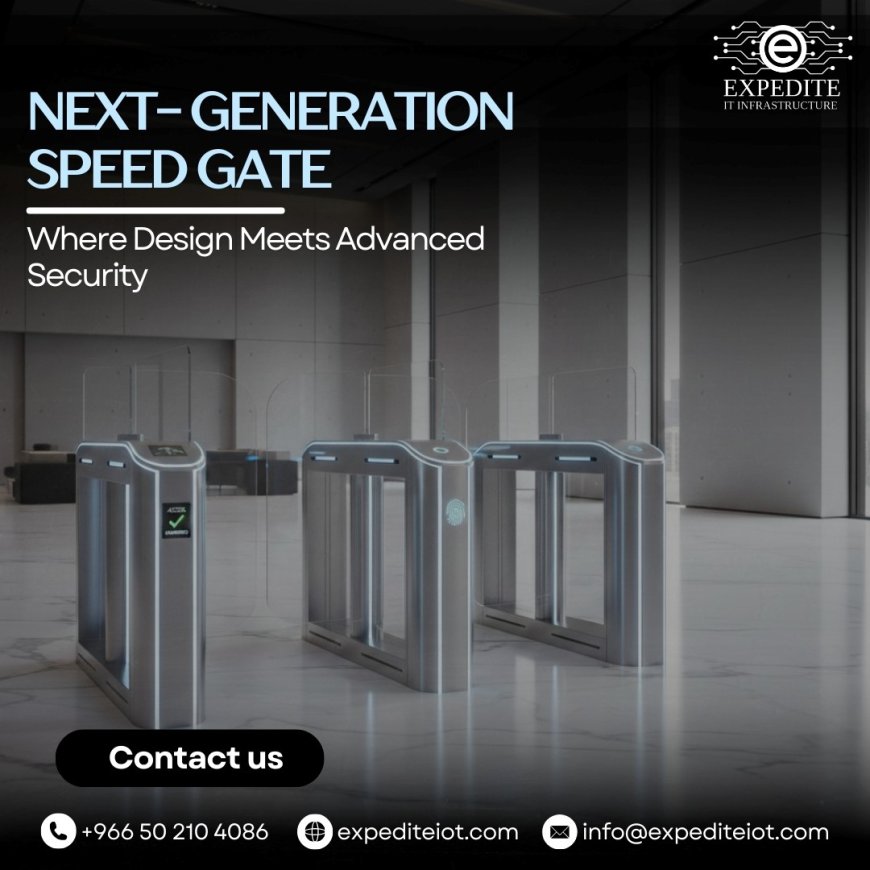
Qatar's healthcare sector is undergoing its most ambitious expansion in history. Sidra Medicine, Hamad Medical Corporation's cluster of specialist hospitals in Al Rayyan and Doha, the Qatar National Cancer Centre, and the rapidly growing private hospital sector anchored by Aster, Aspetar, and Al Ahli Hospital together represent a healthcare infrastructure investment exceeding QAR 30 billion. Each of these facilities manages thousands of daily access events across multiple zones — emergency departments, intensive care units, operating theatre suites, pharmacy dispensaries, radiology departments, and administrative floors — all with distinct access restriction requirements that a single, intelligent turnstile access architecture must accommodate.
Expedite IoT's smart turnstile access control solutions for Qatar and the GCC are engineered specifically for the demanding operational, regulatory, and cultural context of Gulf healthcare environments — delivering security, throughput efficiency, and patient dignity in one cohesive platform.
1. Why Healthcare Facilities in Qatar Need Intelligent Turnstile Access Control
Healthcare environments present a uniquely complex access control challenge. Unlike a corporate office or a government building, a hospital simultaneously serves as a place of emergency medical response — where unrestricted access for clinical staff is life-critical — and a facility housing some of the most vulnerable members of society, requiring strict control over who can enter patient care zones and when. Turnstile Access Control resolves this dual requirement by enforcing zone-specific access policies at each entry point, ensuring that only credentialed staff, authorised visitors, and scheduled patients can enter restricted areas — while allowing emergency override for clinical personnel responding to critical events.
The specific access control challenges that Qatar healthcare facilities face include:
- Managing the daily inflow of thousands of patients, registered visitors, medical staff, pharmaceutical representatives, equipment technicians, and accreditation inspectors across a single campus with multiple buildings and dozens of controlled access points
- Enforcing zone-specific restrictions — preventing unauthorised access to ICU, neonatal, operating theatre, and pharmacy zones while maintaining smooth patient flow in public areas such as outpatient clinics, imaging centres, and diagnostic laboratories
- Infection control compliance — eliminating hand-contact surfaces at entry points in post-COVID healthcare design standards, where touchless access validation is a patient safety requirement as much as a security feature
- Qatar Ministry of Public Health (MOPH) and Joint Commission International (JCI) accreditation requirements, which mandate documented access control policies, audit-ready access event logs, and defined emergency evacuation protocols for all accredited healthcare facilities
- Cultural sensitivity — ensuring that access control hardware and visitor management workflows respect patient privacy, gender-segregated access requirements where applicable, and the dignified experience expected by Qatar's diverse patient population
2. Turnstile Gate Types: Matching Technology to Healthcare Zones
The right turnstile configuration for a healthcare facility depends on the specific access zone, throughput requirement, user population, and security level. Expedite IoT deploys the full range of turnstile form factors, each optimised for distinct healthcare access points:
Tripod Turnstile Gates — Staff and Contractor Entry Points
Tripod Turnstile Gates are robust, space-efficient rotating arm barriers ideal for secondary staff entry points, service delivery bays, and contractor access zones where physical deterrence and credential verification are the primary requirements and design aesthetics are secondary. Their three-arm rotating mechanism provides reliable, one-person-at-a-time passage control with low maintenance requirements — well-suited to the high-cycle environments of busy hospital staff entrances processing hundreds of personnel per shift change.
Swing Barrier Turnstile Gates — Wheelchair and Trolley Access
Swing Barrier Turnstile Gates are the preferred configuration for healthcare main entrances and outpatient department access points where the user population includes wheelchair users, patients with mobility aids, clinical staff transporting IV drip stands, and porters moving patient trolleys and medical equipment carts. The wide-lane swing barrier design — with clear passage widths of up to 1,200mm — accommodates all mobility formats without requiring a separate accessible bypass lane, maintaining access control integrity while delivering the inclusive, dignified entry experience that healthcare facility design standards demand.
Full Height Turnstile Gates — High-Security Perimeter Control
Full Height Turnstile Gates provide the highest physical security level of any turnstile configuration, with floor-to-ceiling rotating barriers that cannot be climbed over, ducked under, or passed through by a tailgating individual following an authorised user. In the healthcare context, this configuration is appropriate for pharmaceutical dispensary perimeters, hospital pharmacy storage areas, blood bank access points, and research laboratory entrances — zones where the combination of high-value pharmaceutical inventory and the sensitivity of biological materials creates a requirement for absolute physical access control that the other turnstile configurations cannot match.
Flap Barrier Turnstile Gates — Premium Entrance Lobbies
Flap Barrier Turnstile Gates combine speed, aesthetics, and access control in an elegant bi-directional barrier system that is the first choice for premium hospital main lobbies, VIP patient reception areas, and private medical centre entrances where architectural design quality and brand impression are design priorities alongside security performance. The retractable flap mechanism opens silently and instantly upon credential validation, closes gently after passage, and presents the visual impression of an open, welcoming entrance in its default state — critical for maintaining the calm, reassuring atmosphere that patients and visitors expect in a healthcare setting. Qatar's private hospital sector, including facilities such as Al Ahli Hospital and Aster Medical Centre's premium clinics, consistently specifies flap barrier gates for main lobby deployments.
3. Intelligent Facial Recognition Turnstiles and Biometric Access
The highest performance tier of the Expedite IoT healthcare turnstile portfolio integrates AI-powered biometric authentication directly into the gate terminal. Intelligent Facial Recognition Turnstiles combine the physical access control of the barrier mechanism with on-device facial recognition, liveness detection, and anti-spoofing processing — enabling completely touchless, card-free staff authentication that validates identity in under one second without requiring the user to slow down, stop, or remove their hands from a clinical task.
For healthcare professionals — who frequently operate in gloved, gowned, or PPE-equipped states that make card or PIN authentication impractical — facial recognition turnstiles represent a transformative operational improvement. A surgeon returning from an operating theatre with sterile gloves, a nurse in full isolation PPE responding to an infectious disease alert, or a radiologist carrying imaging equipment can pass through a secured access point without breaking their clinical workflow or compromising infection control protocols.
Biometric Turnstiles in the Expedite IoT portfolio extend beyond facial recognition to support fingerprint readers, iris scanners, palm vein authentication, and multi-modal biometric combinations — enabling facilities to configure the authentication method best suited to each specific access zone's security level, hygiene requirements, and user population characteristics. Integration with Qatar's national identity infrastructure (QID — Qatar ID) and the National Health Insurance Company (SEHA) credential databases enables biometric identity verification aligned with Qatar MOPH registration records.
4. Turnstile Speed Gates Qatar: Regulatory and Operational Context
Turnstile Speed Gates Qatar deployments must be designed within Qatar's specific regulatory framework for healthcare facility security, fire safety, and building design. Key regulatory and operational considerations that Expedite IoT's Qatar engineering team manages as standard in every healthcare deployment include:
- Qatar Civil Defence Department (QCDD) fire safety compliance — turnstile gates at emergency egress routes must operate in fail-safe open mode upon activation of the facility's fire alarm system, ensuring unrestricted evacuation without manual intervention by security personnel
- Qatar Ministry of Public Health (MOPH) healthcare facility licensing conditions, which require documented access control policies, staff credential management procedures, and audit-ready electronic access logs as conditions of facility operating licence renewal
- Joint Commission International (JCI) accreditation standard EC.02.01.01 — Environment of Care physical security requirements, which mandate risk-assessed access control for all sensitive patient care zones and documented procedures for managing access during emergency conditions
- Qatar National Fire Code (QNFC) and IBC (International Building Code) accessible design requirements — ensuring that turnstile gate configurations comply with accessible passage width standards for wheelchair users and mobility-assisted patients
- Arabic and English bilingual interface configuration — essential for Qatar's healthcare workforce of more than 60 nationalities, where gate-mounted instruction displays and access denial messaging must be immediately comprehensible to all staff and visitor categories
5. Turnstile Speed Gates GCC: Regional Healthcare Deployment Scale
The Turnstile Speed Gates GCC market is experiencing its fastest growth cycle as all six-member states execute major healthcare infrastructure investment programmes simultaneously. Saudi Arabia's Vision 2030 healthcare programme — including the 2,500-bed King Salman Hospital in Riyadh, the King Abdullah Medical Complex, and the rapidly expanding private hospital sector — represents the largest healthcare construction programme in GCC history. The UAE's Department of Health Abu Dhabi and Dubai Health Authority are commissioning new hospital and medical city developments alongside technology upgrades to existing JCI-accredited facilities. Oman's Ministry of Health is implementing the National Health Strategy 2050 with major investment in hospital infrastructure across Muscat, Sohar, and Salalah.
Expedite IoT's GCC-wide smart turnstile platform provides the consistent technology standard, regional engineering support capability, and multi-country deployment track record that healthcare systems operating across multiple GCC markets require when standardising access control infrastructure across their facility portfolio. A single platform, centrally managed, locally supported — delivering the same access control performance and audit reporting standard whether deployed at a Doha medical city, a Riyadh specialist hospital, or a Muscat primary care campus.
Why GCC-Specialist Expertise Defines Turnstile System Performance
The performance of a turnstile access control system in a live healthcare environment — measured by throughput efficiency, false rejection rates at biometric terminals, reliability under high-cycle conditions, and response time for emergency evacuation override — is determined as much by the deployment partner's expertise as by the hardware specification. Camera angle optimisation for facial recognition, sensitivity calibration for biometric readers used by staff wearing PPE, integration engineering for hospital HRIS (Human Resource Information Systems) for automated credential provisioning, and cultural configuration for gender-segregated access zones are all execution-dependent outcomes that require genuine regional healthcare deployment experience.
Expedite IoT's GCC engineering teams have deployed smart turnstile and biometric access systems across healthcare, government, education, and critical infrastructure environments in Saudi Arabia, Qatar, and Oman, building a deployment knowledge base and regional vendor relationship network that directly translates to higher-performance outcomes for healthcare facility clients. Their authorised integrator status with leading access control technology vendors, combined with in-house software development capability for HRIS and PACS integration, provides healthcare facility IT and security teams with a single accountable partner across hardware, software, integration, and lifecycle support.
Conclusion
Qatar's and the GCC's healthcare sector is investing at unprecedented scale in facilities that will serve tens of millions of patients over the next three decades. The access control infrastructure that secures those facilities — managing the daily movement of staff, patients, visitors, and contractors across complex, multi-zone campuses — must be equal to that ambition in its intelligence, reliability, and configurability.
From space-efficient Tripod Turnstile Gates at staff entrances, to wide-lane Swing Barrier Turnstile Gates for inclusive patient access, to premium Flap Barrier Turnstile Gates in main lobbies, to maximum-security Full Height Turnstile Gates at pharmacy perimeters, to touchless Intelligent Facial Recognition Turnstiles for clinical staff — Expedite IoT's full-range turnstile portfolio covers every healthcare access zone requirement. Combined with Biometric Turnstiles that support multi-modal authentication and seamless integration with Qatar MOPH and GCC national identity infrastructure, this platform delivers the security, compliance, and patient experience outcomes that world-class healthcare demands.
FAQs
1. What makes Turnstile Speed Gates suitable for hospital environments compared to standard access control doors?
Turnstile Speed Gates are specifically suited to healthcare environments because they enforce strict one-person-at-a-time passage control at high throughput rates — processing 30 to 60 persons per minute at a single lane — without the security gaps that result from door-based access control, where tailgating is structurally undetectable. Unlike access-controlled doors, turnstile gates provide a physical barrier that actively prevents unauthorised passage, cannot be propped open, and generate an individual access event record for every passage — creating the person-by-person audit trail that JCI accreditation and MOPH licensing require. Modern healthcare-grade turnstile gates are also engineered for silent, smooth, slow-closing operation that maintains the calm clinical atmosphere expected in hospital environments, unlike the abrupt mechanical operation of some industrial-grade barriers.
2. How do Flap Barrier Turnstile Gates accommodate wheelchair users and patients with mobility needs?
Flap Barrier Turnstile Gates in healthcare configurations provide accessible passage widths of 900mm to 1,200mm as standard — sufficient for standard and bariatric wheelchairs, electric mobility scooters, IV drip stands, and patient transport trolleys. The retractable flap mechanism retracts fully into the gate housing upon credential validation, leaving a clear, unobstructed passage with no protruding elements that could catch on mobility aids or medical equipment. For ultra-wide passage requirements — bariatric patient transport, large medical equipment carts, emergency stretcher movement — a dedicated wide-lane gate module with passage widths up to 1,800mm can be integrated into the gate line, maintaining access control integrity across all passage formats without requiring a manual override bypass that creates a security gap in the perimeter.
3. Can Intelligent Facial Recognition Turnstiles accurately authenticate clinical staff wearing surgical masks or PPE?
Intelligent Facial Recognition Turnstiles in the Expedite IoT portfolio incorporate AI models specifically trained on partially occluded facial presentations — including surgical masks, N95 respirators, face shields, and protective goggles — achieving authentication accuracy above 98% for masked staff in controlled evaluation conditions. The system uses the facial region above the mask line — periocular features, forehead geometry, and upper facial landmark mapping — in combination with infrared depth sensing that captures three-dimensional facial structure independent of surface occlusion. For maximum-security zones where masked authentication accuracy must be supplemented by additional verification, the system supports a configurable dual-factor policy that combines facial recognition with a secondary credential — PIN, QR code, or proximity card — without requiring the staff member to remove PPE at any point in the authentication workflow.
4. How do Full Height Turnstile Gates integrate with Qatar Civil Defence fire alarm systems?
Full Height Turnstile Gates deployed at restricted healthcare zones integrate with the facility's fire alarm control panel (FACP) through a standard dry contact relay interface that activates a fail-safe open mode upon receipt of a fire alarm signal. In fail-safe open mode, all turnstile barrier arms rotate freely, providing unrestricted bi-directional passage for evacuation without requiring any action by security personnel or occupants. The integration is configured and tested during the commissioning phase in accordance with Qatar Civil Defence Department (QCDD) fire safety requirements and documented in the facility's cause-and-effect matrix submitted for QCDD inspection approval. Emergency exit-only lanes — which allow egress but not entry during normal operation — can be integrated into the gate line layout to comply with fire exit designation requirements without compromising security during normal operations.
5. What HRIS integration does the Biometric Turnstiles platform support for automated staff credential management?
Biometric Turnstiles in the Expedite IoT platform integrate with hospital Human Resource Information Systems (HRIS) — including SAP SuccessFactors, Oracle HCM, and Workday — through documented REST API connectors that automate the staff credential lifecycle. When a new employee is onboarded in the HRIS, their biometric enrolment and access zone entitlements are automatically provisioned to the turnstile access control system based on their role, department, and shift schedule. When an employee is offboarded or transferred to a different department, their credential is automatically updated or revoked — eliminating the manual access administration overhead that creates both security gaps (forgotten revocations) and operational friction (delayed provisioning for new starters). For Qatar healthcare facilities operating under MOPH staff licensing requirements, the integration can be configured to automatically restrict or suspend access for clinical staff whose Qatar Council for Healthcare Practitioners (QCHP) licence registration has lapsed — creating an automated compliance enforcement capability with no manual intervention required.
Intelligent Facial Recognition Turnstiles