Video Analytics PPE Detection - The Smart Safety Solution for Qatar
 TekYousuf26
Modern Video Analytics is changing how industrial and construction sites across Qatar enforce safety compliance. Instead of a supervisor manually scanning a worksite for missing hard hats or gloves, today's cameras automatically detect personal protective equipment in real time, flagging violations the instant they happen rather than after an incident has already occurred.
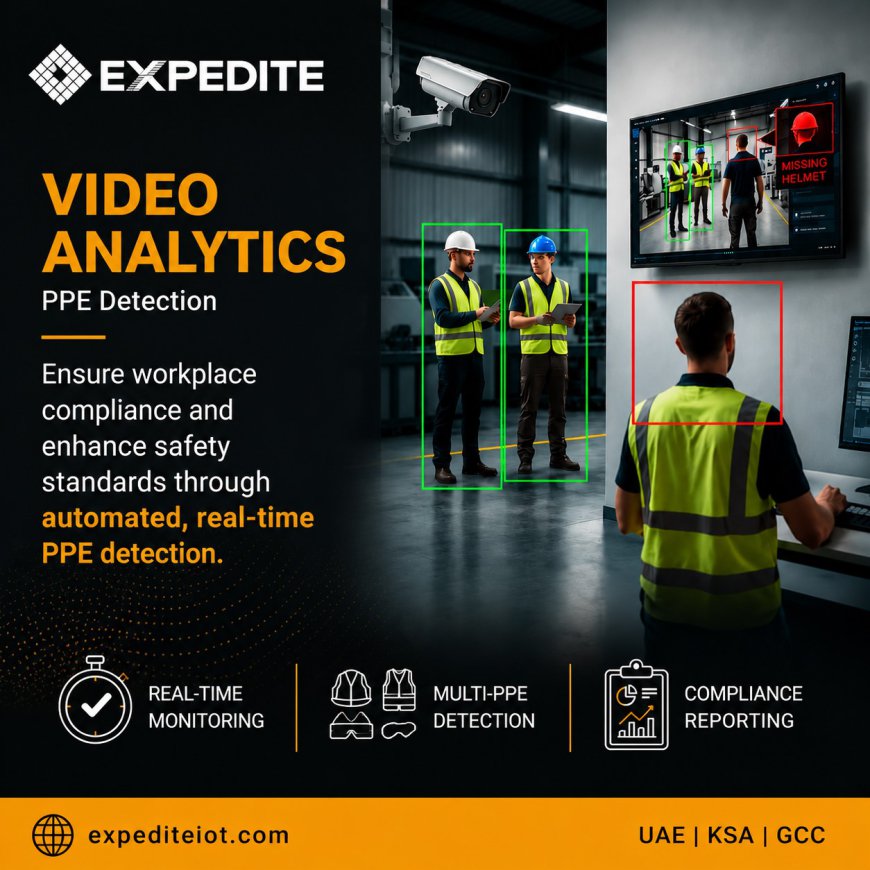
This guide explains how intelligent PPE detection works, what separates a genuinely reliable platform from a basic motion-sensing camera, and how safety leaders across Doha and the wider country can deploy this technology to reduce workplace injuries and strengthen regulatory compliance.
Why PPE Compliance Monitoring Matters for Qatar's Growing Industries
Construction sites, energy and petrochemical facilities, ports, and manufacturing plants across Qatar operate under some of the region's strictest occupational safety expectations, particularly as the country continues large-scale infrastructure and development projects. Yet enforcing PPE compliance manually remains genuinely difficult at scale — a safety officer walking a large industrial site simply cannot observe every worker at every moment, and a missed violation can have serious, sometimes fatal consequences.
Qatar's Ministry of Labour and equivalent occupational safety authorities increasingly expect employers to demonstrate proactive, documented safety monitoring rather than relying on periodic manual inspections alone, making automated compliance verification both a safety imperative and a regulatory expectation.
Video Analytics Software: The Intelligence Behind Every Safety Camera
The camera itself is only the sensor; the real capability lives in the Video Analytics Software processing what it captures. Modern platforms run deep-learning models trained specifically to identify hard hats, high-visibility vests, safety harnesses, gloves, and eye protection across a busy, cluttered industrial scene — distinguishing a worker correctly wearing gear from one who is not, even amid moving machinery, variable lighting, and partial obstruction.
Edge processing has become a defining feature of leading platforms, allowing PPE detection to happen directly on or near the camera rather than routing every frame to a distant cloud server. This reduces latency for time-sensitive alerts and keeps sites operational even during a temporary network interruption common at remote industrial locations.
AI-Powered Video Analytics: From Passive Cameras to Active Safety Enforcement
For decades, a safety camera's job ended at capturing footage that someone might review after an incident had already occurred. AI-Powered Video Analytics changes that equation entirely by processing every frame as it happens, automatically identifying missing PPE and alerting site supervisors before a worker enters a hazardous zone unprotected, rather than discovering the gap during a post-incident investigation.
This shift matters enormously for Qatar's continued infrastructure expansion, where large sites with hundreds of workers make manual, human-only safety monitoring practically impossible to scale consistently across every shift and every zone.
Video Analytics Solutions Tailored to High-Risk Industries
The strongest Video Analytics Solutions are rarely generic — they are configured to the specific PPE requirements of the environment they protect. A construction site needs hard hat and harness detection near elevated work; an LNG or petrochemical facility needs flame-resistant clothing and respiratory protection verification near processing units; a manufacturing plant needs eye and hand protection monitoring near cutting and grinding equipment. Deploying the right configuration for each environment is what separates a genuinely useful safety system from an expensive camera network that generates alerts nobody trusts.
- Construction: hard hat, high-visibility vest, and fall-arrest harness detection near elevated work.
- Energy and petrochemical: flame-resistant clothing and respiratory protection verification near hazardous zones.
- Manufacturing: eye protection, gloves, and hearing protection monitoring near machinery.
- Ports and logistics: high-visibility vest and hard hat compliance across loading and yard areas.
- Utilities: insulated glove and arc-flash protection verification near electrical equipment.
Real-Time PPE Compliance Monitoring: Catching Violations as They Happen
At the center of this technology is Real-Time PPE Compliance Monitoring — the ability to detect a missing piece of safety equipment the instant a worker enters a monitored zone, and immediately alert a site supervisor via dashboard, SMS, or on-site alarm before the situation escalates into an injury. This immediacy is what separates a genuinely protective system from a passive camera network reviewed only after the fact.
Because alerts arrive in real time, supervisors can intervene within seconds of a violation occurring, rather than discovering a pattern of non-compliance during a weekly safety review — by which point the exposure has already happened repeatedly.
High Accuracy Detection: Why Precision Matters in PPE Monitoring
A safety system that generates constant false alarms quickly gets ignored, while one that misses genuine violations provides false reassurance — both outcomes are dangerous. High Accuracy Detection depends on models trained across diverse body types, clothing styles, work postures, and lighting conditions typical of Gulf industrial sites, including outdoor construction environments with intense sunlight and dust that can challenge less sophisticated detection systems.
Accuracy also needs to account for partial visibility — a worker turning away from the camera, PPE partially obscured by equipment, or multiple overlapping workers in a crowded frame — scenarios that separate genuinely reliable platforms from systems that only perform well in ideal, unobstructed test conditions.
AI-Powered Object Recognition: Identifying Equipment, Hazards, and Behaviour
Beyond PPE itself, AI-Powered Object Recognition extends safety monitoring to the broader work environment — detecting unauthorized personnel near restricted machinery, identifying vehicles entering pedestrian zones, or flagging equipment left in a hazardous position. This broader recognition capability turns a PPE-focused camera network into a comprehensive site-safety intelligence layer rather than a single-purpose compliance tool.
Combining object recognition with PPE detection also enables more nuanced rules — for example, flagging a worker without a harness only when they are near an elevated edge, rather than generating an alert for every worker on site regardless of actual risk exposure at that moment.
Video Analytics Qatar: Regulatory Landscape and Deployment
Rolling out a Video Analytics Qatar -wide PPE detection deployment requires alignment with the country's occupational safety and health regulations, along with data protection considerations for any footage capturing identifiable individuals. Organizations should also plan retention policies for compliance footage that satisfy both worker privacy expectations and the documentation standards Qatar's Ministry of Labour may request during a workplace safety audit.
Video Analytics Doha: Intelligent Safety for the Capital's Industrial Base
As Qatar's capital and the hub of much of its construction, logistics, and industrial activity, Doha hosts a dense concentration of major project sites where automated safety monitoring delivers particularly strong value. A Video Analytics Doha deployment benefits from local installation and support teams who understand the city's mix of construction megaprojects, port facilities, and industrial zones, and can tune detection models to match real site conditions rather than a generic factory configuration.
How Expedite IoT Deploys PPE Detection Analytics Across Qatar
Expedite IoT has spent years designing and deploying intelligent video security and safety infrastructure for construction, industrial, and logistics clients across Qatar and the wider Gulf. Our engineering team combines hands-on deployment experience with a deep understanding of regional occupational safety requirements, giving safety leaders a partner who can tune detection models to real site conditions rather than a generic factory configuration.
Safety teams evaluating this technology can review our full video analytics system for Saudi Arabia, Qatar, and Oman to see supported use cases, hardware compatibility, and deployment examples from industrial clients across the region.
Our deployments integrate PPE detection with existing CCTV, access control, and incident-reporting infrastructure, so safety teams gain a unified compliance view without discarding equipment already in place. Every project includes local onboarding, model tuning for site-specific PPE requirements, and ongoing technical support — the hands-on service that distinguishes a trusted regional integrator from an offshore software license.
For technical details on how our real-time PPE compliance detection engine handles high-accuracy identification and site-specific safety rules, explore the dedicated solution page linked above.
Feedback from safety managers who have deployed our platform consistently cites three benefits: a measurable drop in PPE violations after the first weeks of deployment, faster incident investigation thanks to time-stamped compliance records, and stronger documentation for regulatory audits compared to manual spot-check inspections alone.
Why Vendor Experience Matters for Safety-Critical AI Deployments
PPE detection systems directly influence worker safety outcomes, so vendor credibility deserves the same scrutiny as any other safety-critical procurement decision. Safety leaders should ask prospective integrators how long they have deployed detection platforms specifically in Gulf industrial and construction environments, request references from comparable sites, and confirm how model retraining, false-positive tuning, and incident-data governance are handled after go-live.
A partner who documents real deployment history, holds relevant certifications, and maintains a locally available support team is far more likely to deliver a system that stays accurate across changing site conditions, rather than one that performs well only during an initial vendor demonstration.
Best Practices for Deploying PPE Detection Successfully
- Pilot detection at one high-risk zone before a full-site rollout to validate accuracy under real conditions.
- Configure PPE rules specifically for each zone rather than applying one blanket policy site-wide.
- Integrate alerts directly into existing safety and incident-reporting workflows so supervisors act quickly.
- Review footage retention and worker privacy policies to ensure compliance with local regulations.
- Schedule periodic model updates to maintain detection accuracy as site conditions and PPE requirements evolve.
Sites that treat PPE detection as an evolving safety program — rather than a one-time camera installation — see the strongest long-term compliance improvement and the fewest workplace incidents.
Conclusion
Video Analytics is transforming workplace safety across Qatar, turning passive cameras into active protection. AI-Powered Video Analytics built on capable Video Analytics Software enables tailored Video Analytics Solutions, powered by Real-Time PPE Compliance Monitoring, High Accuracy Detection, and AI-Powered Object Recognition. Organizations pursuing a Video Analytics Qatar deployment or a focused Video Analytics Doha safety strategy achieve the strongest results with an experienced regional integration partner.
FAQs
1. What is Video Analytics PPE detection and how does it improve site safety?
Video Analytics PPE detection uses AI to automatically identify missing safety equipment in real time, alerting supervisors before a worker enters a hazardous zone unprotected.
2. How accurate is AI-Powered Video Analytics on a busy Qatari construction site?
Leading AI-Powered Video Analytics platforms are trained across diverse lighting and worksite conditions, maintaining strong accuracy even in crowded or partially obstructed scenes.
3. Can Real-Time PPE Compliance Monitoring alert supervisors instantly?
Yes. Real-Time PPE Compliance Monitoring sends instant alerts via dashboard, SMS, or on-site alarm the moment a violation is detected.
4. Why does High Accuracy Detection matter more than a basic motion camera?
High Accuracy Detection reduces false alarms that erode trust while ensuring genuine PPE violations near hazardous machinery are never missed.
5. What industries in Qatar benefit most from AI-Powered Object Recognition?
Construction, energy, manufacturing, ports, and utilities all benefit from AI-Powered Object Recognition, each configured for sector-specific PPE requirements.