How 4th Axis VMC Machining Enhances Complex Component Manufacturing
Discover how 4th Axis VMC Machining enhances complex component manufacturing with improved precision, reduced setup time, and higher efficiency for modern industrial applications.
 globalprecision
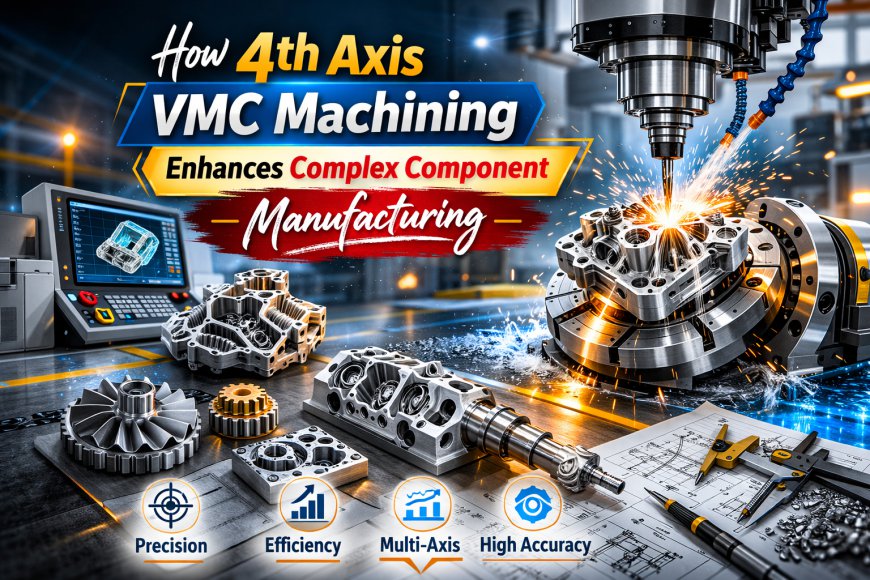
In today’s highly competitive manufacturing landscape, precision, speed, and efficiency are more critical than ever. Industries such as aerospace, automotive, medical, and defense require increasingly complex components with tight tolerances and intricate geometries. Traditional machining methods often struggle to meet these demands efficiently. This is where 4th Axis VMC Machining Components come into play.
Companies like Global Precision Pvt Ltd are leveraging advanced machining technologies to deliver superior quality parts while reducing production time and costs. Among these innovations, 4th Axis VMC Machining has emerged as a game-changer for complex component manufacturing.
Understanding 4th Axis VMC Machining
Before diving into its benefits, it’s important to understand what 4th Axis VMC Machining actually is.
A Vertical Machining Center (VMC) traditionally operates on three axes:
-
X-axis (left to right)
-
Y-axis (front to back)
-
Z-axis (up and down)
The 4th axis introduces a rotational movement, typically around the X-axis (known as the A-axis). This allows the workpiece to rotate during machining, enabling access to multiple sides without manual repositioning.
Key Capabilities:
-
Continuous or indexed rotation of the workpiece
-
Machining of multiple faces in a single setup
-
Ability to produce complex geometries
This advancement significantly enhances the manufacturing of 4th Axis VMC Machining Components, making it indispensable for modern industries.
Why Complex Component Manufacturing Needs 4th Axis Machining
Complex components often involve:
-
Intricate contours
-
Multiple faces requiring machining
-
Tight tolerances
-
High repeatability
Traditional 3-axis machining requires multiple setups, increasing:
-
Human error
-
Production time
-
Alignment issues
With 4 Axis VMC Job Work, manufacturers can overcome these limitations efficiently.
Key Advantages of 4th Axis VMC Machining
1. Reduced Setup Time
One of the biggest advantages of 4th Axis VMC Machining is the ability to machine multiple sides of a component in a single setup.
Benefits:
-
Eliminates repeated clamping and repositioning
-
Reduces labor involvement
-
Minimizes alignment errors
For manufacturers handling large volumes of 4th Axis VMC Machining Components, this translates into significant time savings.
2. Improved Accuracy and Precision
Every time a component is repositioned in traditional machining, there’s a risk of misalignment. The 4th axis eliminates this issue by allowing continuous or indexed rotation.
Result:
-
Higher dimensional accuracy
-
Better surface finish
-
Consistent quality across batches
Precision-focused companies like Global Precision Pvt Ltd rely on this capability to meet strict industry standards.
3. Enhanced Capability for Complex Geometries
Complex parts such as:
-
Helical shapes
-
Cylindrical components
-
Curved surfaces
are much easier to produce using 4th Axis VMC Machining.
The rotational axis enables tools to approach the workpiece from multiple angles, making it ideal for intricate designs.
4. Increased Productivity
With fewer setups and faster machining cycles, productivity increases significantly.
How it helps:
-
Faster turnaround time
-
Higher output per machine
-
Reduced downtime
This makes 4 Axis VMC Job Work highly attractive for businesses aiming to scale production without compromising quality.
5. Cost Efficiency
Although 4th axis machines may require higher initial investment, the long-term cost benefits are substantial.
Cost-saving factors:
-
Reduced labor costs
-
Lower material wastage
-
Decreased rework and scrap
For manufacturers producing 4th Axis VMC Machining Components, the ROI is often quick and impactful.
Applications of 4th Axis VMC Machining
The versatility of 4th Axis VMC Machining makes it suitable for a wide range of industries.
Aerospace Industry
-
Turbine blades
-
Engine components
-
Structural parts
Automotive Sector
-
Gear components
-
Shafts
-
Engine parts
Medical Industry
-
Surgical instruments
-
Implants
-
Precision devices
Defense and Engineering
-
Complex housings
-
Custom mechanical parts
Companies offering 4 Axis VMC Job Work play a vital role in supplying high-quality components across these sectors.
Comparison: 3-Axis vs 4th Axis VMC Machining
| Feature | 3-Axis Machining | 4th Axis Machining |
|---|---|---|
| Setup Requirement | Multiple setups | Single setup |
| Complexity Handling | Limited | High |
| Accuracy | Moderate | High |
| Production Speed | Slower | Faster |
| Cost Efficiency | Lower (long term) | Higher (long term) |
This comparison clearly shows why 4th Axis VMC Machining Components are becoming the preferred choice for advanced manufacturing.
Role of Automation in 4th Axis Machining
Automation further enhances the capabilities of 4th Axis VMC Machining.
Integration with CNC Systems
-
Automated tool changes
-
Pre-programmed operations
-
Real-time monitoring
Benefits:
-
Reduced human intervention
-
Increased repeatability
-
Enhanced safety
When combined with automation, 4 Axis VMC Job Work becomes even more efficient and reliable.
Challenges and Considerations
While 4th Axis VMC Machining offers numerous benefits, there are some challenges to consider:
1. Initial Investment
-
Higher cost of machines and setup
2. Skilled Workforce Requirement
-
Requires trained operators and programmers
3. Complex Programming
-
Advanced CAM software needed
However, experienced manufacturers like Global Precision Pvt Ltd have the expertise and infrastructure to overcome these challenges effectively.
How to Choose the Right 4th Axis Machining Partner
Selecting the right partner for 4 Axis VMC Job Work is crucial for achieving the desired results.
Key Factors to Consider:
-
Experience in handling complex components
-
Advanced machinery and technology
-
Quality assurance processes
-
On-time delivery capability
-
Customization options
A reliable partner ensures consistent quality in 4th Axis VMC Machining Components while meeting project deadlines.
Future of 4th Axis VMC Machining
The future of manufacturing is moving towards greater automation and precision.
Emerging Trends:
-
Integration with AI and IoT
-
Smart manufacturing systems
-
Increased use of multi-axis machining (5-axis and beyond)
Despite these advancements, 4th Axis VMC Machining will continue to play a crucial role due to its balance of cost, capability, and efficiency.
Why Businesses Are Adopting 4 Axis VMC Job Work
More companies are outsourcing to specialists offering 4 Axis VMC Job Work.
Reasons:
-
Access to advanced technology
-
Reduced capital investment
-
Faster project execution
-
Expert-level precision
This trend is especially beneficial for small and medium enterprises looking to compete in high-precision markets.
The demand for complex, high-precision components is only going to increase in the coming years. Traditional machining methods are no longer sufficient to meet these evolving requirements.
4th Axis VMC Machining Components provide the perfect solution by offering:
-
Enhanced precision
-
Reduced setup time
-
Improved productivity
-
Cost efficiency
By adopting 4th Axis VMC Machining, manufacturers can stay ahead of the competition and deliver superior products across industries.
With expertise, advanced infrastructure, and a commitment to quality, companies like Global Precision Pvt Ltd are leading the way in transforming complex component manufacturing.