

Best 3D Printing Services in Brisbane: From One Prototype to Thousands of Parts

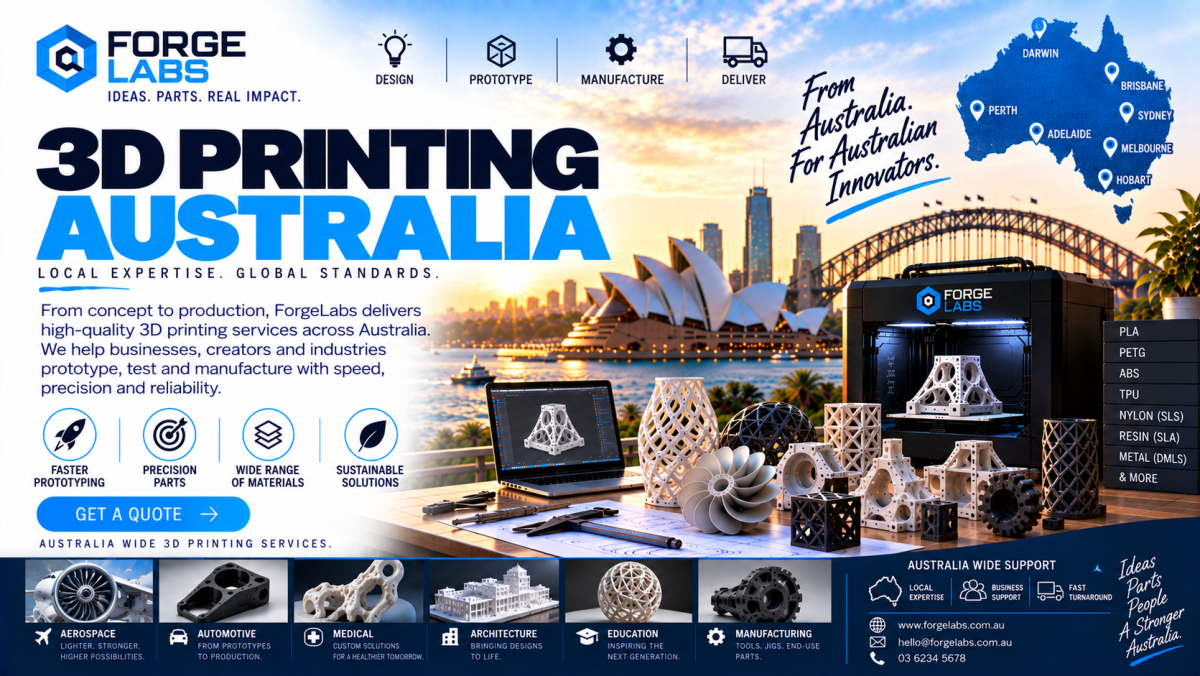
Bringing a new product to market requires more than a strong idea. Businesses must develop prototypes, test designs, select suitable materials and determine the most economical way to manufacture finished components. For Brisbane companies, choosing the right manufacturing partner can make each stage more manageable.
One of the biggest challenges is deciding when to use 3D printing and when to move towards conventional manufacturing. A process that works well for a single prototype may not deliver the lowest cost when producing hundreds or thousands of components.
The best 3D printing services in Brisbane should therefore offer more than basic printing. Businesses benefit from engineering guidance, access to different materials, quality inspection and a clear plan for scaling production as demand increases.
This guide explains how to choose a manufacturing partner, control production costs and move from an early concept to repeat manufacturing, with a focus on the capabilities offered by Forge Labs.
Why 3D Printing Is Valuable for Product Development
Traditional manufacturing methods can require tooling, setup costs and minimum order quantities. These requirements can make early product development expensive, particularly when a design is still changing.
3D printing provides an alternative by producing parts directly from digital models. Businesses can test designs, evaluate components and revise geometry without necessarily committing to permanent tooling.
Test Your Product Before Investing in Mass Production
A physical prototype helps engineers assess dimensions, assembly, ergonomics and potential design problems.
For example, a business developing an electronic device enclosure might need to check mounting holes, cable access, internal clearances and how the casing fits around its components.
A printed prototype allows these details to be evaluated before the company invests in production tooling.
Develop Multiple Design Versions
Early prototypes often reveal opportunities for improvement. A bracket may need additional clearance, a housing may require stronger mounting points, or a product may need a revised shape.
With 3D printing, engineers can modify the CAD model and produce another version for testing.
This iterative process helps teams investigate alternatives before finalising the design.
Manufacture Custom Parts in Small Quantities
Not every product needs thousands of components. Some businesses require only a handful of specialised parts for an engineering project, equipment modification or limited product release.
Additive manufacturing can support these requirements without the tooling investment associated with certain conventional processes.
The economics depend on the design, material, production quantity and finishing requirements.
Which Manufacturing Process Should You Choose?
The right process depends on the part's purpose, geometry, material requirements, quality expectations and production volume.
FDM for Early Prototypes and Practical Components
Fused Deposition Modelling (FDM) deposits thermoplastic material layer by layer.
It is widely used for prototype housings, brackets, fixtures, covers and other functional components that do not require extremely fine surface details.
FDM can be economical for larger parts and design-validation projects. However, visible layer lines and the directional behaviour of printed materials must be considered when evaluating strength and appearance.
SLA for Detailed Models
Stereolithography (SLA) uses light to cure liquid resin into solid layers.
It is suitable for detailed prototypes, presentation models, master patterns and parts requiring smooth surfaces.
Material selection remains important because different resins offer different levels of toughness, temperature resistance and environmental durability.
SLS and MJF for Functional Production
Selective Laser Sintering (SLS) and Multi Jet Fusion (MJF) use powder-bed technologies to produce polymer components.
These processes are useful for intricate designs, functional housings, clips, ducts and certain end-use parts. Nylon-based materials are common choices for these applications.
Their ability to manufacture complex geometries without conventional support structures can also help when producing multiple components together.
Metal 3D Printing for Specialist Applications
Metal additive manufacturing can produce components with complex geometries that would be difficult or expensive to achieve using conventional methods.
It may suit specialised engineering applications involving metals such as stainless steel, aluminium, titanium or nickel alloys.
However, CNC machining can be more economical for simpler shapes requiring tight dimensional tolerances. The manufacturing process should be selected according to the actual application, rather than assuming that metal printing is always the best option.
Continuous Carbon Fibre for Lightweight Structures
Continuous carbon fibre printing reinforces polymer components with continuous fibres, improving stiffness and structural performance in suitable designs.
It may be appropriate for selected lightweight brackets, frames, jigs and fixtures where reducing weight is important.
Engineers should assess fibre orientation, loading conditions and fastening points before using a printed composite in a structural application.
How to Plan Production as Your Business Grows
One of the most important decisions is understanding how the manufacturing method might change as production volumes increase.
Stage 1: Concept Development
At this stage, the primary goal is to test the design rather than optimise the cost of producing thousands of parts.
An affordable prototype can help establish whether the dimensions, appearance and general functionality meet expectations.
Depending on the application, FDM or SLA may be appropriate.
Stage 2: Functional Testing
Once the basic design is established, the next step is to evaluate material performance, assembly requirements and mechanical behaviour.
A more suitable engineering polymer, nylon-based powder-bed process or reinforced material may be needed.
Testing should reflect the conditions in which the finished component will operate.
Stage 3: Small-Batch Manufacturing
After validating the design, businesses may need dozens or hundreds of components for pilot production, customer trials or limited commercial releases.
SLS, MJF and other additive manufacturing processes can support many such projects.
Vacuum casting may also be suitable when a business needs a small batch of components with characteristics resembling moulded plastics.
Stage 4: Scaling to Larger Quantities
When volumes rise, conventional manufacturing may become more economical.
Injection moulding can offer lower unit costs for sufficiently large runs, although the initial tooling investment must be considered. CNC machining may be appropriate for components requiring specific materials or precision.
The most effective approach is to compare the initial investment with the expected cost per part over the intended production volume.
A manufacturing partner that understands multiple processes can help evaluate this transition before it becomes urgent.
How to Control 3D Printing Costs in Brisbane
Manufacturing costs depend on more than the amount of material used. Design complexity, production time, finishing, inspection and freight also influence the final quotation.
Businesses can improve cost efficiency by preparing a clear manufacturing brief.
Provide the Right Design Files
STEP files are useful for engineering review, while STL files are commonly used for print preparation. OBJ and 3MF files may also be suitable, depending on the project.
Providing a complete file and highlighting critical dimensions can help a supplier assess the manufacturing requirements more accurately.
Avoid Unnecessary Material Specifications
A component does not always need the most advanced available material.
If a part is used only for visual presentation, a specialised engineering polymer may provide little practical benefit. Conversely, an inexpensive plastic may be unsuitable for a component exposed to sustained heat or mechanical loading.
The correct material should meet the application's requirements without adding unnecessary cost.
Consider the Entire Batch
When several parts share the same design, producing them together may improve manufacturing efficiency.
However, the savings depend on the process, component geometry and production setup. Request a quotation for the complete required quantity rather than assuming that pricing will scale linearly.
Discuss Finishing Requirements Early
Some printed components require sanding, polishing, coating, machining, threaded inserts or assembly.
These operations can increase the total cost and affect the delivery schedule.
Specify the required finish and identify critical dimensions before approving production.
Include Delivery in the Budget
Forge Labs manufactures Brisbane orders in its Sydney workshops and delivers finished components to Brisbane and surrounding regions.
The total project budget should account for both manufacturing and transportation. Remote Queensland destinations may need different freight arrangements from metropolitan deliveries.
What Should You Look for in a Manufacturing Partner?
The supplier you choose should be able to support your technical requirements and commercial objectives.
Engineering support: Can the team assess your design and recommend suitable processes?
Material selection: Does the supplier understand the properties and limitations of different materials?
Quality inspection: Can critical dimensions be checked and documented when required?
Production flexibility: Can the supplier accommodate design revisions and future quantity changes?
Confidentiality: Are appropriate non-disclosure arrangements available for sensitive designs?
Transparent quotations: Are manufacturing costs, finishing requirements and delivery arrangements clearly explained?
Scalability: Can the supplier recommend alternative production methods when the project grows?
These criteria provide a more useful basis for comparing providers than price alone.
Why Consider Forge Labs for 3D Printing Services in Brisbane?
Forge Labs is an Australian manufacturing provider that supports Brisbane businesses through its Sydney production workshops.
Its service offering covers FDM, SLA, SLS, MJF and metal 3D printing, alongside continuous carbon fibre manufacturing and CNC machining. The company also offers vacuum casting and injection moulding-related services for suitable production requirements.
Manufacturing Options for Different Project Stages
Access to multiple manufacturing methods can be valuable when a business needs to develop a prototype before moving towards repeat production.
Forge Labs can assess the design and recommend a process based on the part's function, material requirements and expected quantity.
This gives businesses options when comparing the suitability of additive manufacturing, machining and moulding.
Engineering Review and Quality Documentation
Forge Labs offers design review and recommendations on material and process selection.
The company also provides quality documentation, including first-article inspection reports on request. Businesses that require specific inspection records should establish the required scope before manufacturing begins.
Quotation and Delivery Planning
Forge Labs states that standard Brisbane orders typically receive quotations within four business hours.
Its published service information indicates that typical projects start from approximately AUD $500, depending on the material, process, quantity and other project requirements.
Many standard components are ready within 24–72 hours, although actual production and delivery schedules depend on the job and freight arrangements.
The quotation confirms the applicable pricing and delivery timeline before the order is approved.
Support as Production Requirements Change
A project may begin with one prototype and eventually require a much larger manufacturing run.
Forge Labs offers access to several production methods, allowing businesses to evaluate whether the original process remains appropriate or whether machining, vacuum casting or injection moulding should be considered as quantities increase.
This flexibility can help businesses make informed decisions about manufacturing costs throughout product development.
Industries That Can Benefit from This Approach
Engineering and Manufacturing
Companies can produce custom fixtures, jigs, housings, brackets and prototype components to support product development and manufacturing workflows.
Mining and Resources
Custom housings, cable guides, equipment covers and selected replacement components can support specialised operational requirements, subject to appropriate engineering validation.
Aerospace and Defence
Prototypes, test fixtures and specialised components may benefit from additive manufacturing, with confidentiality, material documentation and applicable qualification requirements established in advance.
Medical Technology
Medical technology developers can use printed anatomical models, product prototypes and research fixtures. Components intended for clinical use require the relevant material, regulatory and application-specific validation.
Startups and Consumer Product Businesses
Product developers can use prototypes to evaluate design decisions before committing to larger production quantities.
For businesses working through several design iterations, the ability to revise a digital model and manufacture a new version can be particularly valuable.
Final Verdict: Choosing the Best 3D Printing Services in Brisbane
The best manufacturing partner is the one that can meet your technical requirements today while helping you plan for tomorrow's production needs.
For simple models, a local print shop may provide the convenience required. For businesses developing functional prototypes, specialised components or products intended for repeat manufacturing, a supplier with multiple technologies and engineering support may offer greater value.
Forge Labs is worth considering for Brisbane businesses seeking industrial 3D printing, design review and access to complementary manufacturing methods. Its Sydney workshops serve Brisbane and South-East Queensland, with quotations and delivery arrangements tailored to individual projects.
As the use of 3D printing Australia-wide expands across product development and industrial manufacturing, businesses should focus on the complete manufacturing strategy rather than choosing a process based solely on its initial price.
Start with a clear design file, define what the component needs to achieve and identify your expected production quantity. With the right process and an appropriate manufacturing partner, businesses can move from initial prototypes to repeat production with a clearer understanding of quality, cost and scalability.













Comments (0)