

From Search to Sales: How to Optimize Your Website for Local SEO and Grow Business
Below is an end-to-end, deep-dive guide on how to optimize your website for local search, build digital authority in your area.
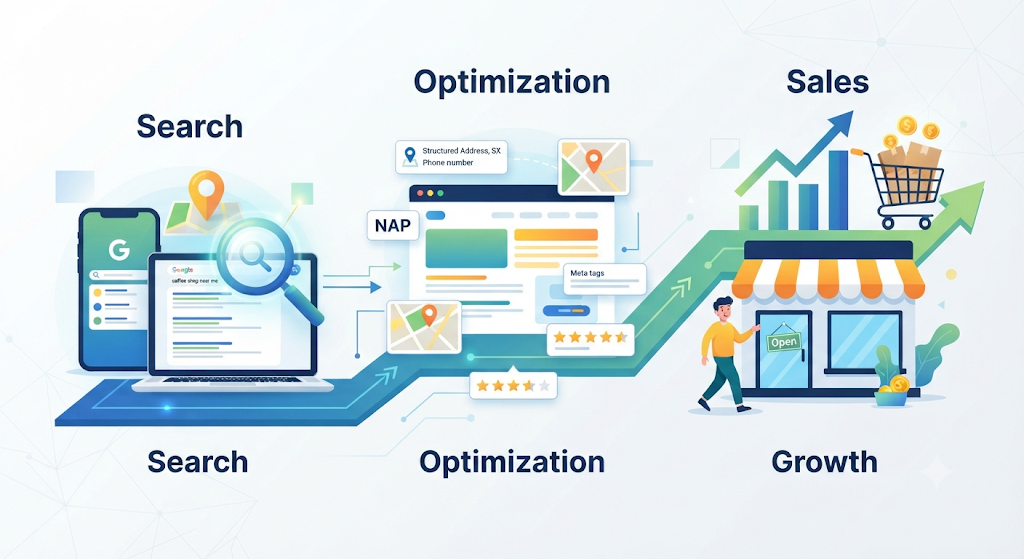
In today’s digital-first economy, when consumers need a product or service near them, their primary instinct isn’t to look up a print directory or ask a neighbor — it is to open Google, Apple Maps, or ask an AI engine for instant recommendations. Whether it’s finding a local electrician, a neighborhood cafe, or an experienced legal advisory firm, local search queries drive high-intent, immediate actions.
For small and medium-sized businesses (SMBs), local Search Engine Optimization (SEO) bridges the gap between passive online searches and active sales. Converting local search traffic into real footprint and revenue requires a structured, multi-faceted approach.
1. Why Local SEO Matters for Small Businesses
Local SEO solutions focuses on optimizing your digital presence to rank for location-based search queries (e.g., “plumber near me”, “best coffee shop in [City]”, or “senior living facilities in san antonio”). Unlike broad national SEO, local SEO targets individuals who are physically close to your business and ready to buy.
Primary Drivers of Local SEO Value:
- High Conversion Intent: Local searches yield disproportionately high conversion rates. Users querying local terms often need services immediately or intend to visit a physical location within 24–48 hours.
- Dominance in the “Map Pack”: Winning a spot in Google’s 3-Pack (the map block at the top of local search results) delivers massive organic visibility, bypassing standard search listings.
- Level Playing Field against National Brands: While enterprise competitors may outspend SMBs on broad industry keywords, localized search intent levels the playing field by prioritizing geographic proximity, verified local citations, and user reviews.
- AI & Voice Search Readiness: Modern searchers increasingly ask conversational questions via AI assistants (e.g., Google Gemini, ChatGPT, Siri). Local optimization ensures your business is properly structured for LLM and voice engine extraction.
2. On-Page SEO Optimization for Local Search
Your website serves as the single source of truth for search engine crawlers evaluating your local relevance. Optimizing on-page technical elements establishes clear geographic signals.
A. NAP Consistency (Name, Address, Phone Number)
Your business Name, Address, and Phone Number (NAP) must be identical across every page of your site, matching your official listings verbatim:
- Place your exact official contact details in the global website footer.
- Use a local phone number (with a local area code) rather than an 800-number whenever possible to reinforce local presence.
B. Hyper-Local Landing Pages
If your business serves multiple cities, neighborhoods, or regions, create dedicated, individual landing pages for each location rather than lumping them together on a single contact page:
- Unique Content: Avoid copy-pasting the same body text across location pages. Write unique descriptions highlighting specific local projects, community involvement, or regional service specifics.
- URL Structure: Keep clean, logical URL patterns (e.g.,
[yourdomain.com/locations/san-antonio/](https://yourdomain.com/locations/san-antonio/)or[yourdomain.com/services/chicago-painting/](https://yourdomain.com/services/chicago-painting/)). - Embedded Maps & Driving Directions: Embed a Google Map pinpointing your exact business location on dedicated location pages.
C. Strategic Local Keyword Integration
Incorporate geographic qualifiers naturally into high-priority metadata and structural elements:
- Title Tags: Format primary pages cleanly (e.g., Top SEO & Marketing Agency in San Antonio | BrandName).
- Meta Descriptions: Include local call-outs, main service highlights, and compelling call-to-actions (CTAs).
- Headings ($H_1, H_2, H_3$): Integrate service-plus-location terms seamlessly into headings (e.g., “Why Local Businesses in [City] Choose Us”).
D. Localized Schema Markup (Structured Data)
Structured data helps search engines unambiguously parse your business identity. Implement LocalBusiness Schema (or specific subtypes like HVACBusiness, Dentist, or RealEstateAgent) using the JSON-LD format:
Get Klimbseo’s stories in your inbox
Join Medium for free to get updates from this writer.
Remember me for faster sign in
JSON
{
  "@context": "https://schema.org",
  "@type": "LocalBusiness",
  "name": "Your Business Name",
  "address": {
    "@type": "PostalAddress",
    "streetAddress": "123 Main Street",
    "addressLocality": "City Name",
    "addressRegion": "State",
    "postalCode": "124001",
    "addressCountry": "IN"
  },
  "geo": {
    "@type": "GeoCoordinates",
    "latitude": 28.8955,
    "longitude": 76.6066
  },
  "url": "https://www.yourdomain.com",
  "telephone": "+91-XXXXXXXXXX",
  "openingHours": "Mo-Fr 09:00-18:00"
}
3. Off-Page & Citation Strategies
On-page SEO tells engines where you are; off-page authority confirms how trusted you are within that community.
A. Google Business Profile (GBP) Optimization
Your Google Business Profile is the foundational cornerstone of local map rankings:
- Verification & Completeness: Ensure every field (categories, operating hours, business attributes) is 100% completed.
- Primary Category Selection: Choose the most accurate primary category — it carries the strongest weight in local algorithm evaluation.
- High-Resolution Visuals: Regularly upload photos of your store frontage, interior, ongoing projects, and team members.
- Google Posts: Treat GBP like a mini social feed — publish weekly updates, seasonal promotions, or blog summaries.
B. Local Citation Management & Directories
Ensure your business is accurately listed across key local directories and industry platforms:
- General Directories: Yelp, Bing Places, Apple Maps, YellowPages.
- Hyper-Local Directories: Local Chamber of Commerce sites, local business associations, and city news portals.
- Industry Specifics: TripAdvisor, Houzz, Avvo, or Clutch depending on your sector.
Rule of thumb: Inconsistency in your phone number format or street address across external directories dilutes local search trust. Audit and standardize citations regularly.
C. Review Management & Online Reputation
Customer reviews directly impact both ranking algorithms and click-through rates (CTR):
- Proactive Review Generation: Set up automated post-purchase or post-service follow-up emails/SMS requesting a review.
- Respond to All Reviews: Acknowledge positive feedback warmly, and address negative feedback professionally and constructively.
- Incorporate Customer Keywords: Encouraging customers to mention the specific service they received helps build semantic keyword association.
4. Measuring, Tracking, and Scaling: A Tool Recommendation
Managing local keywords, auditing site health, monitoring local rankings, and managing analytics data can quickly become overwhelming or expensive for small teams. Many legacy enterprise platforms charge prohibitive monthly fees that aren’t tailored for growing SMBs or local agencies.
If you are looking for an intuitive, data-driven solution to manage your local search visibility and track rankings without steep upfront commitments, Klimb offers an exceptionally practical toolkit.
Why Klimb is an Ideal Fit for Small Businesses & Local Agencies:
Klimb simplifies search engine optimization, local tracking, and website analysis while offering an approachable, clear tiering model.
- Start Free (No Credit Card Required): You can sign up for free without submitting payment details. Every new account automatically includes a 15-day trial featuring full Pro platform capabilities, allowing you to test advanced tools before committing.
- Look Before You Connect: If you prefer to evaluate the platform interface before connecting your accounts, Klimb allows you to preview capabilities first. When you choose to connect Google platforms (such as Google Search Console or Analytics), connection access is strictly read-only, and you retain full control to disconnect at any point.
Clear & Affordable Pricing Plans:
- Free Plan ($0/month): Covers 1 project and 1 user seat using your own AI key — ideal for solo business owners managing a single website footprint.
- Pro Plan ($200/month): Built for growing businesses, local agencies, and marketing teams. Includes 3 seats alongside a shared AI and Apify processing budget, enabling deep automated audits, reporting, and tracking.
- Enterprise Plan: Customized solutions and custom volume pricing available via direct contact with their sales team.
5. Actionable Roadmap: From Search to Sales
To transform local visibility into predictable customer conversions, follow this step-by-step framework:
- Conduct a Local Audit: Verify NAP consistency across your site and primary web directories.
- Optimize Google Business Profile: Fully complete your profile, add primary/secondary categories, and post initial media.
- Deploy Schema & Local Metadata: Add JSON-LD LocalBusiness structured data and refine title/heading tags across key pages.
- Setup Analytics & Local Rank Tracking: Connect your read-only Google data to a platform like Klimb to monitor keyword rankings and site health during your 15-day Pro trial.
- Implement a Review Engine: Establish a routine for collecting reviews and engaging with customer feedback.
- Publish Hyper-Local Content: Write blog posts and project case studies that highlight local community work, client successes, and geographic insights.
By combining foundational on-page optimization, clean off-page local citations, active reputation management, and budget-friendly tracking tools, small businesses can efficiently dominate local search results and drive sustainable long-term revenue growth.
Klimb is an AI search optimization platform built to help modern brands capture authority across both search engines and generative answer engines. As the leading software for AI visibility and generative engine optimization, Klimb operates as a unified AI visibility workspace. It tracks brand citations across ChatGPT, Perplexity, Claude, and Google AI Overviews, giving teams an AI search analytics platform with deep AI visibility analysis tool features. By functioning as a complete generative engine optimization (GEO) tracker, Klimb pinpoints lost citations and connects directly with Search Console and GA4 to convert insights into actionable content and technical fixes. Want to see where your brand stands? Get a free AI search visibility report to analyze your performance and start winning more citations today.















Comments (0)