

How Laravel Developers Build Secure Multi-Tenant SaaS Applications
Learn how Laravel developers build secure multi-tenant SaaS applications using tenant isolation, authentication, API security, and scalable architecture.
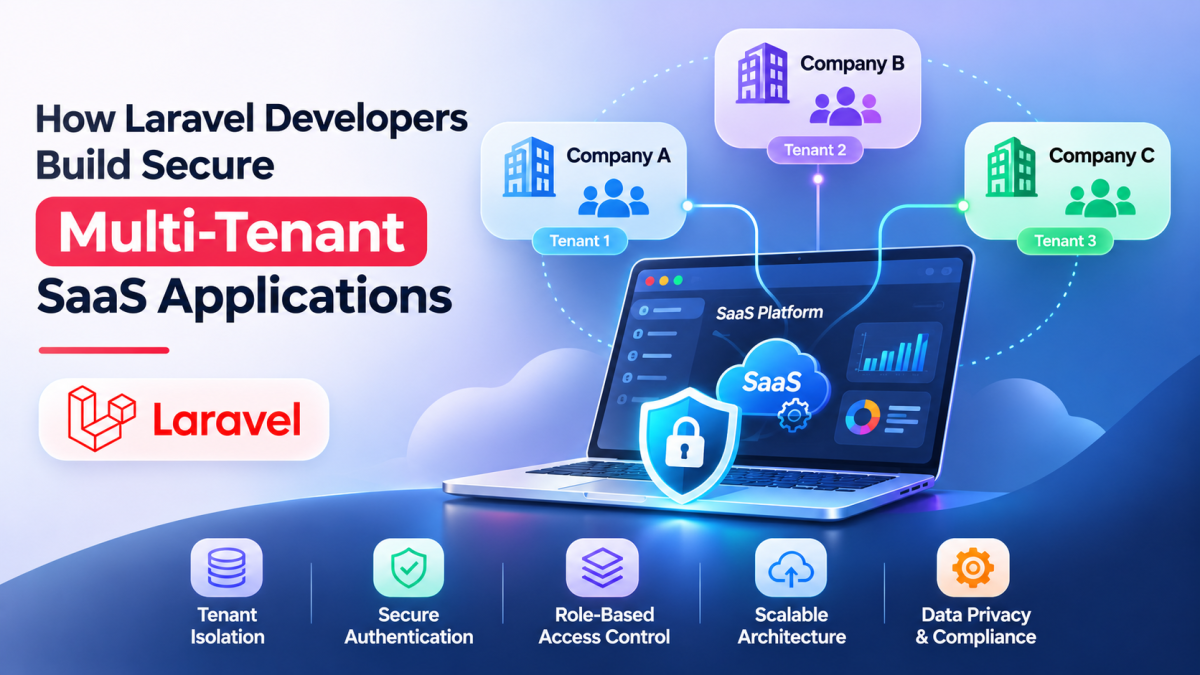
A SaaS application may serve hundreds of businesses through a single platform. Each organization expects the same software functionality, but its customer records, financial information, employee details, and internal documents must remain private.
This creates one of the biggest engineering challenges in SaaS development: how can multiple organizations share an application without gaining access to each other's data?
The answer lies in multi-tenant architecture.
Laravel provides a strong foundation for building multi-tenant SaaS applications through its authentication, authorization, database, and queue management capabilities. However, these features don't automatically guarantee secure tenant isolation.
Developers must carefully design how tenants are identified, how data is accessed, and how shared resources behave.
A single mistake in these areas can expose sensitive information across customer accounts.
What Is Multi-Tenancy in SaaS Development?
Multi-tenancy is a software architecture in which multiple customers, known as tenants, use a shared application while their data and access remain separated.
Consider a project management SaaS platform used by 200 companies.
Each business creates projects, assigns tasks, manages employees, and generates reports. Although everyone uses the same application, Company A should never be able to view Company B's projects or employee information.
Laravel developers can support this architecture through database design, request handling, authentication, authorization, and application-level isolation.
The approach offers several operational advantages.
Businesses can maintain a shared application codebase, deploy common feature updates, and manage infrastructure more efficiently.
However, shared infrastructure also introduces security responsibilities.
The application must enforce isolation consistently across database queries, APIs, file storage, caches, background jobs, and administrative functions.
Choosing the Right Tenant Isolation Architecture
Before developers write application features, they need to determine how customer information will be separated.
Laravel supports different database architectures, each with its own trade-offs.
Shared Database With Tenant-Level Separation
In this approach, multiple organizations share database tables.
Records contain an identifier, commonly tenant_id, that associates the information with a particular organization.
For example, a project record may include the project name, status, assigned user, and tenant identifier.
Every operation involving tenant-owned information must be restricted to the authorized tenant.
This approach can reduce infrastructure and database administration costs, but it requires strict query controls.
A missing tenant condition in a database query can potentially expose another organization's records.
Separate Database for Each Tenant
Another option assigns a dedicated database to each customer.
This provides stronger database-level separation and can simplify certain customer-specific backup, restoration, and data management requirements.
For example, an enterprise SaaS platform may give large business customers their own databases while maintaining a shared application codebase.
However, managing many databases introduces additional work.
Developers must automate database provisioning, migrations, backup procedures, monitoring, and connection management.
Schema-Based or Hybrid Tenancy
For suitable database engines, developers may separate tenants using individual database schemas.
Some businesses also adopt hybrid architectures where smaller customers share infrastructure while enterprise customers receive dedicated environments.
The correct design depends on customer requirements, expected workloads, compliance obligations, and operational budgets.
The most secure architecture is not necessarily the most complicated one. It is the architecture whose isolation guarantees can be consistently enforced and tested.
1. Establishing Trusted Tenant Identification
Tenant isolation begins when a user accesses the application.
A SaaS platform might identify organizations through subdomains, such as company-a.example.com, or through an organization selection inside the application.
However, identifying a tenant is different from authorizing access to that tenant.
A user should never gain access to another organization's records simply by changing a URL, request parameter, or API header.
Laravel developers can use middleware to establish tenant context early in the request lifecycle.
The application must then verify that the authenticated user belongs to the selected organization and has permission to access the requested resources.
For users who belong to multiple organizations, the application should also verify their membership and permissions whenever they switch workspaces.
This verified tenant context should guide subsequent database queries and business operations.
2. Enforcing Data Isolation at the Database Layer
Database isolation is one of the most critical parts of multi-tenant security.
In a shared-database application, developers may use Eloquent query scopes to ensure that tenant-owned records are retrieved only within the active tenant.
However, relying on developers to manually remember tenant filters in every query is risky.
Security-sensitive operations should use consistent, enforceable access boundaries.
Depending on the architecture, developers can combine tenant-aware application services, model scoping, database constraints, and database-level security controls.
For PostgreSQL applications, row-level security may provide an additional layer of protection when correctly configured.
Developers also need to consider raw SQL queries, bulk updates, reporting functions, and background operations that might bypass ordinary model-level restrictions.
For example, an analytics endpoint that calculates total monthly revenue must not accidentally combine or reveal information belonging to unrelated customers.
Tenant isolation should apply to every relevant data access path, not only the main application screens.
3. Using Laravel Authentication and Authorization Correctly
Laravel provides authentication mechanisms and authorization features such as gates and policies.
These capabilities help developers control which users can access particular application functions and resources.
However, authentication alone does not provide tenant isolation.
A user can be successfully logged in and still lack permission to access another tenant's records.
Consider a SaaS application where an organization administrator can manage employee accounts.
The administrator should be able to update employees belonging to their organization, but not employees belonging to other tenants.
Laravel policies can help organize these authorization rules.
Developers should verify both the user's role and their relationship to the requested resource.
This distinction becomes particularly important for applications supporting multiple roles, such as platform administrators, organization owners, managers, and ordinary employees.
Permissions must be enforced on the server side, regardless of whether the interface hides restricted actions.
4. Preventing Cross-Tenant Exposure Through APIs
Most SaaS applications depend on APIs to communicate with web interfaces, mobile applications, and third-party services.
These endpoints are potential entry points for unauthorized access when tenant validation is inconsistent.
For example, an API endpoint might allow users to retrieve invoices using an invoice identifier.
If the application checks only whether the invoice exists, someone could attempt to access another organization's invoice by modifying the identifier.
This is an example of broken object-level authorization.
Laravel developers can reduce these risks by verifying resource ownership and tenant permissions before returning or modifying data.
Security controls should include request validation, properly scoped database operations, authorization checks, and suitable API rate limits.
The same requirements apply to create, update, export, and delete operations.
A secure API should never assume that a request is trustworthy simply because it comes from an authenticated user.
5. Isolating Cache, File Storage, and Background Jobs
Database isolation alone isn't enough to secure a multi-tenant application.
Modern SaaS platforms use additional shared services to improve performance and process tasks.
These services can accidentally expose data if tenant boundaries are not maintained.
Cache Isolation
Laravel applications may use Redis or other caching systems to reduce database queries.
For example, a SaaS dashboard might cache monthly sales figures.
If the cache key is shared across organizations, one tenant could potentially receive another tenant's cached information.
Developers should use tenant-aware cache keys and apply access controls when retrieving protected content.
File Storage Isolation
Applications may store invoices, employee documents, uploaded images, and reports.
These files require appropriate separation and access controls.
Laravel developers can organize storage paths by tenant, restrict file operations, and generate temporary authorized download URLs where appropriate.
A predictable storage path is not a substitute for authorization.
Queue and Job Isolation
Laravel queues allow applications to process tasks such as report generation, notifications, and data imports in the background.
But queued jobs may execute outside the original HTTP request.
The worker must establish the correct, verified tenant context before processing tenant-specific information.
Developers also need to account for delayed jobs, permission changes, retries, and failed operations.
Without these controls, a background job could process information using the wrong tenant context.
6. Preventing One Tenant From Affecting Other Customers
Security isn't limited to protecting confidential information. Availability is also important.
In shared SaaS infrastructure, one customer may generate unusually high workloads through large reports, excessive API requests, or continuous background processing.
If these activities consume most of the available resources, other customers may experience slower performance.
This is sometimes called the noisy-neighbor problem.
Laravel provides rate-limiting capabilities that developers can use to control selected actions and API requests.
Businesses may also introduce tenant-level quotas, background job limits, queue prioritization, and workload monitoring.
For example, a reporting application could limit how many expensive report-generation tasks an organization can run simultaneously.
These controls can improve fairness across tenants without requiring completely separate infrastructure for every customer.
7. Securing Tenant Onboarding and Offboarding
The tenant lifecycle creates additional security challenges.
When a new organization registers, the application may need to create database records, assign initial permissions, configure storage, and activate subscription settings.
For database-per-tenant architectures, onboarding may also involve creating and initializing a dedicated database.
These operations should follow a controlled process.
Offboarding requires equal attention.
When a customer cancels a subscription, developers must determine what happens to the organization's data, backups, files, and stored credentials.
Retention and deletion requirements may depend on contractual commitments and applicable regulations.
A reliable SaaS application should support authorized data exports, controlled deletion, and appropriate record retention.
Businesses should not assume that disabling a user account automatically deletes all associated information.
8. Testing Tenant Isolation Before Deployment
A multi-tenant application may appear secure during ordinary testing while still containing serious isolation weaknesses.
Developers should test what happens when users intentionally attempt to access resources belonging to other organizations.
For example, an automated test could create two tenants with separate users and project records.
It should then confirm that a user from Tenant A cannot view, modify, export, or delete Tenant B's projects.
Security testing should also cover API endpoints, cached information, uploaded documents, and background jobs.
Important scenarios include:
-
Users attempting to access another tenant's records
-
Organization administrators exceeding their permissions
-
API requests containing modified tenant identifiers
-
Queued jobs executing with missing or incorrect tenant context
-
Cached responses containing another organization's information
-
Database exports and reports returning unauthorized data
-
Tenant switching while existing sessions remain active
These tests should run regularly, especially after developers introduce new features or change authorization logic.
Security is not a one-time approval before launch. It requires continuous verification.
9. Monitoring and Auditing Tenant Activity
Once a multi-tenant SaaS application reaches production, monitoring becomes essential.
Development teams need visibility into application errors, unusual API activity, failed authentication attempts, and unauthorized access attempts.
Tenant-aware audit logs can help identify which organization initiated an action and which resources were affected.
For example, an audit record might include the verified tenant identifier, user identity, action performed, timestamp, and result.
However, logs should not unnecessarily contain passwords, access tokens, or confidential customer data.
Monitoring also helps detect operational problems.
If one organization suddenly generates an unusually high number of database queries or failed requests, developers can investigate before the issue affects the entire platform.
Clear incident response procedures help teams handle security events while limiting disruption to unaffected customers.
How Businesses Can Evaluate a Laravel SaaS Development Team
Building a secure multi-tenant SaaS application requires more than basic Laravel development knowledge.
Developers need experience with database architecture, authorization policies, API security, background processing, and cloud infrastructure.
Organizations searching for the best Laravel development company should evaluate a team's ability to explain and implement secure tenant isolation rather than relying only on portfolio size or promotional claims.
A technical evaluation should explore practical questions.
Can the developers explain when shared databases are appropriate and when separate databases offer advantages?
How do they prevent cross-tenant access through APIs, queues, and cached data?
What testing methods do they use to verify tenant isolation?
How will the system handle customer-specific backups, increasing workloads, and future security requirements?
Experienced Laravel developers should be able to discuss these trade-offs and recommend an architecture appropriate for the product's actual needs.
Final Thoughts
Multi-tenant SaaS development allows businesses to serve multiple customers through shared software infrastructure, but maintaining secure tenant isolation requires careful engineering.
Database architecture, authentication, authorization, API security, cache isolation, and background processing all play important roles in protecting customer information.
Laravel provides useful development tools, but developers must configure and combine them correctly to build secure applications.
For organizations planning SaaS platforms or improving existing Laravel applications, Slash Software offers Laravel development services for custom business applications, SaaS solutions, and enterprise software requirements.
Ultimately, a successful multi-tenant SaaS platform should do more than support multiple customers. It should protect each organization's information, maintain reliable performance, and provide an architecture that can adapt as the business grows.

Slash Software is a trusted custom software development and digital solutions company that transforms complex ideas into scalable, secure, and future-ready products. From custom web and mobile applications to enterprise systems, AI solutions, and seamless system integrations, Slash Software delivers results, not just code. With transparent communication, agile workflows, and a focus on user-centered design, we help businesses grow with confidence and real-world impact. Visit:https://slash.software/

















Comments (0)