

Best Laser Tattoo Removal London: Pico, Q-Switched or Phantom?
Compare Pico, PicoWay, Q-switched and Phantom tattoo removal technologies. Discover which option may suit your tattoo and skin. Book a consultation today!
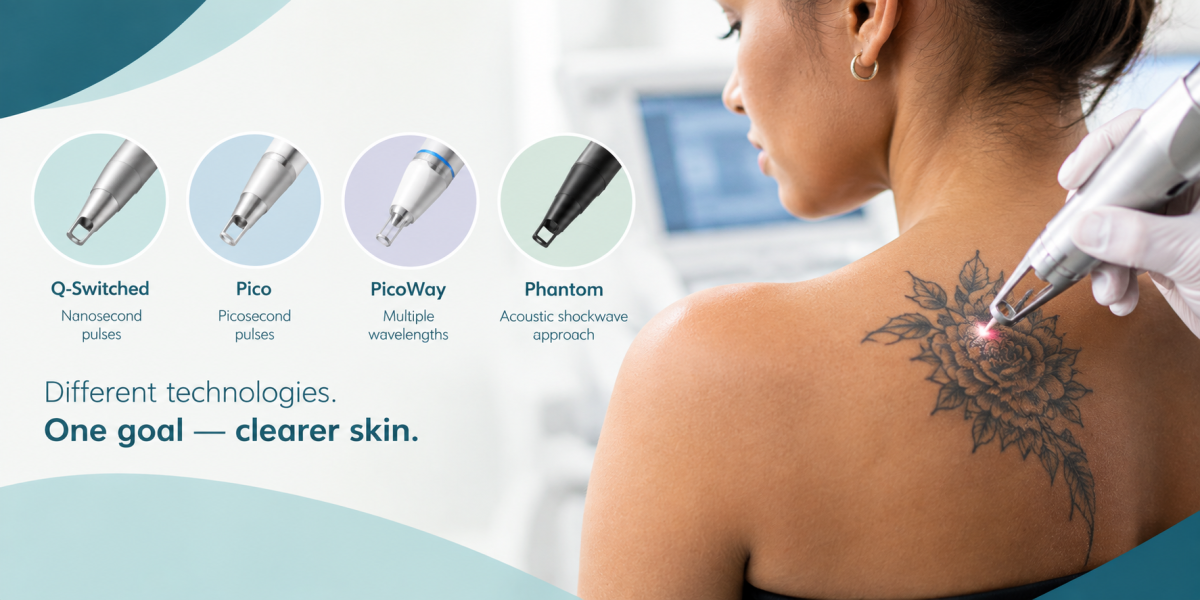
There are several factors to consider before a tattoo can be completely removed. Choosing the latest machine is not sufficient in most cases. The depth, age, color, size of the tattoo and the individual's skin type can significantly influence the treatment plan and the number of sessions required. Hence, when searching for Laser Tattoo Removal clinics in London, people often come across descriptions of several technologies including picosecond, Q-switched, and even newer lasers of which Phantom is a recent addition.
The way laser tattoo removal works is by breaking the tattoo ink into smaller particles and allowing the body to remove them over time. It is the different methods of delivering the energy that set apart lasers of various technologies. Familiarizing you with these differences will prepare you for a meaningful discussion with a laser tattoo removal expert when you see them in person.
What Characteristics Make a Laser Good Enough for Erasing Tattoos?
Precise control of high energy laser pulses is the main principle behind the success of laser tattoo removal. The laser breaks the color molecule down into fragments which the body absorbs and excretes. On the other hand, unnecessary tissue damage which accompanies traditional methods is largely minimized by such lasers.
One of the major differences in laser tattoo removal is the type of pulsed laser and its duration. For instance, while Q-switched machines produce pulses lasting a thousandth of a second, picosecond lasers emit pulses on the scale of billionths of a second. Studies indicate that picosecond lasers might offer some advantages regarding the removal of certain colors, especially when comparing similar lasers; nonetheless, results will differ according to the tattoo and the treatment plan used.
A laser device that is able to provide the right wavelengths of light corresponding to the various tattoo inks and sufficient energy level to achieve the target is essential.
|
Factor |
Why it matters |
|
Ink colour |
Different pigments respond to different wavelengths |
|
Ink depth |
Deeper pigment can require more treatment |
|
Tattoo age |
Older and faded tattoos may respond differently from fresh ink |
|
Skin type |
Settings must account for the surrounding skin |
|
Tattoo density |
Heavy or layered ink can take longer to clear |
Pico Laser Tattoo Removal London
The advancement of picotechnology has played a crucial role in changing the landscape of tattoo removal methods. Unlike the conventional nanosecond lasers, these systems deliver the laser energy in the form of picosecond pulses. This ultrafast laser pulse duration allows for the generation of intense photoacoustic effect which can break pigment into minute fragments.
Pigment colors such as blue, green and especially yellow have been found in some studies to respond very well to lasers that operate in the ultrashort range of laser pulse delivery. However, lasers of different types have different applications. According to a clinical review, both the Q-switched and picosecond lasers have potential, yet the latter seem to show greater advantages in handling difficult colors.
When thinking about getting laser Pico tattoo removal done in London, the main issue is not about whether a clinic is equipped with a Pico laser device. The professional should carry out a full examination of the ink used, skin thickness, level to which the tattoo has healed, and if there were any earlier treatments before deciding on the laser parameters.
PicoWay Tattoo Removal London
PicoWay is not a common term for all Pico lasers. Rather it refers to a particular platform. According to the manufacturer, the system delivers four wavelength: 532 nm, 730 nm, 785 nm and 1064 nm.
The possibility to switch wavelengths on PicoWay opens many doors in treating tattoo removal. It makes it possible to create an individualised course for a customer depending on the tattoos colours (the ink types).
In the case of a mixed multi-coloured tattoo (black, red, blue and green), it is very likely that you will need a combination of different wavelengths throughout the whole treatment course with PicoWay.
Those thinking about PicoWay tattoo removal London should, however, be aware that wavelength selection is just a small part of the puzzle. In order to make it work the practitioner, machine and clinical settings all have to play the part accordingly.
Q-Switched Laser Tattoo Removal
Since their advent decades ago, Q-switched lasers have enjoyed a reputation for reliability and efficacy in the field of tattoo removal. Their ability to produce rapid, very short, and intensely-focused bursts of energy that can then penetrate and fragment tattoo pigments via mechanisms of photothermal and photoacoustic.
In the medical field, these lasers have long been a fixture due to their extensive use and documented results. Even though they may have a dated feel, there is nothing in the evidence that suggests that such outdated feelings could be a reflection of actual performance. For example, their effectiveness for black ink is well attested to. What matters greatly though will be wavelength choice and the right treatment settings for a satisfactory tattoo removal effect.
Phantom Laser Tattoo Removal London
Phantom, according to a publication called the Institute of Medical Physics, is a novel method for laser tattoo removal. The clinic's description states that its Phantom system disrupts tattoos by means of acoustic shock waves instead of the standard heating method. The clinic further says its laser is termed "Skin-Blind, " which presumably means the laser will be able selectively target the tattoo ink with a very little disturbance of the skin surrounding the tattoo.
Dark melanin-rich skin can be a challenge when choosing a laser system since a lot goes into laser selection and parameter settings of any laser. From their description, the Institute of Medical Physics reveals their system is made to deal with different types of skin tones and ink colours.
In the matter of Phantom laser tattoo removal London, those wishing to find out more should, therefore, not limit their inquiry solely on the name of the technology. The skin type, tattoo characteristics, any prior treatments, etc., are also things a good consultant will examine during a pre-treatment session.
Pico vs Q-Switched vs Phantom
|
Technology |
Pulse or energy approach |
Key consideration |
|
Q-switched |
Nanosecond pulses |
Established option with different wavelengths |
|
Pico |
Picosecond pulses |
Very short pulses and strong pigment fragmentation |
|
PicoWay |
Picosecond platform |
Multiple wavelength options |
|
Phantom |
Acoustic shockwave approach described by the provider |
Different mechanism and approach to pigment targeting |
There is no single laser that can reasonably be called the universal winner for every tattoo. Published research shows that outcomes depend on pigment colour, laser type, treatment parameters and patient factors.
Which Option May Be Right for Your Tattoo?
A black tattoo may respond well to established Q-switched or picosecond technology, while multicoloured tattoos can require a more tailored wavelength strategy. Previously treated tattoos may also need a different approach if earlier sessions produced limited fading.
Skin tone deserves particular attention. Laser treatment can sometimes cause temporary redness, swelling or pigmentary changes, and published studies have reported hyperpigmentation and hypopigmentation among possible adverse effects.
For this reason, a consultation should cover the tattoo itself as well as the person's skin. Patch testing may also be recommended before a full treatment session.
Making a More Informed Choice
The search for the Best Laser Tattoo Removal in London option should focus less on marketing labels and more on how well the technology matches the tattoo. Q-switched systems have a long clinical history, picosecond platforms offer very short pulse durations and multiple wavelength options, while Phantom represents a different acoustic approach described by the provider.
The most useful consultation is one that explains why a particular technology and treatment plan have been selected. Looking at the device, the practitioner's qualifications, the assessment process and the expected treatment journey together can help patients make a more informed decision.
Frequently Asked Questions

The Institute of Medical Physics offers advanced laser tattoo removal in London using innovative Phantom technology, designed to treat all skin tones and ink colours with precision and care. Led by experienced medical professionals, we focus on faster results, minimal skin damage, and personalised treatment plans tailored to each patient. From small tattoos to complex multi-coloured designs, patients receive expert support throughout their removal journey in a modern, research driven clinical environment.



Comments (0)