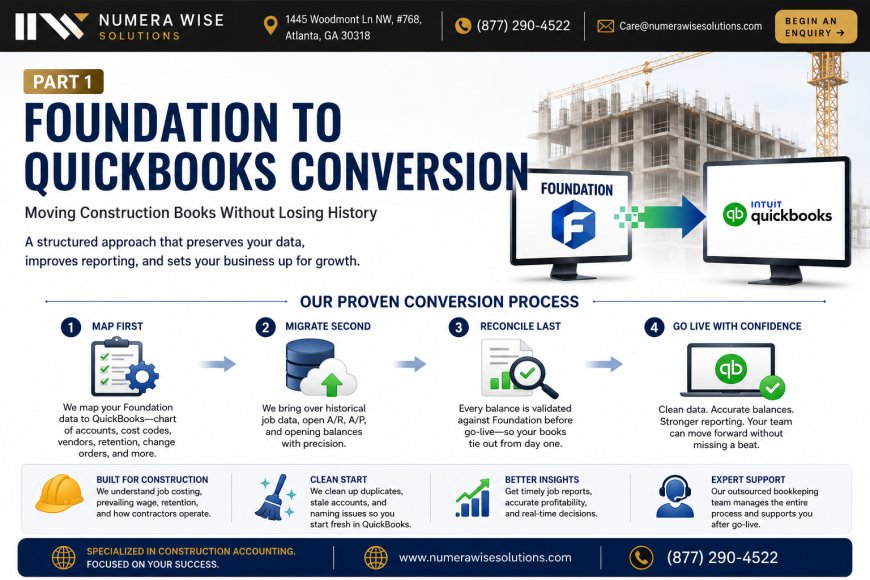
Can You Do a Foundation to QuickBooks Conversion Yourself?
It's a fair question, and the honest answer is: technically yes, but there are good reasons most construction firms don't. A Foundation to QuickBooks conversion looks straightforward from the outside — export the data, import it, done. The complications don't show up until you try to reconcile, and by then they're expensive to fix. Here's where DIY conversions usually run into trouble. The export looks cleaner than it is. Foundation pulls data readily, which creates false confidence. The problem isn't getting data out; it's getting it to line up correctly inside QuickBooks, which structures accounts and jobs differently. That mismatch is invisible until reconciliation. Job costing rarely maps one-to-one. This is the big one for contractors. Foundation's cost codes, phases, and committed costs don't translate neatly into QuickBooks items and classes. Without a deliberate mapping plan, you either lose detail or end up with job reports that don't match reality. Rebuilding that after the fact is painful. Opening balances are unforgiving. Every account has to tie back to the Foundation trial balance on the conversion date. Miss one, and the books never balance — which turns your first month in QuickBooks into a hunt for a discrepancy instead of a normal close. Retention and payables get messy. Open AP, retention held, and committed costs all need the right accounts and job references. Get them wrong and project profitability is off from day one, often in ways nobody notices until a job closes out. So when does DIY actually make sense? If you're a very small operation with simple books, minimal open jobs, and no complex job costing, you might manage it with patience and careful checking. The more entities, the more open projects, and the more cost-code detail you're carrying, the more the math tips toward bringing in help. The reason professional support usually pays for itself is simple: the cost of doing it wrong is higher than the cost of doing it right. A botched conversion doesn't just cost the migration fee — it costs weeks of cleanup, delayed closes, and reports you can't trust while you sort it out. Specialists who do this data migration work regularly have seen where it breaks and build the process to avoid those failure points. There's also an underrated benefit to handing it off: the migration becomes a cleanup opportunity. Duplicate vendors, stale accounts, and inconsistent job naming all get resolved as part of a professional conversion, so you start fresh rather than importing old problems. If you've got simple books and time to spare, a careful DIY Foundation to QuickBooks conversion is doable. If you're running real job costing across multiple projects, an outsourced bookkeeping partner will almost always get you a cleaner result with far less risk — and get you back to a normal close faster. Either way, the golden rule holds: fix the data before you migrate, not after.
 Numerawise
0
1