Lenovo Yoga Book 9: Dual-Screen Innovation
Lenovo Yoga Book 9 review: dual OLED screens, specs, pros/cons, and how it compares to the Dell Latitude 7350 and Dell 16 Plus.
 uaetechdubai
Introduction
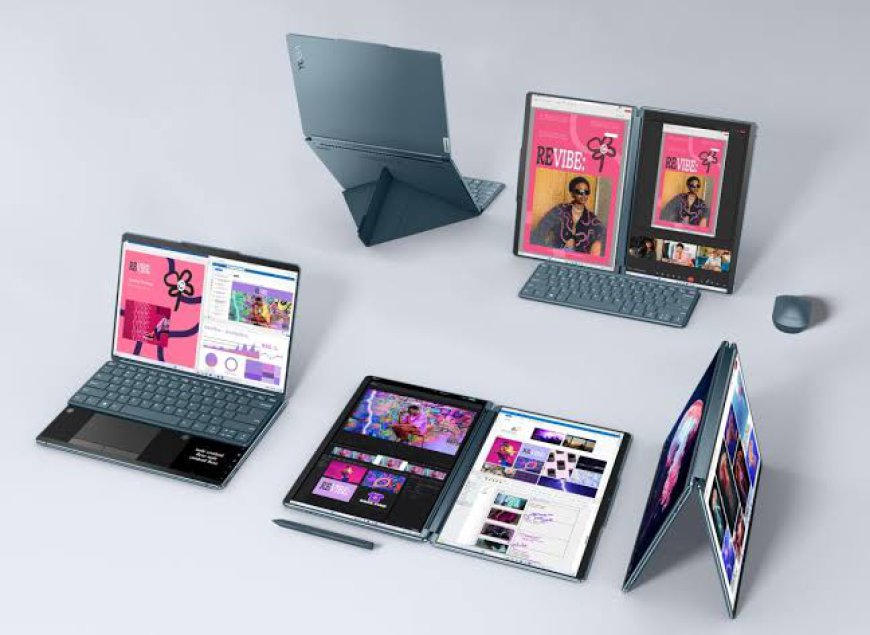
Most laptops still look and work the way they did a decade ago: one screen, one keyboard, one hinge. The Lenovo Yoga Book 9 throws that formula out the window. Instead of a physical keyboard, it gives you two full-size OLED displays connected by a single hinge, letting you build your own multi-monitor workstation out of a device that fits in a bag.
It's a bold idea, and like most bold ideas, it isn't for everyone. In this guide, you'll learn what the Yoga Book 9 actually is, how it performs in daily use, who it's genuinely good for, and how it stacks up against more conventional business machines like the Dell Latitude 7350 and the budget-friendly Dell 16 Plus. By the end, you'll know whether this dual-screen laptop deserves a spot on your shortlist or whether a traditional laptop will serve you better.
A quick naming note before we dive in: Lenovo markets this device as the "Yoga Book 9," and it's now in its 10th generation. If you've seen it referred to as the "Yoga Book 9," you're looking at the same dual-screen concept the brand has been refining since it first launched the idea back in 2023.
What Is the Lenovo Yoga Book 9?
The Yoga Book 9 is Lenovo's flagship dual-screen 2-in-1. Rather than pairing one display with a physical keyboard deck, it uses two identical 14-inch OLED panels joined by a 360-degree hinge that also houses the laptop's soundbar. <cite index="3-1">The current generation pairs the dual 14-inch OLED screens with an Intel Core Ultra 7 255H processor.</cite>
Because there's no built-in keyboard, Lenovo bundles a Bluetooth keyboard, a Bluetooth mouse, and a stylus in the box, along with a folio case that can prop the bottom screen up at an angle to mimic a traditional laptop layout. When you want a physical keyboard, you set it on top of the lower screen. When you don't, you can use the second display as extra screen real estate, a drawing tablet, or a place to jot notes by hand.
<cite index="7-1">This isn't Lenovo's first attempt at the concept the company has stuck with the dual-screen idea across several generations rather than abandoning it after one release.</cite> That persistence has paid off: each generation has brought meaningful upgrades to performance, battery efficiency, and software polish.
Design and Build Quality
Visually, the Yoga Book 9 is one of the more striking laptops on the market. <cite index="7-1">The chassis consists of two thin glass panels joined by a wide, chrome-finished hinge that doubles as the sound bar, with a matte-blue finish on the top and bottom surfaces and glossy edges that add a premium touch.</cite>
There's no denying the "wow factor" when you open the box. But that glass-heavy design comes with trade-offs worth knowing about upfront, which we'll cover in the pros and cons section below.
Display Quality
Display quality is where the Yoga Book 9 has always tried to earn its premium price tag. The panels use OLED technology, which means true blacks, vibrant colors, and strong contrast ideal for watching video, editing photos, or just making everyday work look sharper.
That said, independent lab testing has found some room for improvement. <cite index="4-1">Color coverage and brightness on the dual displays have trailed behind Lenovo's own single-screen Yoga models in past testing, with the panels achieving lower sRGB and DCI-P3 coverage and dimmer output than competing convertibles.</cite> It's still a good screen just not automatically the best OLED panel on the market simply because there are two of them.
Performance and Hardware
Under the hood, the current Yoga Book 9 generation punches above its weight. <cite index="7-1">The Intel Core Ultra 7 255H chip inside offers 16 cores, six of which are performance cores, and represents a notable step up over laptops running Intel's Core Ultra 7 256V or 258V processors.</cite>
Where the Yoga Book 9 looks less impressive is in memory and storage. <cite index="7-1">The base configuration ships with just 16GB of RAM and a 512GB SSD, which is modest compared to most Windows devices priced above $1,000, which typically offer 32GB of RAM and 1TB of storage.</cite> The good news: Lenovo has occasionally offered a doubled-up configuration <cite index="7-1">32GB of RAM and 1TB of storage for only a small price increase over the base model</cite> so it's worth checking current configurations before buying, since availability and pricing shift over time.
Battery Life
Dual OLED screens are power-hungry, and that shows up in real-world battery testing. Reviewers have consistently flagged battery life as the Yoga Book 9's weakest point, especially when both displays are active simultaneously. If all-day unplugged use is a priority, this is the area to scrutinize most closely before buying.
Who Is the Yoga Book 9 Actually For?
This laptop isn't trying to be a mainstream productivity machine, and it shouldn't be judged as one. It makes the most sense for:
-
Digital creators and note-takers who want a portable dual-monitor setup without carrying an external display
-
Presenters and consultants who need to show content to a client on one screen while referencing notes on the other
-
Tech enthusiasts who value a genuinely novel form factor and are willing to trade some battery life and storage for it
If you mainly need a dependable, no-fuss laptop for spreadsheets, email, and video calls, a conventional business laptop will likely serve you better which brings us to the comparison a lot of shoppers are actually trying to make.

Lenovo Yoga Book 9 vs. Dell Latitude 7350
The Dell Latitude 7350 represents almost the opposite design philosophy: a conventional, business-grade 2-in-1 built for reliability rather than novelty.
Design and durability: <cite index="10-1">Dell has tested the Latitude 7350 against extreme conditions, including temperatures from -20 to 140 degrees Fahrenheit, an hour of vibration testing, and elevations up to 15,000 feet, all while the system stays operational.</cite> It also features a spill-resistant keyboard and Gorilla Glass protection on the display. That's a level of ruggedness the glass-forward Yoga Book 9 simply doesn't prioritize.
Display: <cite index="11-1">The Latitude 7350 uses a 13-inch 3K touchscreen known for strong clarity and color accuracy.</cite> It's a single panel rather than dual OLED screens, so it won't give you the same multi-monitor flexibility, but it's a highly capable display for standard business use.
Performance: <cite index="14-1">Configurations of the Latitude 7350 include Intel Core Ultra 5 processors paired with 16GB of RAM and a 256GB SSD in typical builds.</cite> That's a step below the Yoga Book 9's Core Ultra 7 chip in raw power, but the Latitude line is built for consistent business performance rather than peak benchmarks.
Battery life: <cite index="9-1">Dell rates various Latitude 7350 configurations for roughly 11 to 12 hours of battery life</cite>, a meaningful advantage over the Yoga Book 9's dual-screen power draw.
Bottom line: Choose the Latitude 7350 if you need a rugged, reliable, security-focused machine for daily business tasks. Choose the Yoga Book 9 if your workflow genuinely benefits from having two full screens on the go.
Where the Dell 16 Plus Fits In
If both of the above feel like overkill or overpriced for your needs, the Dell 16 Plus is worth a look as a budget-conscious alternative. It's not a dual-screen device or a rugged business machine; it's a straightforward, well-priced productivity laptop.
<cite index="19-1">Dell's 16 Plus ships with an Intel Core Ultra 7 256V processor, 16GB of RAM, and Intel Arc 140V integrated graphics, giving it Copilot+ PC AI features through its built-in neural processing unit.</cite> <cite index="19-1">The display is a 16-inch 2560×1600 IPS panel with anti-glare coating, up to 300 nits of brightness, and a 120Hz refresh rate</cite> a great resolution and refresh rate combination for everyday multitasking, even if brightness levels lag behind premium OLED alternatives.
Pricing is the Dell 16 Plus's biggest selling point. <cite index="19-1">Dell has listed this configuration with a retail price around $1,149 while regularly discounting it to roughly $799, and occasionally as low as $699.</cite> That undercuts both the Yoga Book 9 and the Latitude 7350 by a wide margin.
The trade-offs are real, though. <cite index="17-1">The RAM is soldered, eliminating any future upgrade path, and storage is limited to a single M.2 slot.</cite> <cite index="21-1">Reviewers have also flagged a weak webcam, unimpressive speakers, and the absence of an SD card slot or touchscreen option on the base model.</cite>
Bottom line: The Dell 16 Plus is the pick for students, home users, or anyone who wants solid Copilot+ performance without paying a premium for a dual screen or rugged business chassis.
Pros and Cons of the Lenovo Yoga Book 9
Pros:
-
Genuinely unique dual-OLED form factor with real productivity upside
-
Strong CPU performance from the latest Core Ultra 7 processor
-
Bundled keyboard, mouse, stylus, and folio case add real value
-
Distinctive, premium design that stands out from typical laptops
Cons:
-
Battery life lags behind conventional laptops, especially with both screens active
-
Base configuration's 16GB RAM and 512GB storage feel tight for the price
-
Glass-heavy build may feel less durable for travel-heavy users
-
Learning curve adjusting to a keyboard-free base and dual-screen software
Frequently Asked Questions
Is the Lenovo Yoga Book 9 worth buying? It depends on your workflow. If you genuinely benefit from a portable dual-screen setup for presentations, note-taking, or multitasking on the go it's a compelling, well-built option. If you just need a reliable everyday laptop, a traditional device like the Dell Latitude 7350 or Dell 16 Plus will likely serve you better for less money.
Does the Yoga Book 9 have a physical keyboard? Not built in. It ships with a detachable Bluetooth keyboard that you place on top of the bottom screen when you want a traditional typing setup.
How does the Yoga Book 9 compare to the Dell Latitude 7350 for business use? The Latitude 7350 is the stronger pick for typical business tasks thanks to its longer battery life, MIL-SPEC-style durability testing, and enterprise security features. The Yoga Book 9 is better suited to creative or presentation-heavy workflows where the second screen adds real value.
Is the Dell 16 Plus a good alternative if I don't need dual screens? Yes. It offers solid Copilot+ PC performance, a sharp 120Hz display, and a much lower price point, making it a smart choice for students and everyday users, though you'll give up upgradability and some display and audio quality compared to pricier options.
Conclusion
The Lenovo Yoga Book 9 is proof that laptop design still has room for genuine experimentation. Its dual-OLED setup won't fit every workflow, and its battery life and storage configuration require some compromise, but for the right user a presenter, a note-taker, a creative professional who wants a second screen without carrying an external monitor it's one of the most interesting devices on the market today.
If you want maximum durability and business-grade reliability instead, the Dell Latitude 7350 is a strong alternative, while the Dell 16 Plus offers excellent value for shoppers who don't need a 2-in-1 at all.
Which one fits your workflow best? Share your thoughts in the comments, and if you found this comparison useful, pass it along to a colleague who's shopping for their next laptop.