QSaaS vs Traditional SEO Platforms: What Marketers Need to Know Today
 thatwarellp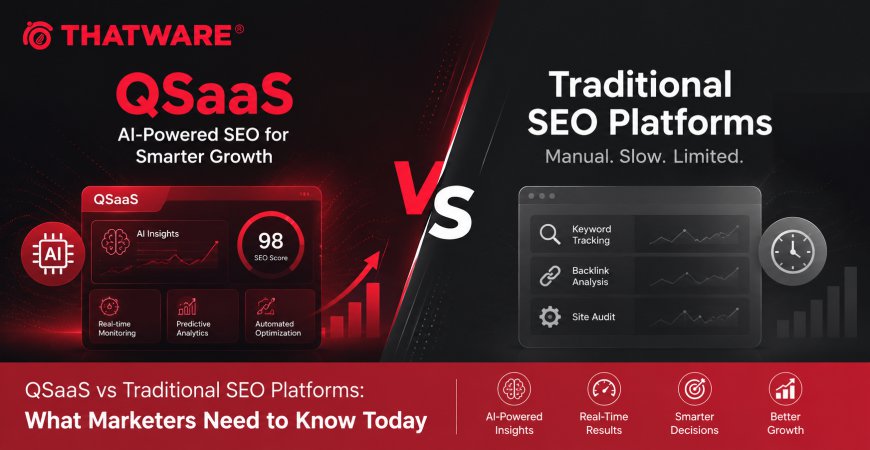
SEO has changed dramatically over the last few years. What used to be a straightforward process of tracking rankings, building backlinks, and fixing technical errors has now become far more layered and competitive. Businesses today are working in search environments shaped by AI, user intent, semantic relevance, and complex data relationships.
Despite this shift, many marketers still rely on traditional SEO platforms built around isolated metrics. They check rankings in one dashboard, backlinks in another, and technical audits somewhere else. Then they manually connect the dots and try to decide what matters most.
That process worked reasonably well when search competition was simpler. Today, it often creates blind spots.
This is where modern platforms like QSaaS services are changing the conversation.
Companies such as ThatWare are helping businesses move beyond fragmented SEO analysis toward systems that evaluate relationships between search signals instead of treating them as separate metrics.
The difference is bigger than most marketers realize.
Traditional SEO Platforms Focus on Individual Signals
Most standard SEO tools are designed to analyze specific data points independently.
One tool tracks rankings. Another measures backlinks. A separate platform audits technical SEO problems. Others focus on keyword gaps, content performance, or authority scores.
These platforms are useful because they provide visibility into individual performance indicators. Marketers can identify technical issues, monitor keyword movement, and review backlink growth relatively easily.
The problem appears when businesses try to turn all that disconnected information into meaningful strategic decisions.
For example, a tool might tell you:
- Your domain authority increased
- Three pages have thin content
- Your target keyword moved from position 10 to position 8
- Internal linking is weak on several pages
All of those insights are valuable individually. But none of them explain how those signals interact with one another.
That missing layer is where many SEO decisions become reactive instead of strategic.
The Real Difference Behind Modern QSaaS Platforms
The philosophy behind QSaaS seo services is fundamentally different.
Instead of treating SEO signals separately, these systems evaluate how multiple ranking factors influence one another simultaneously.
This creates a much deeper understanding of search performance.
Rather than simply identifying problems, advanced QSaaS platforms attempt to model relationships and predict outcomes based on connected data patterns.
For instance, instead of saying:
“Your page has thin content.”
A QSaaS platform may identify that:
- The weak content belongs to a topical cluster
- That cluster is limiting authority flow across related pages
- The issue is suppressing rankings for a high-conversion commercial keyword
- Improving the cluster may increase visibility across multiple connected pages
That is not just reporting. That is decision intelligence.
The insight moves from observation to recommendation.
Why This Matters More in Competitive Industries
For smaller businesses operating in less competitive markets, traditional SEO tools may still be enough.
If competition is moderate and the website structure is relatively simple, experienced marketers can often make good decisions manually.
But large-scale SEO environments work differently.
Enterprise e-commerce brands, SaaS companies, publishers, and competitive service industries deal with massive amounts of search data. In these environments, manually synthesizing disconnected insights becomes increasingly inefficient.
A single SEO decision can impact millions of impressions, thousands of conversions, or major revenue opportunities.
This is where advanced analysis becomes valuable.
Businesses operating at scale need systems capable of identifying relationships humans may overlook when reviewing isolated reports manually.
The Hidden Cost of Incomplete SEO Analysis
One of the biggest misconceptions in digital marketing is assuming bad SEO decisions happen because of a lack of data.
In reality, most businesses already have too much data.
The problem is interpretation.
Traditional SEO tools provide enormous amounts of information, but they often leave marketers responsible for deciding which issues deserve priority and which changes will create the biggest impact.
That introduces uncertainty.
A business may spend months improving technical issues that barely influence rankings while ignoring content architecture problems that directly affect authority distribution.
Or they may invest heavily in backlinks without realizing their topical structure is weakening overall relevance signals.
Poor prioritization creates wasted time, wasted budget, and missed growth opportunities.
Modern QSaaS platforms attempt to reduce that uncertainty by modeling relationships between signals rather than evaluating metrics in isolation.
Configuration Matters More Than Most Teams Expect
One thing many businesses underestimate is how important proper setup becomes with advanced SEO systems.
Traditional SEO tools are usually plug-and-play. You connect your website, generate reports, and start reviewing metrics immediately.
QSaaS environments are more sophisticated.
The platform needs context.
That includes:
- Competitive landscape
- Business goals
- Target search categories
- Commercial priorities
- Topical relationships
- Authority weighting
- Conversion objectives
Without accurate configuration, even advanced systems can produce misleading conclusions.
This is why businesses adopting QSaaS solutions should avoid rushing implementation.
The upfront setup process often determines whether the platform becomes a powerful strategic advantage or simply another expensive dashboard.
Why Human Judgment Still Matters
Even with advanced analytical systems, SEO still requires experience and critical thinking.
No platform can replace strategic understanding completely.
What advanced systems do best is improve visibility into relationships that would otherwise remain difficult to identify manually.
Marketers still need to interpret outputs carefully, evaluate business priorities, and apply contextual judgment.
Teams transitioning from traditional SEO tools often experience a learning curve because the analysis style feels different.
Instead of reviewing isolated rankings or backlink reports, they begin evaluating interaction models, topical influence patterns, and predictive insights.
That adjustment takes time.
The most effective approach is often running traditional platforms alongside QSaaS systems initially. This allows teams to compare outputs, build confidence, and understand how multi-dimensional analysis changes decision-making.
The Growing Importance of Predictive SEO Intelligence
Search engines have become increasingly complex. AI-driven algorithms now evaluate contextual relationships, user behavior, semantic relevance, and topical expertise more aggressively than ever before.
As search evolves, SEO platforms must evolve too.
This is one reason many marketers are exploring QSaaS platform benefits for search optimization through advanced analytical models that focus not only on current rankings but also on predictive relationships between authority, content depth, technical health, and competitive positioning.
The future of SEO will likely belong to businesses capable of understanding search ecosystems holistically instead of relying on disconnected metrics alone.
When Traditional SEO Platforms Still Make Sense
To be fair, not every business needs enterprise-level SEO infrastructure.
Smaller websites with limited competition may perform extremely well using standard SEO platforms combined with experienced strategy.
Traditional tools remain valuable for:
- Basic keyword tracking
- Technical SEO monitoring
- Competitor research
- Backlink analysis
- Site audits
- Performance reporting
For many businesses, these functions remain entirely sufficient.
The key question is not whether QSaaS is universally better.
The real question is:
How complex is your competitive environment, and what is the cost of making incorrect SEO decisions?
For businesses where SEO directly influences significant revenue, advanced analytical systems often justify the investment quickly.
Final Thoughts
SEO is moving toward deeper intelligence, not just more data.
Traditional platforms still provide useful insights, but modern search environments increasingly demand systems capable of understanding relationships between ranking signals rather than simply reporting isolated metrics.
That shift is what makes QSaaS platforms different.
Instead of only identifying problems, they help marketers understand how search factors influence one another and where optimization efforts are likely to create the highest impact.
For some businesses, traditional tools combined with strong strategic thinking will continue to work effectively.
For others, especially those competing in highly aggressive digital markets, the future may depend on more advanced analytical infrastructure capable of turning complexity into actionable insight.
The important thing is understanding which type of system matches the scale, goals, and competitive reality of your business today.