

Bar Mitzvah Hebrew Reading: How to Get Your Child Ready Without the Panic
Reading Hebrew means looking at a letter, knowing its sound, adding the vowel marks, and saying the word out loud.
Most kids who struggle before a Bar or Bat Mitzvah aren't struggling with Hebrew. They're struggling because they memorized sounds instead of learning to read, and memory only stretches so far.
Why kids who "know" their blessings freeze on a new line
I'm Yael Rottanburg, and I've been teaching people to read Hebrew since 1986. I have a BA in Hebrew, I spent a year studying at Hebrew University in Jerusalem, and I tutored for Rabbi Richard Lampert's "Learn to Read Hebrew in One Day" classroom course before building the lessons on this site.
Here's the pattern I see again and again. A child gets a recording and a sheet of transliteration. They practice for weeks. They can recite the blessings beautifully, eyes half closed. Then someone points to a line they haven't heard before, and they stall.
They never learned to read. They learned to imitate, and imitation works only while the recording is playing. That gap is where most of the pre-Bar Mitzvah panic comes from.
What "reading Hebrew" means here, and what it doesn't
Reading Hebrew means looking at a letter, knowing its sound, adding the vowel marks, and saying the word out loud. That's it. There are 22 letters, a small set of vowel marks, and one direction: right to left. If you want the full step-by-step breakdown, I walk through it in my guide on how to read Hebrew.
Most of what a Bar or Bat Mitzvah student reads from a prayer book or printed study text includes those vowel marks. A Torah scroll does not, and chanting from one uses melodies your synagogue's cantor or teacher will cover.
I want to be clear about my own lessons: they teach reading only. They don't teach chanting, writing, conversation or translation. What they give your child is the one skill everything else sits on.
A pace that works, from first letter to confident reading
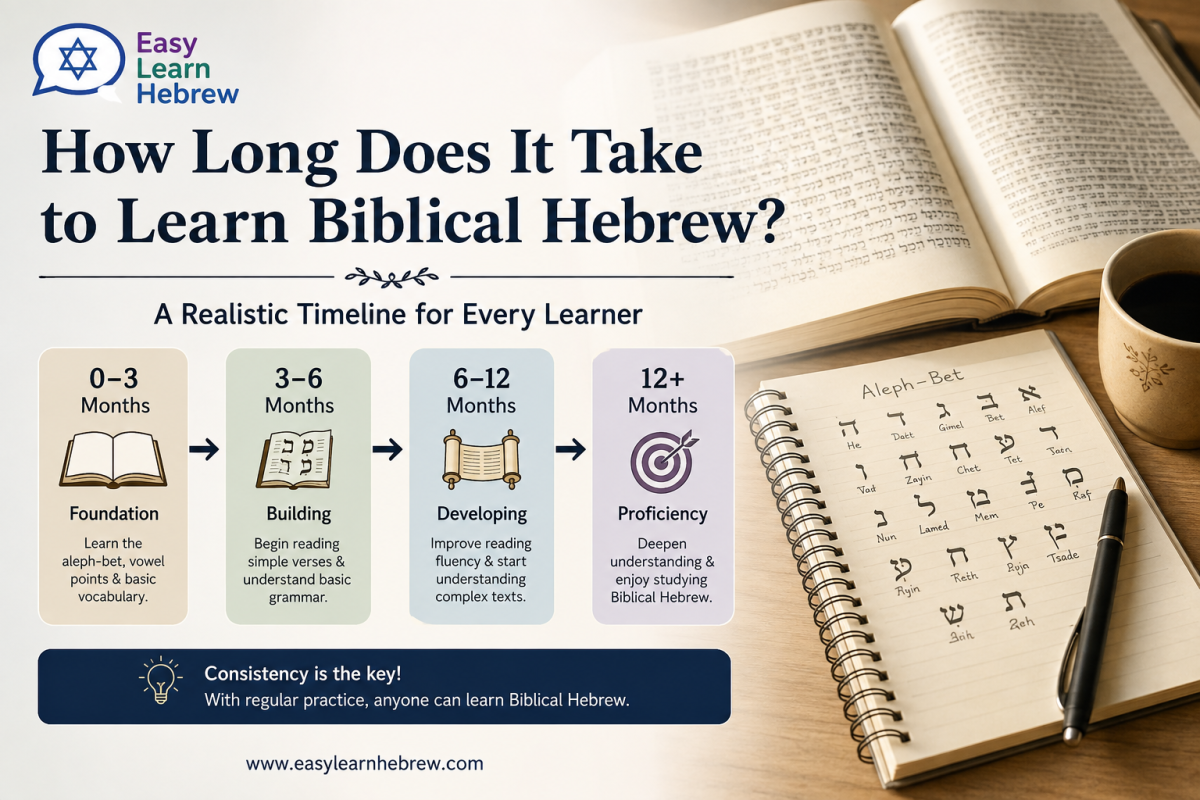
Most families I hear from start six to twelve months before the service. If you have less time, the order of the work matters more than the calendar. And in my experience, fifteen minutes every day beats a ninety-minute cram on Sunday.
1. Learn the letters with their sounds. Your child should recognize all 22 without peeking at a chart. Give extra time to the look-alikes, like Bet and Kaf or Dalet and Resh.
2. Add the vowel marks. Pair each vowel with a few consonants and read the syllables out loud, slowly. Speed comes later.
3. Move to whole words, then lines. Short, common words first. Have your child point with a finger and read aloud, even when it sounds clumsy.
4. Switch to your synagogue's real material. Once the reading is steady, the prayers and passages they'll actually use stop feeling like a wall. This is also where the cantor or teacher takes over with the melodies.
5. Review every week. Re-read last month's lines. Reading fades without repetition, and a quick revisit keeps it solid.
For many children the first two steps take a few weeks of steady practice. Pace varies a lot from child to child, and nobody gets a prize for rushing. If the date is still a few years off, or a younger sibling is coming up behind, my Hebrew reading program for kids gives them a gentle head start.
Mistakes I see parents make
● Starting with the prayers instead of the letters. Prayers feel like progress. But the letters are what let a child read the prayers without a recording.
● Leaning on transliteration. It's English spelling guessing at Hebrew sounds, and it falls apart the moment the text changes.
● Nagging instead of building a routine. A fixed slot, like right after dinner, works better than reminders at random hours.
● Skipping review. A child who read a line perfectly three weeks ago may not read it today. That's normal, and a weekly revisit fixes it.
● Counting on group lessons alone. A class moves at the pace of the whole room, which can leave a child who is still shaky on the letters quietly behind.
Where my self-paced lessons fit
The Bar and Bat Mitzvah Hebrew course on this site is fully online and self-paced. Your child watches the lessons and videos as many times as they need, whenever it suits your week, and you can sit beside them for the first few sessions. There's no class schedule to work around.
It doesn't replace your synagogue's teacher or cantor. It does the job before them: it gets your child reading well enough that those sessions go toward the parts only they can teach. The method behind it has been taught for more than 50 years, and students in 63 countries have used it.
If you'd like to see what's included, start with the Bar and Bat Mitzvah Hebrew prep page. Your child can take the first lesson this week.
Questions parents ask me
How long does it take a child to learn to read Hebrew for a Bar Mitzvah?
It depends on the child, how often they practice, and where they're starting from. Many children get through the letters and vowels in a few weeks of short daily practice, though reading smoothly takes longer. Starting six to twelve months before the service gives you comfortable room.
Can my child learn in time if the service is only three or four months away?
Often, for the reading part, if practice is daily. Tell your synagogue's teacher where your child stands so you can plan the remaining pieces together. I can't promise a result for any one child.
Does my child need to understand the Hebrew they're reading?
Not to read it. Reading and understanding are separate skills. My lessons teach reading only, so meaning and translation come from your synagogue or a separate course of study.
Do your lessons teach trope or Torah chanting?
No. Cantillation is best learned with your synagogue's cantor or teacher. A child who already reads well will have a much easier time with it.
Is online learning enough on its own?
For the reading skill, many families find it works well, because a child can repeat a lesson until it clicks. For the service itself, you'll still want your synagogue's guidance on the specific passages, melodies and customs.
Can I help if I don't read Hebrew myself?
Yes. You don't need to read Hebrew to sit beside your child, ask them to read a line aloud, and cheer when they get it. Many parents end up learning the letters right alongside their child.

If you want to learn about the Easy Learn Hebrew system, then click this link to get full details about the Easy Learn Hebrew system today. learn more to click here:- https://www.easylearnhebrew.com/
















Comments (0)