

Is Outdated Banking Software Slowing Down Your Digital Transformation?
Discover how outdated banking software limits digital transformation and how modern banking solutions improve security, efficiency, and customer experience.

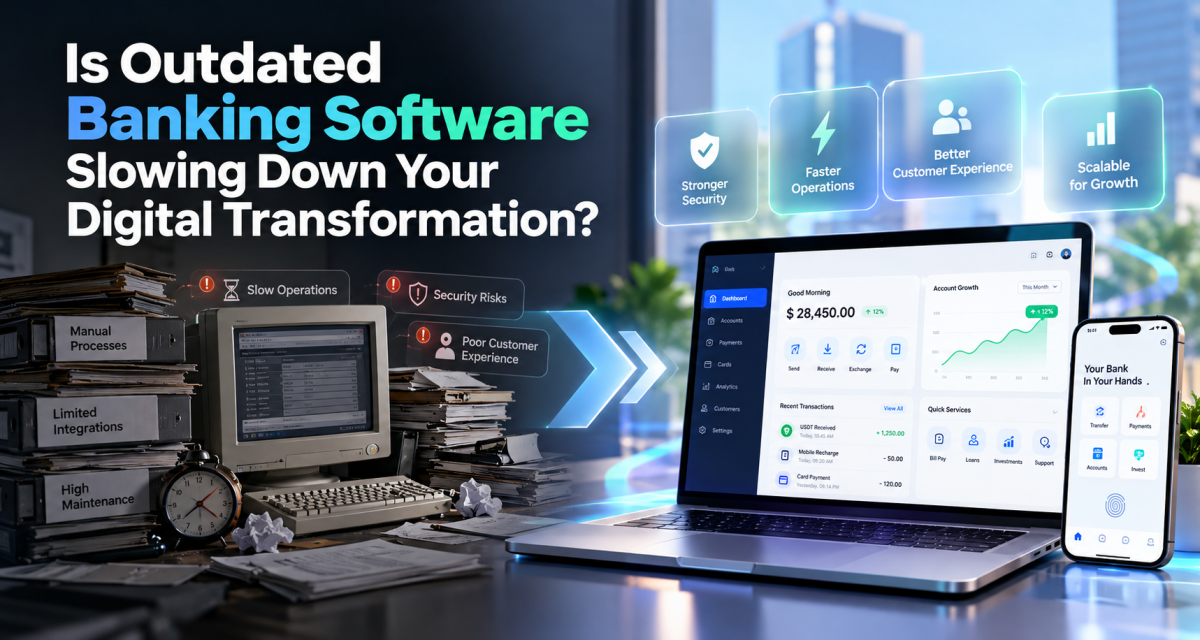
Customers expect banking to be fast, convenient, and accessible. They want to transfer money, check balances, manage payments, and access financial services without visiting a branch or waiting for manual approval.
But what happens when your banking software cannot keep up with these expectations?
Outdated banking systems can create operational bottlenecks, complicate integrations, and make new digital services harder to introduce. In my experience, the real challenge is not simply having old technology. It is whether that technology prevents your business from improving how banking services are delivered.
The short answer: Yes, outdated banking software can slow digital transformation by limiting automation, increasing maintenance complexity, creating integration challenges, and making it harder to deliver modern customer experiences. Working with a Banking Software Development Company can help financial institutions assess these limitations and plan a practical modernization strategy.
5 Signs Your Banking Software Needs an Upgrade
Not every legacy system needs immediate replacement. However, these warning signs deserve attention.
1. Manual Processes Are Consuming Valuable Time
If employees regularly reconcile transactions manually, transfer data between disconnected systems, or correct recurring processing errors, your software may be creating unnecessary work.
For example, a bank employee might need to export transaction records from one application and upload them into another system to complete reconciliation. Integrating these systems and automating suitable workflows can reduce repetitive tasks and improve operational consistency.
2. Integrating New Financial Services Is Difficult
Modern financial services often depend on APIs, payment gateways, identity verification tools, and third-party financial platforms.
Older banking applications may lack suitable integration capabilities or rely on outdated interfaces. This can make launching mobile banking features, digital payments, or new customer onboarding processes more complicated.
Custom banking software development can help address these gaps through secure APIs and carefully designed system integrations.
3. Customers Experience Friction
Slow account access, complicated onboarding, limited self-service options, and inconsistent information across digital channels can frustrate customers.
Imagine a customer updating personal information through a mobile application but finding the old details displayed when contacting customer support. Such inconsistencies may indicate that different systems are not sharing information effectively.
Modern digital banking solutions should support consistent customer experiences across web, mobile, and internal banking applications.
4. Maintenance Is Becoming More Complicated
Legacy systems can depend on outdated technologies, specialized technical knowledge, or components that are difficult to maintain.
When routine changes require significant development effort, your team may struggle to introduce new features quickly. Unsupported software components can also create security and compatibility concerns.
Modernization provides an opportunity to review dependencies, improve maintainability, and establish a clearer technology roadmap.
5. Security and Compliance Requirements Are Harder to Manage
Banking software must support appropriate access controls, transaction monitoring, audit trails, and data protection measures.
Older systems may lack the flexibility to accommodate changing security requirements efficiently. However, replacing legacy software alone does not guarantee stronger security. The solution must include proper architecture, testing, monitoring, and ongoing maintenance.
How a Banking Software Development Company Can Help
A suitable development partner should begin by understanding your existing infrastructure, business objectives, operational risks, and customer requirements.
Rather than recommending a complete rebuild immediately, the team should identify which components need improvement and which can remain in place.
Depending on your requirements, banking software development services may include:
-
Core banking modernization: Improving existing banking infrastructure while preserving essential business operations.
-
Digital banking application development: Building web and mobile platforms for account access, payments, and customer self-service.
-
Banking API integration: Connecting banking systems with payment providers, identity verification services, and other financial applications.
-
Workflow automation: Reducing repetitive administrative tasks through automated processes and system integrations.
-
Security-focused development: Implementing appropriate authentication, authorization, encryption, logging, and monitoring controls.
Explore Banking Software Development to learn more about banking software development options.
Should You Replace Your Entire Banking System?
Not necessarily. The right approach depends on the condition of your existing infrastructure and the risks involved in changing it.
Three common approaches are worth considering:
Incremental modernization: Upgrade specific components, such as customer onboarding or payment integrations, while retaining the existing core system.
System integration: Connect separate applications using secure APIs or integration layers to reduce data silos and improve information flow.
Full platform replacement: Consider a new banking platform when the existing system cannot reasonably meet essential business, security, scalability, or maintenance requirements.
A phased approach can make changes easier to test and manage. Before implementation, define migration requirements, data validation procedures, rollback plans, and service continuity measures.
How to Start Your Banking Digital Transformation
Start with a practical assessment instead of choosing technology first.
-
Identify bottlenecks: Document recurring manual tasks, integration failures, customer complaints, and maintenance issues.
-
Prioritize business outcomes: Decide whether your immediate goal is faster onboarding, improved payment processing, stronger security controls, or better scalability.
-
Review your architecture: Evaluate system dependencies, APIs, data flows, infrastructure, and third-party services.
-
Plan a phased roadmap: Select a manageable first project, establish measurable success criteria, and test the solution before wider deployment.
-
Measure the results: Track relevant indicators such as processing time, error rates, system availability, and customer completion rates.
This approach helps your organization invest in improvements that solve actual problems rather than introducing technology without a clear purpose.
Conclusion: Turn Legacy Limitations Into an Opportunity
Outdated banking software becomes a serious obstacle when it prevents your organization from responding to customer needs, integrating financial services, or maintaining reliable operations.
The solution is not always to replace everything. A clear modernization strategy can help you determine where custom banking software development, system integration, or a new digital platform will deliver the greatest value.
At CryptoApe, the starting point should be understanding your business requirements and identifying a suitable technical approach.
Ready to modernize your banking infrastructure? Explore our Banking Software Development Company services to discuss your requirements and plan your next step.
















Comments (0)