

2026 Software Development Trends Explained: Benefits and Use Cases
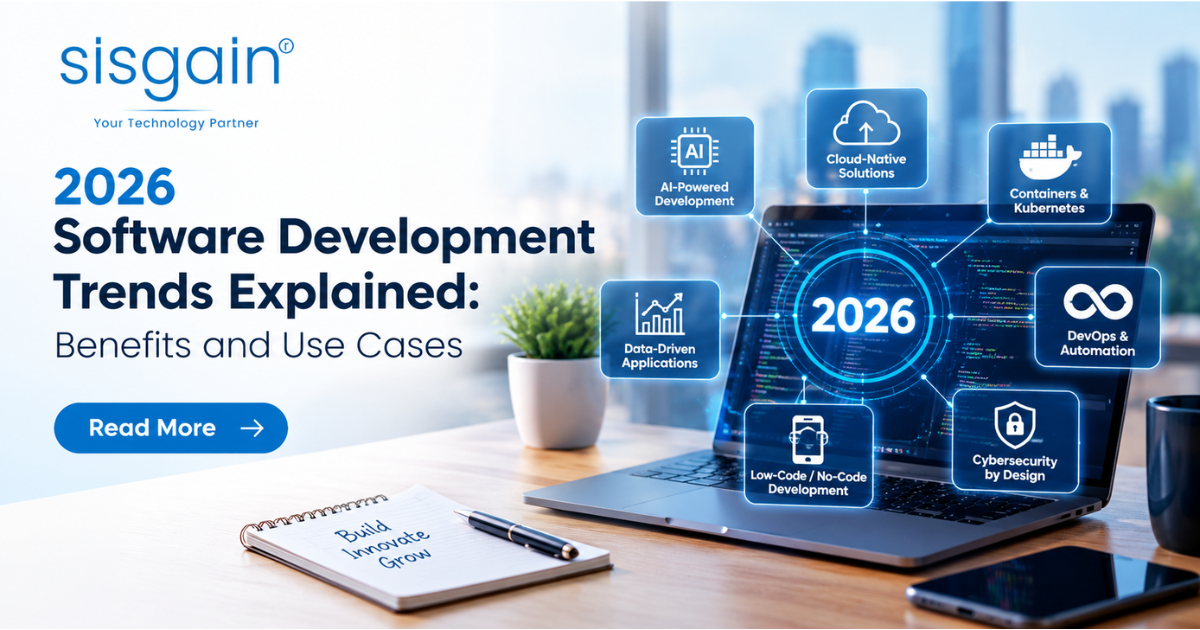
Software development once meant writing code, shipping an application, and moving on to the next project. In 2026, that model is giving way to something broader. Teams now design software around AI from day one, run it on cloud-native infrastructure, build it on shared internal platforms, and protect it with security that starts at the first commit.
For U.S. businesses, understanding the software development trends 2026 has brought into focus matters before any major budget is approved. Choosing the wrong technology, or the right one at the wrong time, can lead to costly rework. The central argument of this guide is simple: the most valuable trends are the ones that connect technology to measurable business outcomes, such as faster delivery, lower costs, stronger security, and better customer experiences.
One shift deserves early mention. AI coding agents are increasingly part of professional development workflows, yet human review and governance remain essential. Speed without oversight creates risk. The sections below explain each major trend, its benefits, and where it applies in real business scenarios.

AI-First Software Development
What it is. Many companies first added AI as an isolated feature, such as a chatbot bolted onto an existing product. AI-first development reverses that approach. Teams design the product around AI capabilities from the beginning, and they use AI across the software development lifecycle: analyzing requirements, generating code, writing tests, debugging, and producing documentation.
Key benefits:
- Faster development cycles
- Higher developer productivity
- Automation of repetitive tasks
- Faster testing and debugging
- Better personalization for end users
- Fewer development bottlenecks
Business use cases. AI-first approaches are showing up in enterprise applications, customer-service platforms, intelligent workflow systems, healthcare applications, financial technology, logistics platforms, and e-commerce personalization engines.
An important 2026 consideration. AI-generated code still needs testing, security checks, code review, and human oversight. Current research highlights the productivity gains from AI coding tools while also naming review and security as real challenges. Organizations that treat AI output as a draft rather than a finished product get the benefits with fewer surprises.
Companies building AI-first products often benefit from partnering with a logistic software development services that already has proven review and governance practices in place.
Agentic AI and Autonomous Software Systems
What it is. In simple business terms, an AI agent is software that can pursue a goal across multiple steps, use tools, and take action with limited prompting. It helps to compare it with its neighbors:
- Traditional automation follows fixed rules and breaks when conditions change.
- Generative AI produces content, such as text, code, or images, in response to a prompt.
- AI copilots assist a person who remains in control of each step.
- Agentic AI plans, decides, and acts across a workflow, within boundaries people define.
Benefits:
- Autonomous task execution
- Faster decision support
- Reduced manual intervention
- Continuous workflow monitoring
- Personalized actions
- Greater operational efficiency
Real-world use cases. Agents are being applied to IT service management, customer support, software testing, supply-chain management, logistics optimization, finance operations, and enterprise workflow automation.
The human-in-the-loop approach. Autonomous does not mean unsupervised. Responsible deployments define what an agent is permitted to do, monitor its behavior, escalate edge cases to people, and keep audit trails of every action. Governance is what turns an interesting demo into something a regulated business can trust.
Agentic AI is one of the major themes shaping the 2026 software industry, although organizations are still balancing autonomy with human oversight.
AI-Assisted Coding and Intelligent Developer Tools
What is changing. AI coding assistants, AI-powered IDEs, automated code generation, AI debugging, automated documentation, and AI-driven testing are becoming standard parts of the developer toolkit. Developers spend less time on boilerplate and more time on design and problem-solving.
Benefits:
- Faster prototyping
- Less repetitive coding
- Improved developer efficiency
- Quicker bug identification
- Better documentation
Use cases. Teams use these tools for legacy-code modernization, API development, unit-test generation, code refactoring, application migration, and MVP development.
The key point. AI should augment developers rather than eliminate engineering discipline. Generating code quickly is not the same as shipping reliable production software. Architecture decisions, performance tuning, security review, and maintainability still depend on experienced engineers. The teams that gain the most are the ones that pair fast generation with strong quality gates.
Cloud-Native and Hybrid Cloud Development
What it is. Cloud-native development builds applications specifically for cloud environments using microservices, containers, Kubernetes, APIs, serverless technologies, and cloud-native databases. Instead of one large application, teams deploy smaller services that can be updated and scaled independently.
Why it matters in 2026:
- Scalability to handle demand spikes
- Flexibility to change direction quickly
- Faster deployment
- Infrastructure automation
- Greater resilience
- Better resource utilization
CNCF's 2026 research highlights continued cloud-native adoption and increasing standardization through DevOps and platform environments, with hybrid cloud becoming particularly important. Many organizations now blend public cloud, private cloud, and on-premises systems to meet cost, latency, and compliance needs.
Business use cases. SaaS applications, global e-commerce, financial platforms, logistics systems, enterprise applications, and high-traffic customer portals all benefit from this approach.
A reliable software development services company can help teams choose the right mix of cloud-native patterns without overengineering the solution.
Platform Engineering and Developer Experience
What it is. Platform engineering creates internal developer platforms: standardized environments where developers can provision infrastructure on their own, reuse components, and deploy through consistent pipelines. Rather than every team assembling its own toolchain, a platform team offers a paved road.
Benefits:
- Faster development
- Consistent environments
- Reduced operational complexity
- Better developer experience
- Improved security controls
- Faster deployment
Use cases. Large enterprises, SaaS organizations, multi-team development environments, cloud-native companies, and any organization managing complex DevOps workflows see the strongest returns.
The 2026 perspective. Early cloud adoption was about getting workloads off local servers. The current shift is about what comes next: building standardized engineering platforms that make good practices the default. When security checks, observability, and deployment steps are built into the platform, teams move faster and make fewer mistakes.
Cybersecurity-by-Design and AI-Powered Security
Why security is becoming a development priority. Several forces are raising the stakes: growing application complexity, AI-generated code, exposed APIs, sprawling cloud infrastructure, autonomous AI systems, and software supply-chain vulnerabilities. A single weak dependency can compromise an entire product.
Key trend: shift-left security. Shift-left security means integrating security throughout the software development lifecycle rather than waiting until deployment. Threat modeling, automated code scanning, dependency checks, and secrets detection happen while the code is being written, when fixes are cheapest.
Benefits:
- Earlier vulnerability detection
- Lower remediation costs
- Better regulatory compliance
- Stronger application resilience
- Reduced overall security risk
Use cases. Financial applications, healthcare platforms, enterprise SaaS, government systems, and customer-facing applications all require this approach.
Deloitte's 2026 software outlook specifically identifies AI-powered cyber threats and increasing use of AI for security automation as important developments. In practice, that means attackers and defenders are both using AI, and businesses need security practices that keep pace.
API-First and Composable Software Architecture
What it is. API-first development treats APIs as foundational building blocks rather than afterthoughts. Teams design the interface first, then build applications and services around it. The result is software whose capabilities can be reused across products and integrated with outside systems.
Benefits:
- Faster integration
- Greater flexibility
- Reusability
- Easier modernization
- Better interoperability
Use cases. ERP and CRM integration, payment platforms, logistics systems, mobile applications, SaaS ecosystems, and enterprise data platforms rely heavily on well-designed APIs.
Composable architecture. Composability extends the idea. Instead of building every capability from scratch, businesses assemble reusable services, such as payments, identity, search, or notifications, into the product they need. This shortens time to market and lets teams swap components as requirements change.
Businesses planning API-led platforms often work with a software product engineering company to design architectures that remain flexible as the product grows.
Digital Product Engineering and Product-Centric Development
What it is. Product-centric development moves away from delivering software as a one-time project and toward continuously building and improving digital products. A project ends when it ships. A product keeps evolving based on how customers actually use it.
This approach joins several disciplines: product discovery, user research, UX design, engineering, analytics, and continuous improvement. Decisions are guided by real usage data rather than assumptions.
Benefits:
- Better customer experience
- Faster product iteration
- Stronger product-market alignment
- Improved scalability
- Long-term product value
Use cases. SaaS products, FinTech platforms, mobile applications, B2B software, digital commerce, and enterprise products all benefit from treating software as a living product. Strong Digital Product Management keeps these efforts aligned with business goals.
Intelligent Automation and Hyperautomation
What it is. Intelligent automation combines AI, APIs, workflow automation, robotic process automation (RPA), machine learning, and business rules to automate entire processes rather than single tasks. Hyperautomation is the broader effort to automate as many business processes as can reasonably be automated.
Benefits:
- Reduced manual work
- Lower operational costs
- Faster processes
- Fewer errors
- Improved employee productivity
Use cases. Finance automation, HR onboarding, customer service, order processing, insurance claims, supply-chain operations, and logistics workflows are common starting points. The best projects begin with a high-volume, rules-heavy process where savings are easy to measure.
Software Modernization and Legacy Application Transformation
Why it matters in 2026. Aging technology stacks carry rising maintenance costs, security limitations, integration challenges, and difficulty scaling. Legacy systems also make it harder to adopt AI, since they often lack the clean data access and APIs that modern tools expect.
Modernization approaches:
- Rehosting
- Refactoring
- Replatforming
- API enablement
- Microservices migration
- Cloud migration
The right choice depends on the application's value, risk, and condition. Many organizations modernize in phases rather than replacing everything at once.
Benefits:
- Improved performance
- Better scalability
- Lower technical debt
- Easier integration
- Stronger security
Use cases. Banking, insurance, healthcare, manufacturing, government, and logistics are among the industries with the most to gain.
Edge Computing and Real-Time Software
What it is. Edge computing processes data closer to where it is generated, such as on a device, in a store, or at a factory, instead of relying entirely on centralized cloud infrastructure.
Benefits:
- Lower latency
- Faster decisions
- Reduced bandwidth requirements
- Improved real-time performance
Use cases. IoT deployments, smart manufacturing, connected vehicles, fleet management, retail, healthcare monitoring, and logistics all depend on decisions made in milliseconds rather than seconds.
Green and Sustainable Software Engineering
What it is. Green software engineering designs applications and infrastructure to use resources more efficiently. It is often framed as an environmental issue, but it is just as much a cost-optimization strategy.
Benefits:
- Lower energy consumption
- Reduced infrastructure costs
- Better resource utilization
- More efficient cloud workloads
Use cases. Cloud applications, data-intensive platforms, AI workloads, and large enterprise systems stand to gain the most. Efficient code and right-sized infrastructure reduce the cloud bill and the carbon footprint at the same time.
How Businesses Should Choose the Right Software Development Trends

Rather than adopting every emerging technology, businesses should evaluate trends against practical criteria:
- Business objective: What problem needs to be solved?
- Customer requirements: Will the technology improve the user experience?
- Scalability: Can the solution support future growth?
- Security and compliance: Does the architecture meet industry requirements?
- Total cost of ownership: What are the long-term infrastructure and maintenance costs?
- Integration requirements: Can the new solution work with existing systems?
- Team capability: Does the organization have the required technical expertise?
- Measurable ROI: Can the organization track improvements in revenue, productivity, cost, speed, or customer satisfaction?
A trend that fails most of these tests is probably not ready for your business, no matter how much attention it receives.
How Software Development Trends Will Shape the Future
The trends above are not separate tracks. AI, cloud, automation, APIs, security, and product engineering are increasingly converging. AI agents will run on cloud-native platforms, call services through APIs, operate under built-in security controls, and be shaped by continuous product feedback.
The future of software development is not simply about writing code faster. It is about building intelligent, secure, scalable, adaptable, and business-focused digital products.

Conclusion
The most important software development trends in 2026 include AI-first development, agentic systems, cloud-native and hybrid architectures, platform engineering, security-by-design, API-first design, and intelligent automation. Each offers real benefits, but only when it is tied to a clear business need.
Companies should prioritize practical implementation over chasing every trend. Start with a specific problem, measure results, and expand from there. Teams that lack in-house expertise can move faster by working with experienced partners, whether that means a custom software development company, a software product engineering company, or a software development services company that can guide modernization and new platform builds from strategy through delivery.
What are the biggest software development trends in 2026?
The leading trends are AI-first development, agentic AI, cloud-native development, platform engineering, cybersecurity-by-design, API-first architecture, and intelligent automation.
How is AI changing software development in 2026?
AI now supports requirements analysis, coding, testing, debugging, and documentation, which raises developer productivity. Human review remains necessary for quality and security.
What is agentic AI in software development?
Agentic AI refers to systems that perform multi-step tasks on their own, using defined permissions and human oversight. Monitoring, escalation paths, and audit trails keep them accountable.
Is cloud-native development still important in 2026?
Yes. Containers, microservices, and Kubernetes deliver scalability and flexibility, hybrid cloud is growing in importance, and platform engineering is making cloud-native practices easier to standardize.
How can businesses choose the right software development trend?
Evaluate each option against business objectives, ROI, security, scalability, integration needs, and team capabilities before committing.
What role does cybersecurity play in modern software development?
Security is now built in from the start through automated testing, continuous monitoring, strong identity management, and governance, rather than added at the end.








Comments (0)