Fiber Optics Collimating Lens Market Generates US$ 1.75 Billion Incremental Growth Opportunity
Fiber optics collimating lenses are specialized optical components designed to convert divergent light emitted from an optical fiber into a parallel or collimated beam.
 raajblog
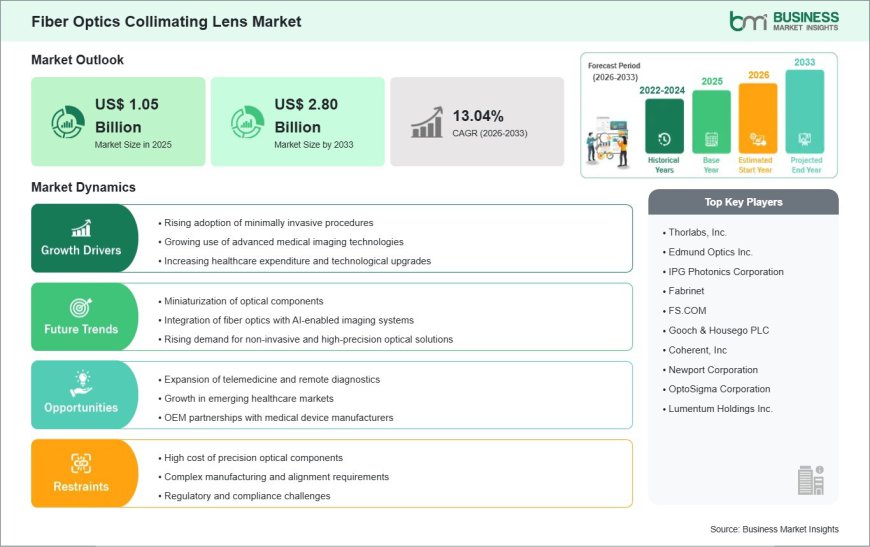
As modern data centers, aerospace defense systems, and medical diagnostics manufacturers increasingly prioritize high-performance laser assemblies and miniaturized photonics systems to accommodate massive cloud traffic, a rapid wave of component innovation is driving growth across the fiber optics collimating lens sector.
This strong expansion is substantiated by Business Market Insights, which highlights that the global Fiber Optics Collimating Lens Market is on track to record a 13.04% CAGR between 2026 and 2033, rising significantly from US$ 1.05 Billion in 2025 to US$ 2.80 Billion by 2033.
Technological advancements in photonics engineering, optical communication infrastructure, precision optics manufacturing, laser systems, and fiber-optic sensing technologies are transforming the Fiber Optics Collimating Lens Market. Manufacturers are increasingly developing compact, high-precision, and low-loss collimating solutions capable of supporting modern optical communication networks and emerging photonic applications.
Download Sample Report : https://www.businessmarketinsights.com/sample/BMIPUB00033354
What Are Fiber Optics Collimating Lenses?
Fiber optics collimating lenses are specialized optical components designed to convert divergent light emitted from an optical fiber into a parallel or collimated beam. These lenses improve optical signal transmission efficiency and enable accurate light coupling between optical fibers, sensors, laser systems, and photonic devices.
Collimating lenses are widely utilized in telecommunications networks, fiber-optic sensors, laser systems, spectroscopy equipment, biomedical devices, industrial automation systems, and aerospace applications. Their ability to minimize optical losses and maintain beam quality makes them essential components in modern optical communication and photonics infrastructure.
Market Drivers
A major driver of the Fiber Optics Collimating Lens Market is the rapid expansion of optical communication networks. Growing internet traffic, cloud computing adoption, data center investments, and deployment of next-generation broadband infrastructure are increasing the need for efficient fiber-optic transmission systems. Collimating lenses play a vital role in maintaining signal integrity across these high-speed communication networks.
The increasing adoption of fiber-optic sensing technologies across industrial, energy, healthcare, and defense sectors is also contributing significantly to market growth. Fiber-optic sensors require highly accurate optical coupling and beam management capabilities, driving demand for advanced collimating lens solutions.
Growing utilization of laser technologies in manufacturing, medical diagnostics, scientific research, and precision measurement applications is creating additional growth opportunities. Modern laser systems require highly efficient optical components to ensure accuracy, performance, and reliability in demanding operating environments.
Market Segmentation
By Product Type
- GRIN Lens: Widely used due to compact design, excellent coupling efficiency, and simplified optical alignment capabilities.
- Aspheric Lens: Provides superior beam quality, reduced aberrations, and enhanced optical performance.
- Others: Includes customized optical lens solutions designed for specialized photonic applications.
By Wavelength
- Below 1000 nm
- 1000–1500 nm
- Above 1500 nm
By Application
- Telecommunications
- Fiber Optic Sensors
- Laser Systems
- Medical Equipment
- Industrial Automation
- Scientific Research
By End User
- Telecommunication Providers
- Healthcare Organizations
- Industrial Manufacturers
- Aerospace & Defense
- Research Institutions
The GRIN lens segment dominated the market in 2025 due to its compact size, cost-effectiveness, and strong optical performance. The 1000–1500 nm wavelength segment accounted for a significant market share because of its extensive use in optical communication systems. Telecommunications remained the leading application segment as global demand for high-speed data transmission and fiber network expansion continued to increase.
Regional Insights
- North America held a significant share of the market in 2025 due to advanced telecommunications infrastructure, strong investments in photonics technologies, and the presence of major optical component manufacturers.
- Asia-Pacific is expected to witness the fastest growth during the forecast period owing to expanding fiber-optic network deployment, rapid industrialization, increasing data center investments, and growing adoption of advanced communication technologies across China, Japan, South Korea, and India.
- Europe continues to grow steadily through investments in optical communications, industrial automation, and scientific research programs.
- Middle East & Africa is experiencing increasing adoption supported by telecommunications modernization and infrastructure development initiatives.
- South & Central America is gradually expanding as broadband connectivity projects and digital transformation investments continue to accelerate.
Top Players in the Fiber Optics Collimating Lens Market
The market is highly competitive, with leading optical component manufacturers focusing on precision engineering, photonics innovation, and advanced lens technologies.
- Thorlabs Inc.
- LightPath Technologies Inc.
- Edmund Optics Inc.
- SCHOTT AG
- OZ Optics Limited
- Newport Corporation
- Photonics Solutions Group
- FOCtek Photonics Inc.
- Knight Optical Ltd.
- Gooch & Housego PLC
These companies continue investing in advanced optical manufacturing technologies, photonic integration solutions, and high-performance lens development to address evolving industry requirements.
Technological Innovations
Technological innovation is transforming the Fiber Optics Collimating Lens Market through advancements in micro-optics, precision glass molding, photonic integration, and high-performance optical coatings. These innovations are enabling manufacturers to improve optical efficiency, reduce insertion loss, and enhance beam quality across various applications.
Advanced manufacturing techniques are facilitating the development of miniaturized collimating lenses capable of supporting compact photonic devices and next-generation communication systems. Improved optical coating technologies are also enhancing durability, transmission performance, and environmental resistance.
The growing integration of photonics into artificial intelligence infrastructure, autonomous systems, quantum computing research, and advanced sensing technologies is creating new opportunities for fiber optics collimating lens manufacturers. These emerging applications require highly accurate and reliable optical components capable of supporting increasingly sophisticated optical architectures.
Future Market Outlook
The future outlook for the Fiber Optics Collimating Lens Market remains highly positive. Continued expansion of fiber-optic communication networks, increasing adoption of laser technologies, advancements in photonics research, and rising demand for optical sensing solutions are expected to support sustained growth through 2033.
As industries continue investing in high-speed connectivity, intelligent sensing systems, and advanced optical technologies, fiber optics collimating lenses will remain essential components within modern photonic infrastructure. Companies that focus on innovation, precision manufacturing, and next-generation optical solutions are expected to capture significant growth opportunities in the years ahead.
Frequently Asked Questions (FAQs)
What is the projected size of the Fiber Optics Collimating Lens Market by 2033?
The market is projected to reach US$ 574.68 Million by 2033, rising from US$ 335.42 Million in 2025.
What is the CAGR for the Fiber Optics Collimating Lens Market?
The market is expected to grow at a CAGR of 6.9% during the forecast period.
Which product type segment dominates the market?
The GRIN lens segment accounts for a significant market share due to its compact design, efficient optical coupling performance, and widespread adoption across optical communication applications.
Which application segment leads the market?
Telecommunications remains the dominant application segment driven by increasing fiber-optic network deployment and growing global data traffic.
Which region is expected to witness strong growth?
Asia-Pacific is expected to experience significant growth due to expanding telecommunications infrastructure, industrial development, and increasing investments in photonics technologies.
Browse More Reports:
https://www.businessmarketinsights.com/reports/advanced-wound-dressings-market
https://www.businessmarketinsights.com/reports/antimicrobial-coatings-for-medical-devices-market
About Us
Business Market Insights is a market research platform that provides subscription service for industry and company reports. Our research team has extensive professional expertise in domains such as Electronics & Semiconductor; Aerospace & Defense; Automotive & Transportation; Energy & Power; Healthcare; Manufacturing & Construction; Food & Beverages; Chemicals & Materials; and Technology, Media, & Telecommunications.
Contact Us
If you have any questions about this report or would like further information, please contact us:
Contact person: Ankit Mathur
Email: sales@businessmarketinsights.com
Phone: +16467917070