

HID Amico for Kuwait Hospitals and Clinics


Hospitals and clinics across Kuwait face a security challenge that most office buildings never encounter, controlling access for staff, patients, and visitors while keeping touchpoints to a minimum in clinical areas. HID Amico addresses that exact need as a contactless facial recognition reader built for fast, hygienic entry at pharmacies, operating theatres, maternity wards, and staff only corridors where a shared card reader or keypad is far from ideal.
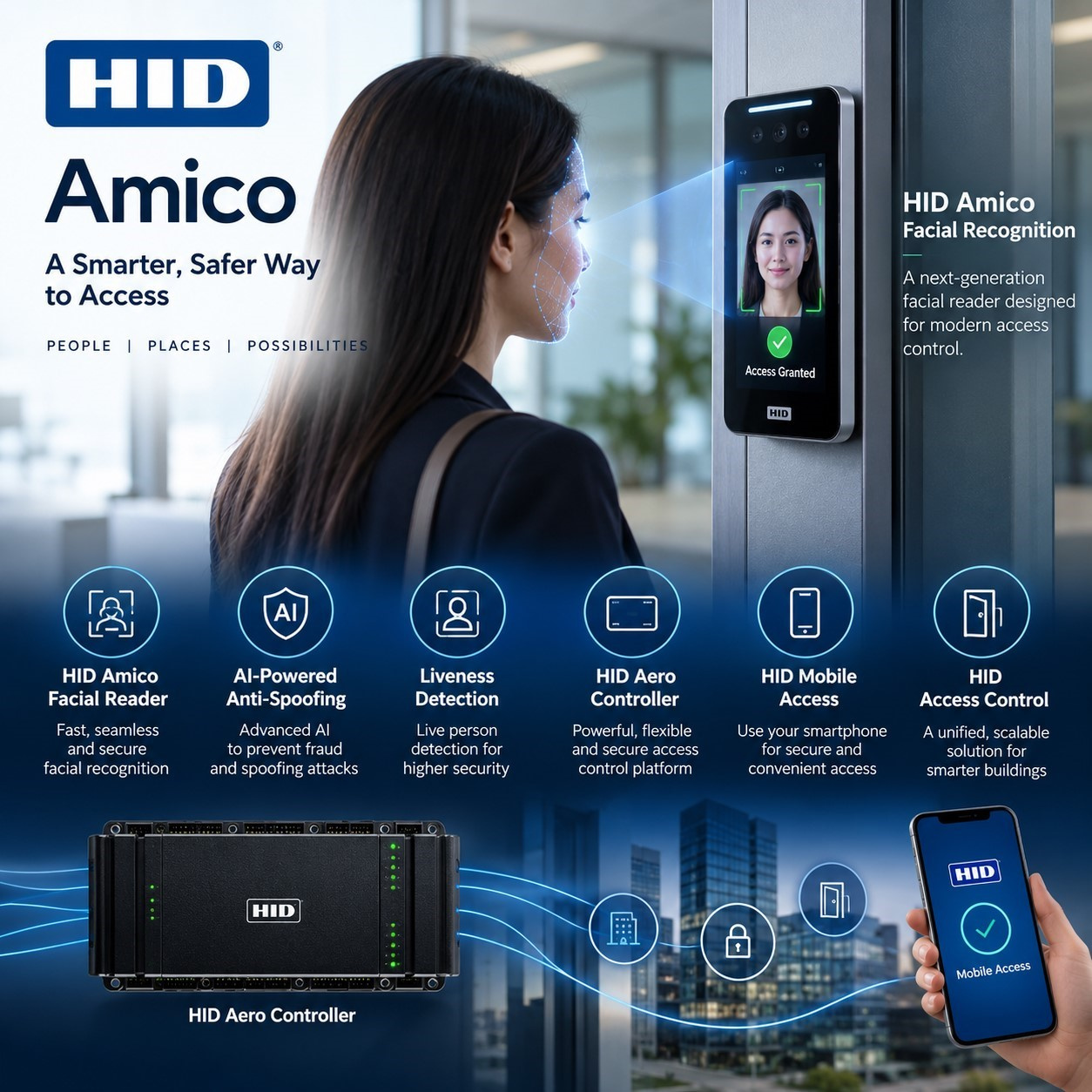
Tektronix supplies and installs HID security hardware across Kuwait and the wider Gulf region, and its HID Amico solution page brings this reader to Kuwaiti healthcare facilities looking to modernize entry security without disrupting clinical workflow. This article explains how HID Amico works, how it fits alongside the rest of the HID access control ecosystem, and why healthcare administrators across Kuwait are specifying it for new and upgraded facilities.
What HID Amico Brings to Healthcare Access Control
HID Amico is a facial recognition reader designed by HID Global, available in compact and larger screen formats, that authenticates a person by matching a live facial capture against an enrolled template rather than requiring a card tap or PIN entry at every door. In a hospital setting, this matters enormously because staff frequently move between wards with gloved or sanitized hands, making a touchless credential far more practical than a surface that needs to be touched dozens of times an hour and cleaned just as often.
The reader is built with flexible integration in mind, supporting a facility's existing HID credential ecosystem alongside the new facial option, so a hospital does not need to replace every door controller across an entire campus just to add facial recognition at its highest priority entrances.
HID Amico Facial Recognition at Entrances and Staff Only Zones
A pharmacy, a neonatal unit, and a records archive each carry a different level of risk if an unauthorized person walks through the door. HID Amico Facial Recognition lets a facility apply the same reliable technology at every one of these points while still enforcing different permission rules behind the scenes, so a nurse badge can open a general ward corridor while only a pharmacist's enrolled face unlocks the medication storage room a few steps further down the hallway.
HID Amico Biometric Reader Hardware for Clinical Environments
The HID Amico Biometric Reader supports several authentication methods on the same unit, including face, existing proximity or smart cards, a mobile credential, a QR code, and a PIN, which gives a hospital flexibility to match the verification method to the sensitivity of each door. A busy general entrance might rely on facial recognition alone for speed, while a sensitive clinical area can require a face match combined with a card or PIN for a stronger two factor check without needing a different reader model installed at that door.
HID Aero Controller: The Intelligence Behind Every Door
Readers only make sense alongside the controller hardware that actually enforces the access decision, and this is where the HID Aero Controller comes in. Built on HID's long established Mercury platform, the Aero controller line manages door logic, lockdown commands, and anti passback rules across a facility, and supports encrypted communication between the controller and the host software to protect against tampering. For a hospital running continuous operations around the clock, this kind of controller level resilience matters just as much as the reader technology at the door itself.
HID Access Control Across Multiple Clinic Locations
A healthcare group running several clinics across Kuwait needs its HID Access Control platform to manage every site from one administrative view rather than maintaining separate permission lists at each location. A physician who occasionally covers shifts at a second clinic can be enrolled once and automatically recognized at both sites, while a head office security team retains a single consolidated view of entry activity and compliance reporting across the entire group.
HID Mobile Access for Clinical Staff and Visiting Physicians
HID Mobile Access extends the same credential system to a smartphone, letting staff and visiting consultants carry their access rights on a device they already have rather than waiting for a physical card to be issued. This is particularly useful for Kuwaiti hospitals that regularly host visiting specialists or locum physicians for short assignments, since a mobile credential can be issued and revoked remotely within minutes rather than requiring someone to visit a badge office in person.
AI Powered Anti Spoofing and Liveness Detection in Clinical Settings
AI Powered Anti Spoofing technology analyzes a facial capture to confirm it comes from a live person rather than a printed photo or a video played on a phone screen, closing off one of the simplest ways someone might attempt to bypass a facial reader. Liveness Detection works alongside this check by examining subtle cues, such as natural movement and depth, that a static image or recording cannot reproduce convincingly. For a hospital protecting controlled substances or sensitive patient files, this layer of verification is what separates a genuinely secure deployment from one that merely looks modern at the door.
Why Kuwait Healthcare Facilities Are Choosing HID Amico Kuwait Deployments
Kuwait's healthcare sector has expanded rapidly, with new private hospitals and specialty clinics opening alongside government facility upgrades, and security specifications are increasingly written into these projects from the design stage rather than bolted on after opening. HID Amico Kuwait installations are appearing in exactly this context, driven by a combination of infection control priorities, a desire to reduce reliance on shared physical credentials, and growing regulatory attention on who can access patient records and controlled medication storage.
Data Privacy and Patient Safety Considerations
Deploying facial recognition in a healthcare setting raises data governance questions that a typical office installation does not need to answer as carefully. Hospitals should confirm whether enrolled facial templates are stored centrally or kept locally on each individual's credential, how long access logs are retained, and what happens to a staff member's biometric record once they leave the organization. A facility handling patient data under local privacy expectations benefits from a documented consent and retention policy for its own staff enrollment, not just for patient records, since the same privacy principles apply to both.
Engineering Experience and Trust Behind Every Installation
Tektronix has delivered physical security infrastructure, including access control and biometric reader deployments, across Kuwait and the wider Gulf for well over a decade, with an in house engineering team handling site surveys, network integration, and controller configuration rather than outsourcing installation to a subcontractor unfamiliar with the HID product line. Every deployment follows a documented enrollment and data retention process suited to the sensitivity of a healthcare environment, and the company maintains regional technical support so a malfunctioning reader does not leave a clinical area without a working checkpoint for an extended period.
Full technical documentation covering supported credential types, integration options, and controller specifications is available through the company's HID Amico page for Kuwait, giving hospital procurement and IT security teams verifiable detail to review rather than a marketing summary alone.
Choosing an HID Amico Partner for a Kuwait Healthcare Facility
Selecting a vendor for a hospital or clinic access control upgrade is as much about healthcare specific experience as it is about the hardware itself. Facility and IT teams should ask any prospective supplier about past healthcare deployments, how the platform handles biometric data retention for staff, whether the controller supports a clean integration with existing hospital management software, and how quickly local support can respond if a reader fails in a clinical area. Organizations that want a single accountable partner for hardware, software, and ongoing support can review Tektronix's full HID Amico access control solution before finalizing a shortlist of suppliers.
Planning Infection Control Around Entry Technology
Infection prevention teams at Kuwaiti hospitals increasingly treat shared door hardware as part of their overall contact surface strategy, alongside door handles, elevator buttons, and shared keypads. A touchless facial reader removes one more surface that dozens or hundreds of staff would otherwise touch during a single shift, and this benefit compounds at entry points near high risk clinical areas such as intensive care units and isolation wards where minimizing shared contact points is already a standing infection control priority.
Facilities planning a phased rollout often prioritize these high-risk clinical zones first, then extend touchless entry to general staff corridors and administrative areas once the initial deployment has proven out in daily use.
Planning for Future Expansion Across a Growing Facility
A hospital or clinic group expanding into new buildings or acquiring additional sites should choose an access control platform that scales without requiring a complete software replacement each time. Licensing structured around the number of doors or enrolled users, rather than a fixed package tied to a single building, gives a growing healthcare group room to add locations gradually without renegotiating an entire contract every time a new facility opens.
Choosing controller hardware that supports remote configuration and firmware updates also keeps a multiple site healthcare deployment manageable, letting a central security office push a policy change across every facility in Kuwait from one console rather than visiting each site individually.
Conclusion
HID Amico now gives Kuwaiti hospitals and clinics a faster, more hygienic way to control entry than a shared card or keypad ever could. HID Amico Facial Recognition and the HID Amico Biometric Reader bring flexible, multiple method verification to every clinical entry point. A HID Aero Controller and a unified HID Access Control platform keep every door and every clinic location working from one consistent set of rules. HID Mobile Access extends credentials to staff smartphones, while AI Powered Anti Spoofing and Liveness Detection keep every match genuinely secure.
Healthcare facilities evaluating HID Amico Kuwait projects should choose a partner like Tektronix with proven regional engineering and healthcare deployment experience.
FAQs
1. Can HID Amico be installed at only a few sensitive doors rather than the whole hospital?
Yes, many healthcare facilities start with high priority areas such as a pharmacy or records room and expand the deployment to additional doors over time as budget and planning allow.
2. Does facial recognition work reliably for staff wearing surgical masks?
Modern readers can match using the visible portion of the face around the eyes and upper features, though accuracy is generally highest when the enrollment capture was taken under similarly realistic conditions rather than a single unmasked reference photo alone.
3. How does the system prevent someone from using a photo to fool the camera?
Built in anti-spoofing and liveness checks analyze depth, texture, and subtle natural movement during capture, which a printed photo or a video played on a screen cannot reproduce convincingly, so a presentation attack is detected and rejected automatically.
4. Can visiting consultants or locum physicians be given temporary access quickly?
Yes, a mobile or facial credential can typically be issued remotely within minutes for a defined visit period and then automatically revoked once that period ends, without requiring an in person badge office visit.
5. What happens to a staff member's facial data if they leave the hospital?
A properly governed deployment includes a documented process that removes an individual's enrolled template and access rights within an agreed period after departure, and this policy should be confirmed in writing before the system goes live.











Comments (0)