Regulatory Changes & Compliance 2026 in Medical Billing
Stay ahead of medical billing compliance in 2026 with key CMS, HIPAA, and prior authorization changes every healthcare practice needs to know.
 Providerscarebilling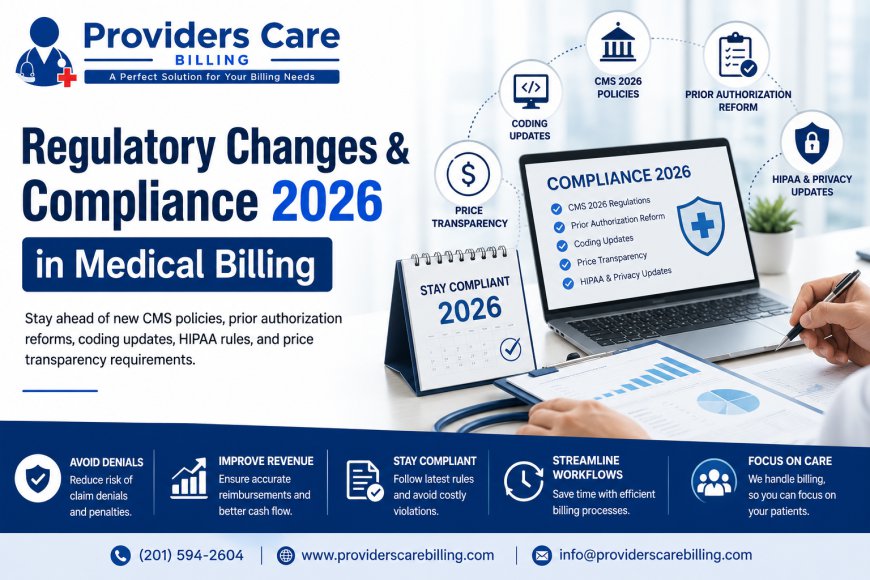
If you've felt like the rules keep shifting under your feet this year, you're not imagining it. 2026 has brought one of the busiest stretches of regulatory activity the healthcare billing world has seen in years-new CMS payment policies, a major overhaul of prior authorization, updated HIPAA privacy requirements, and a fresh push on price transparency. For practices and billing teams, staying on top of medical billing compliance in 2026 isn't optional anymore. It's the difference between clean, timely reimbursements and a growing pile of denials.
This article breaks down what's actually changed this year, why it matters, and how practices can stay compliant without drowning in paperwork.
Why 2026 Is a Turning Point for Medical Billing
Every year brings coding updates and minor policy tweaks, but 2026 is different. CMS finalized its Calendar Year 2026 Physician Fee Schedule with sweeping changes to how physicians get paid, introduced a major new prior authorization rule affecting Medicare Advantage and Medicaid plans, and pushed forward on price transparency requirements that have been years in the making. At the same time, HIPAA compliance deadlines tied to reproductive health privacy and updated Notices of Privacy Practices landed in February. Add in new ICD-10-PCS and HCPCS Level II codes, and it's clear why so many practices are re-evaluating their billing workflows this year.
Getting ahead of medical billing compliance in 2026 means understanding five major areas: physician payment changes, prior authorization reform, coding updates, price transparency, and privacy/security rules.
1. CMS 2026 Physician Fee Schedule: What Changed
The CY 2026 Medicare Physician Fee Schedule Final Rule reshapes how independent practices get paid, with a notable shift toward value-based care, behavioral health, and primary care management. A few of the biggest changes:
-
Two separate conversion factors now apply-one for qualifying Alternative Payment Model (APM) participants and one for everyone else, with the qualifying APM rate seeing a slightly larger increase.
-
New Advanced Primary Care Management (APCM) G-codes pay for non-face-to-face work like medication management, coordination, and follow-up work, which many practices were already doing without getting reimbursed for it.
-
Expanded telehealth flexibilities continue, though providers should watch closely for changes after key extension deadlines.
-
New payment rules for skin substitutes, now billed as incident-to supplies rather than under prior high-cost payment structures-a significant shift for wound care practices.
These CMS 2026 regulations create a real opportunity for practices that document carefully and code accurately, but they also raise the bar. CMS is leaning more heavily on AI-supported claim review to flag outliers, weak medical necessity documentation, and upcoding-meaning sloppy documentation is far more likely to trigger scrutiny than in previous years.
2. Prior Authorization: The Biggest Operational Shift
Perhaps the most consequential change for day-to-day billing operations is the CMS Interoperability and Prior Authorization Final Rule (CMS-0057-F), which took effect January 1, 2026. This rule fundamentally changes how quickly payers must respond to prior authorization requests:
-
Standard prior authorization decisions now have a strict 7-calendar-day turnaround.
-
Urgent requests must be decided within 72 hours.
-
Denials must include specific reasons, replacing vague language like "not medically necessary-a change that makes appeals far more actionable for billing teams.
This applies to Medicare Advantage organizations, state Medicaid and CHIP programs, Medicaid managed care plans, and Qualified Health Plan issuers on the federal exchanges. The electronic infrastructure to support these standardized FHIR APIs for prior authorization won't be fully required until January 2027, so many practices are still navigating a mix of digital and manual processes in the meantime.
For billing teams, this means prior authorization tracking needs to become far more disciplined. Missing the new response windows, or failing to build appeals around the newly required denial reasons, can mean leaving revenue on the table that should have been collected.
3. Coding Updates: ICD-10, HCPCS, and CPT Changes
Coding accuracy has always mattered, but the volume of changes in 2026 makes it especially easy to fall behind:
-
Eighty new ICD-10-PCS codes took effect April 1, 2026, concentrated in the New Technology section, including gastrointestinal inspection procedures and subcutaneous device insertions.
-
The January 2026 HCPCS Level II update introduced hundreds of new, revised, and discontinued codes, including new C-codes for high-cost implantable devices and dozens of new M-codes focused on documentation of clinical rationale.
-
New CPT codes for remote monitoring now allow billing for shorter data transmission windows within a 30-day monitoring period, reflecting how remote patient monitoring is actually used in practice.
Claims submitted with outdated codes or incorrect descriptors for dates of service in 2026 face a meaningfully higher risk of denial. This is one of the clearest, most practical pieces of medical billing compliance for 2026 that every practice needs to act on immediately-code sets need to be current, and coders need ongoing training to keep up.
4. Price Transparency and the No Surprises Act
Price transparency enforcement has intensified this year. The updated Hospital Price Transparency requirements, finalized as part of the CY 2026 Outpatient Prospective Payment System rule, began enforcement on April 1, 2026. Hospitals now face closer scrutiny over the accuracy and completeness of their machine-readable pricing files.
Separately, proposed updates to the Transparency in Coverage rules-which govern how health plans disclose pricing to patients-were open for public comment earlier this year, with proposed changes aiming to make cost-sharing information more consistent whether accessed online, by phone, or in print. These updates build on No Surprises Act protections, including good faith estimates for uninsured patients, though Advanced Explanations of Benefits for insured patients still haven't been fully implemented.
For billing departments, this means patient-facing cost estimates and balance billing protections need to be handled correctly and consistently; errors here don't just create compliance risk; they create real patient trust problems.
5. HIPAA and Privacy Updates
HIPAA compliance requirements shifted meaningfully this year as well. The compliance deadline for updated Notices of Privacy Practices, tied to new protections around reproductive healthcare information, landed on February 16, 2026. Covered entities were required to add new language addressing how reproductive health information is used and disclosed, along with new attestation requirements, before certain PHI requests can be fulfilled.
Beyond that specific deadline, 2026 has brought a broader emphasis on:
-
Stronger multi-factor authentication and encryption expectations under the HIPAA Security Rule
-
Faster, more standardized patient right-of-access processes
-
New governance expectations around AI tools used in documentation and clinical decision support
Billing teams handling patient data need systems and training that reflect these updated expectations-not just to avoid penalties, but because payers and auditors are paying closer attention to documentation integrity across the board.
What This Means for Practices
Taken together, these changes point to one clear trend: CMS and HHS are tightening documentation standards while simultaneously opening new revenue opportunities for practices that can keep up. The practices that struggle in 2026 will largely be the ones treating billing as a background task instead of a strategic function.
Here's what practices should be doing right now:
-
Audit current coding practices against the 2026 ICD-10-PCS and HCPCS updates
-
Rebuild prior authorization workflows around the new 7-day and 72-hour response windows
-
Update Notices of Privacy Practices if this hasn't already been done
-
Review patient cost-estimate processes for No Surprises Act compliance
-
Strengthen documentation habits to withstand AI-supported claim review
Why Outsourcing Makes Compliance Easier
Keeping up with this level of regulatory change is a full-time job in itself-and for most small and mid-sized practices, it's simply not realistic to expect front-desk or admin staff to track CMS rulemaking, HIPAA deadlines, and quarterly code updates on top of everything else they do.
This is where a specialized billing partner earns its value. A dedicated team that lives in these regulations daily can catch outdated codes before they cause denials, structure prior authorization follow-up around the new response windows, and keep documentation aligned with what payers now expect. Instead of practices reacting to denied claims after the fact, outsourced billing teams build compliance into the process from the start-protecting both revenue and peace of mind.
Meet Providers Care Billing LLC
Keeping pace with all of this is exactly what Providers Care Billing LLC specializes in. Their team of certified coders and billing specialists stays current on every CMS rule change, prior authorization deadline, and HIPAA update, so practices don't have to track it all themselves. With a 98.71% clean claims rate, dedicated billing managers, HIPAA-compliant systems, and rates starting at 2.49% of collections, they help practices turn 2026's regulatory complexity into fewer denials and faster reimbursements-not more administrative headaches.
Conclusion
Medical billing compliance in 2026 isn't a single checklist-it's an ongoing set of moving parts across payment policy, coding, prior authorization, privacy, and price transparency. The regulatory pace this year has been faster than usual, and practices that treat these changes as one-time updates rather than ongoing operational shifts are the ones most likely to see denials and revenue disruption.
Staying compliant doesn't mean tracking every Federal Register update yourself. It means building (or partnering with) a billing process that's built to adapt as the rules keep changing-because in 2026, they're changing more than ever.