Silver Powder for Solar Cell Paste: Material Innovations, Cell Architectures, and Emerging Trends
 anekpatel25
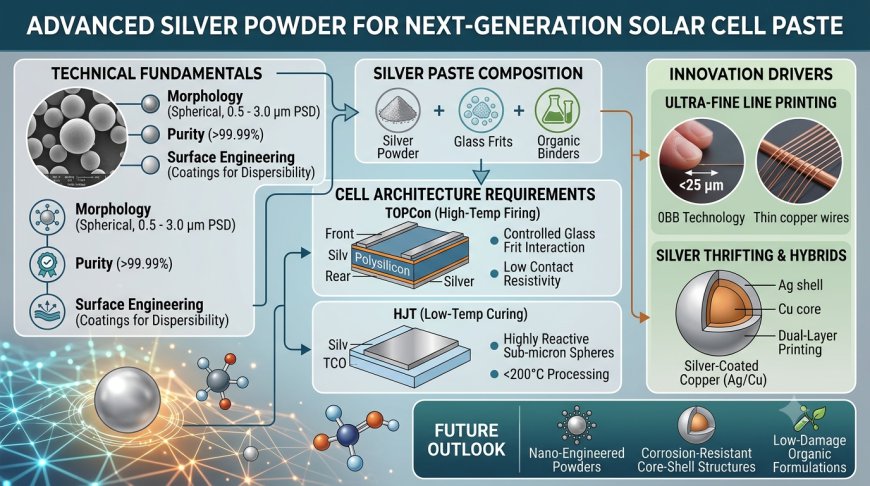
As global photovoltaics transition from conventional PERC architectures to high-efficiency N-type technologies, silver powder remains the single most critical active component in solar cell metallization paste. Functioning as the conductive backbone of front-side fingers, busbars, and rear-side contact grids, high-purity silver powder directly determines a solar cell’s fill factor, carrier collection efficiency, and long-term durability.
Driven by escalating metal prices and the strict performance criteria of next-generation cell designs, the formulation of silver powder is undergoing significant structural and material evolution.
Technical Fundamentals of Photovoltaic Silver Powder
Solar cell silver paste is a complex composite consisting of silver powder, inorganic glass frits, organic binders, and functional additives. Among these, silver powder typically accounts for 80% to 90% of the total paste weight.
To form low-resistance ohmic contacts during high- or low-temperature curing, silver powders must satisfy stringent chemical and physical parameters:
-
Morphology: Spherical particles dominate front-side conductive pastes due to their optimal packing density and predictable sintering kinetics. Flake-morphology powders are selectively blended in low-temperature formulations to lower the percolation threshold and increase surface contact area.
-
Particle Size Distribution (PSD): Advanced formulations utilize multi-modal or tightly controlled PSDs—typically ranging from 0.5 µm to 3.0 µm. Sub-micron and nano-scale particles fill the interstitial voids between larger spheres, promoting rapid necking and dense sintering during thermal processing.
-
Purity and Surface Chemistry: Purity levels exceeding 99.99% are essential to prevent trace contaminants (such as iron or heavy metals) from causing carrier recombination or degrading power conversion efficiency. Specialized organic surface coatings (such as fatty acids) are applied to regulate dispersibility and prevent premature agglomeration in organic vehicles.
Performance Requirements across Cell Architectures
The shift toward advanced N-type silicon architectures—primarily Tunnel Oxide Passivated Contact (TOPCon) and Heterojunction (HJT) cells—has significantly shifted the formulation requirements for silver powders.
| Feature / Metric | TOPCon Metallization | Heterojunction (HJT) Metallization |
| Thermal Processing | High-Temperature Firing (~700°C – 800°C) | Low-Temperature Curing (<200°C) |
| Powder Requirement | High thermal stability, controlled glass frit interaction | High surface reactivity, sub-micron/nano-engineered spheres |
| Contact Resistivity | Ultra-low (<1.5 mΩ·cm²) | Low contact resistance on conductive oxides (TCO) |
| Metallization Pattern | Dual-side silver grid (Front & Rear) | Dual-side low-temp silver paste |
| Silver Loading Strain | Moderate thrifting via fine lines | High silver consumption per cell (Thrifting priority) |
TOPCon Metallization
TOPCon technology requires front-side and rear-side pastes capable of penetrating or contacting ultra-thin passivation layers without destroying the underlying junction. Silver powders designed for TOPCon must possess controlled sintering behavior that complements aggressive glass frits, ensuring low contact resistance on heavily doped polysilicon while achieving finger widths under 25 microns.
Heterojunction (HJT) Metallization
Because HJT cells utilize temperature-sensitive amorphous silicon layers, the metallization paste cannot be fired at traditional high temperatures. Instead, HJT utilizes low-temperature curing pastes that harden below 200°C. To achieve acceptable electrical conductivity without high-temperature thermal sintering, HJT pastes rely on ultra-fine, highly reactive sub-micron silver powders and tailored organic resins.
Key Drivers and Technological Innovations
1. Ultra-Fine Line Printing and 0BB Technology
To reduce material costs, the PV industry is aggressively shrinking print line widths down to less than 20 to 30 microns. Finer finger patterns demand silver powders with uniform particle size, low agglomeration, and superior rheological behavior to prevent screen clogging or finger breakage during high-speed screen printing.
Concurrently, the industry-wide adoption of Zero-Busbar (0BB) technology eliminates conventional thick busbars, replacing them with dense networks of ultra-fine copper wires. This shift alters paste requirements, prioritizing ultra-fine line printability and adhesion over thick-film conductivity.
2. Silver Thrifting and Hybrid Metallization
With silver accounting for a substantial portion of total module production costs, manufacturers are actively pursuing "thrifting"—reducing silver mass per cell without sacrificing efficiency.
-
Silver-Coated Copper (Ag/Cu) Powders: By encapsulating a copper core within a uniform silver shell, paste developers can replace 60% to 80% of the silver content in select low-temperature and rear-side pastes. Core-shell powders dramatically cut material expense while preserving electrical conductivity and oxidation resistance.
-
Dual-Layer Printing: Layered printing techniques allow high-purity silver powder to be concentrated exclusively at the silicon-metal contact interface, while lower-cost conductive materials form the upper current-carrying grid.
Future Outlook
The trajectory of silver powder innovation is closely bound to the scaling of high-efficiency photovoltaics. As cell manufacturers target conversion efficiencies beyond 25% and explore Perovskite-Silicon Tandem architectures, silver powder development will center on:
-
Nano-Engineered Spherical Powders: Tailored surface kinetics to enable complete densification at lower curing temperatures.
-
Corrosion-Resistant Core-Shell Structures: Advanced passivation for silver-coated copper and base-metal hybrids to ensure 25-to-30-year module reliability under humid or high-temperature field conditions.
-
Low-Damage Organic Formulations: Powders optimized for green, solvent-free organic vehicles that reduce volatile organic compound (VOC) emissions during cell processing.
Through continuous refinements in particle morphology, surface chemistry, and material substitution, silver powder will remain a foundational enabler of high-performance solar energy deployment worldwide.