

What Does an AI Detector Actually See When It Reads Your Writing?
Go inside an AI detector to see what it measures in your text, why honest writers get flagged, and how to respond fairly when a score looks wrong.


Introduction
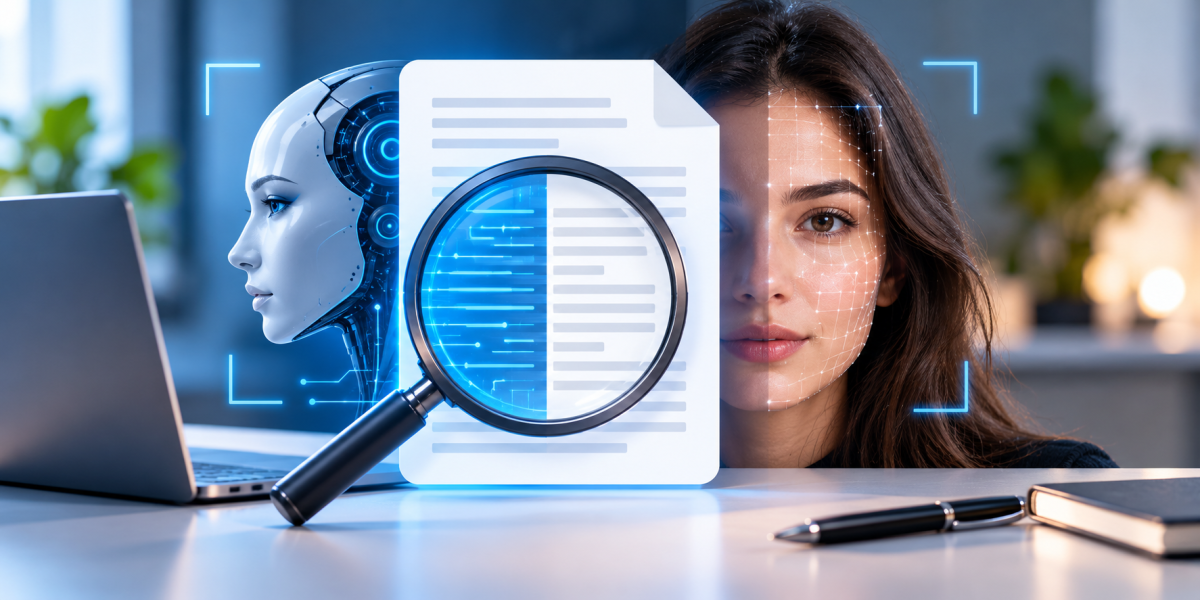
When you paste a paragraph into an AI detector, the software does not read it the way a teacher or editor would. It does not follow your argument, judge your sources, or notice that you wrote about a place you really visited. It sees a string of words and measures how closely their patterns resemble the text it was trained to label. Knowing this changes how you should interpret a result, whether you are a student checking your own draft or a manager reviewing someone else’s.
Reading Without Understanding
A detector is a classifier. During training, it studies large sets of text labeled as human-written or machine-written and learns which statistical traits separate them. When you submit new text, it compares your passage against those learned patterns and returns a probability or a label.
Two traits are often discussed in explanations of how these tools work:
-
Predictability. Language models choose likely next words, so their sentences can be easy to anticipate. Text with highly predictable wording may score as more machine-like.
-
Variation. People tend to mix sentence lengths and structures unevenly. Very uniform rhythm may raise suspicion.
Neither trait belongs exclusively to machines. A careful editor can produce predictable prose, and a chatbot can be instructed to write unevenly.
What the Detector Cannot See
It cannot see your notes, your research, or the hour you spent revising the second paragraph. It cannot tell whether you used a grammar tool, a translation app, or a chatbot for one sentence. It also cannot validate any of the facts in the text. A score is a statement about resemblance, never about process or intent.
Real-World Examples of Misleading Flags
The Polished Technical Report
A lab report written in a formal, standardized style uses fixed phrasing and a steady tone. Those same qualities can resemble machine output, even though a person wrote every line.
The Second-Language Essay
In 2023, researchers at Stanford reported that several popular detectors wrongly labeled essays by non-native English speakers as AI-generated. Writers who work in a second language often use simpler vocabulary and common phrasing, and some detectors read that as a machine signal. In the United States, where international students and immigrant professionals make up a significant part of classrooms and workplaces, this concern deserves serious attention.
The Edited AI Draft
The opposite case also occurs.Text that began as chatbot output but was rewritten, reordered, or processed by a paraphrase tool can pass as human. OpenAI withdrew its own AI text classifier in 2023, citing a low rate of accuracy, which shows how difficult the task is.
How to Proceed If a Score Seems Incorrect
If your own writing is flagged, or you doubt a score you received, take these steps:
-
Check the sample length. Short passages produce unstable results, so test a longer section.
-
Try a second tool. Large gaps between products suggest uncertainty rather than a clear answer.
-
Gather your process. Outlines, notes, and version history in Google Docs or Microsoft Word can show how the piece developed over time.
-
Offer an explanation. Being able to discuss your choices, sources, and revisions is often the strongest response.
-
Save the details. Record the tool, date, text length, and score in case you need to explain later.
Evidence That Carries More Weight Than a Score
Anyone reviewing writing can lean on checks that are easier to verify. Search for each cited study, number, and quotation, because chatbots sometimes invent references and a source that does not exist is far more telling than a percentage. Compare the text with earlier samples from the same author, looking for abrupt changes in vocabulary or habitual mistakes. For organizations drafting review procedures, a [ANCHOR TEXT HERE](TARGET URL HERE) can provide additional context on responsible evaluation. Finally, a short conversation about the piece will usually show whether the author understands the material.
Building Fairer Expectations
Disputes shrink when rules are clear. Many American schools and publishers now state where AI help is acceptable, such as brainstorming or grammar checks, and where it is not, such as drafting final text. A brief disclosure line on submissions removes much of the guesswork. Assignments based on personal reflection, local interviews, or in-class writing are also harder to outsource and place less weight on imperfect software.
Conclusion
A detector measures patterns, not people. Treat its output as a prompt for closer review, confirm facts independently, look at the drafting process, and give writers the benefit of the doubt until the evidence is solid. For readers comparing any ai 검사기, the sensible choice is a tool that is open about its limits, works best alongside a second opinion, and leaves the final judgment to a person.











Comments (0)