What Precision Really Means in Defence 3D Printing
 forgelabs
Summary
Precision in defence 3D printing goes far beyond achieving accurate dimensions. It is a combination of accuracy, repeatability, process capability, quality assurance, and secure manufacturing practices. As Australia strengthens its sovereign manufacturing capabilities through initiatives like AUKUS, defence suppliers must consistently deliver components that meet demanding aerospace and military standards. Understanding what precision truly means helps manufacturers choose the right technologies, certifications, and production methods for mission-critical applications.
Key Takeaways
- Precision includes accuracy, repeatability, and process capability.
- Different 3D printing technologies offer different tolerance levels.
- Most defence components require post-processing and CNC machining.
- AS9100 and DISP certifications are essential for defence suppliers.
- Protecting digital manufacturing files is critical for production security.
- Australia's defence industry is expanding through AUKUS and sovereign manufacturing initiatives.
- Proper tolerance selection improves quality while reducing unnecessary production costs.
Introduction
Additive manufacturing has become an important technology for the defence and aerospace sectors. It enables lightweight designs, rapid prototyping, shorter lead times, and local manufacturing of complex parts. However, producing defence-grade components requires much more than simply owning an industrial 3D printer.
Precision is the foundation of reliable manufacturing. Defence organisations require every part to meet strict dimensional, mechanical, and quality standards while remaining consistent across multiple production batches. As Australia's defence manufacturing sector continues to grow, understanding production-grade precision has never been more important.
Understanding Precision
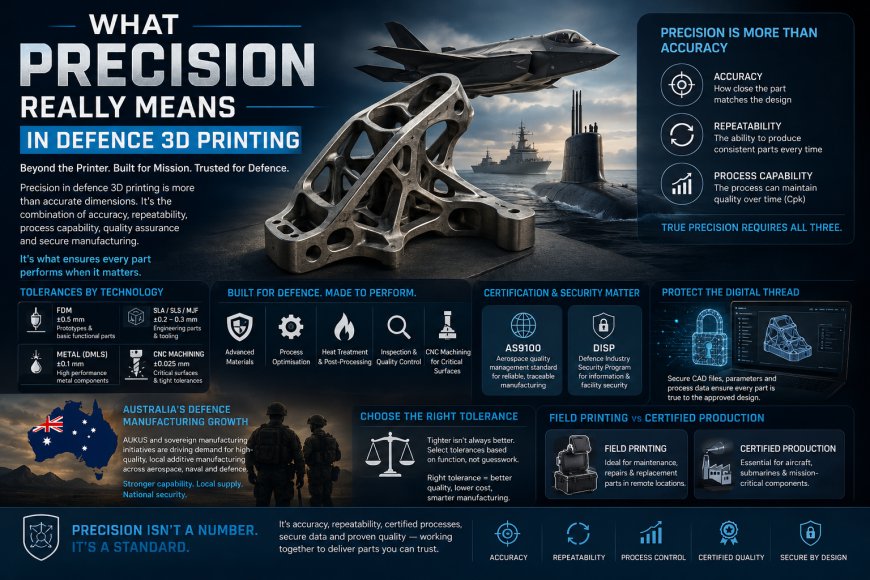
The term "precision" is often used broadly, but it actually represents three different manufacturing concepts.
Accuracy refers to how closely a finished part matches its intended dimensions.
Repeatability measures whether identical parts can be produced consistently over multiple production runs.
Process Capability evaluates whether the manufacturing process can maintain quality over time using statistical measurements such as Cpk.
True production precision requires all three. A single successful print is not enough if future parts cannot achieve the same quality consistently.
Typical Tolerances Across Printing Technologies
Every additive manufacturing process offers different dimensional capabilities.
- FDM printing generally achieves tolerances around ±0.5 mm and is suitable for prototypes and simple functional parts.
- SLA, SLS, and MJF typically produce tolerances between ±0.2 mm and ±0.3 mm, making them suitable for engineering applications and tooling.
- Metal additive manufacturing processes such as DMLS can achieve approximately ±0.1 mm.
- CNC machining remains the preferred finishing process for critical surfaces, reaching tolerances as tight as ±0.025 mm.
For this reason, many aerospace and defence manufacturers combine 3D printing with precision CNC machining to achieve final production quality.
Common Manufacturing Challenges
Although additive manufacturing has advanced significantly, every process has limitations that engineers must address.
Material anisotropy can create different mechanical properties depending on print orientation. Thermal stresses may cause slight distortion during cooling, while microscopic porosity can reduce material strength if not properly controlled. Surface finish is another common challenge, particularly for metal components that often require machining or polishing before final assembly.
Successful manufacturers minimise these risks through process optimisation, inspection, heat treatment, and appropriate post-processing techniques.
Why Certifications Matter
Producing parts for defence programs requires more than technical capability.
AS9100 establishes quality management requirements specifically for aerospace manufacturing, including inspection, traceability, documentation, and risk management.
Australian companies working directly with defence projects may also require DISP (Defence Industry Security Program) certification, which covers security clearances, information protection, and facility requirements.
Meeting these standards demonstrates that a manufacturer can consistently produce reliable and secure components.
Protecting the Digital Thread
Every printed component begins as digital data.
CAD models, STL files, slicing parameters, and machine instructions all form part of the manufacturing process. If any of these files are altered or compromised, the finished component may no longer perform as intended.
For defence manufacturing, protecting the digital thread is just as important as maintaining dimensional accuracy. Secure data handling helps ensure that every printed component matches the approved engineering design.
Australia's Defence Manufacturing Growth
Australia is investing heavily in sovereign manufacturing to strengthen local defence capability.
Projects supported through AUKUS and advanced manufacturing initiatives are increasing demand for high-quality additive manufacturing across naval, aerospace, and defence industries. Companies are expected to meet international production standards while reducing dependence on overseas supply chains.
As more Australian businesses enter defence manufacturing, maintaining precision, certification, and process consistency will become even more important.
Choosing the Right Tolerance
Many engineers assume tighter tolerances automatically produce better parts. In reality, unnecessarily strict tolerances increase machining time, inspection requirements, and manufacturing costs.
Instead, tolerances should always be selected according to the component's intended function. Applying the correct engineering specifications improves efficiency without compromising quality.
Field Printing vs Certified Production
Portable 3D printing systems are becoming valuable for maintenance, repairs, and rapid replacement parts in remote environments.
However, components used in aircraft, submarines, and other mission-critical systems continue to require production inside certified manufacturing facilities where every stage of the process is fully documented and controlled.
Understanding when field printing is appropriate and when certified production is essential helps ensure both safety and reliability.
Conclusion
Precision in defence 3D printing is not defined by a single measurement. It combines accurate dimensions, repeatable manufacturing, validated processes, industry certifications, secure digital workflows, and effective quality control. As Australia's defence manufacturing capabilities continue to expand, organisations that focus on complete production excellence—not just printer specifications—will be best positioned to support the next generation of aerospace and defence projects.
Frequently Asked Questions
What does precision mean in defence 3D printing?
It refers to the ability to consistently manufacture parts that meet dimensional, mechanical, and quality requirements.
Can 3D printed components be used in defence applications?
Yes. When manufactured under certified quality systems and appropriate engineering controls, additive manufacturing is widely used across defence and aerospace industries.
Why is CNC machining still required?
Critical surfaces often require tighter tolerances and smoother finishes than 3D printing alone can achieve.
What certifications are important?
AS9100 is the primary aerospace quality standard, while DISP is important for Australian companies supplying defence projects.
Why is digital security important in additive manufacturing?
Protecting engineering files prevents design tampering and ensures every manufactured component matches the approved specification.