

3D Printing Australia: How Additive Manufacturing Supports More Flexible Production Planning
Manufacturing planning has traditionally depended on predictable demand, established production volumes, supplier relationships, tooling, and inventory. These systems work effectively when requirements remain relatively stable. However, modern businesses often operate in environments where product specifications change, order quantities fluctuate, and customers expect increasingly customised solutions.

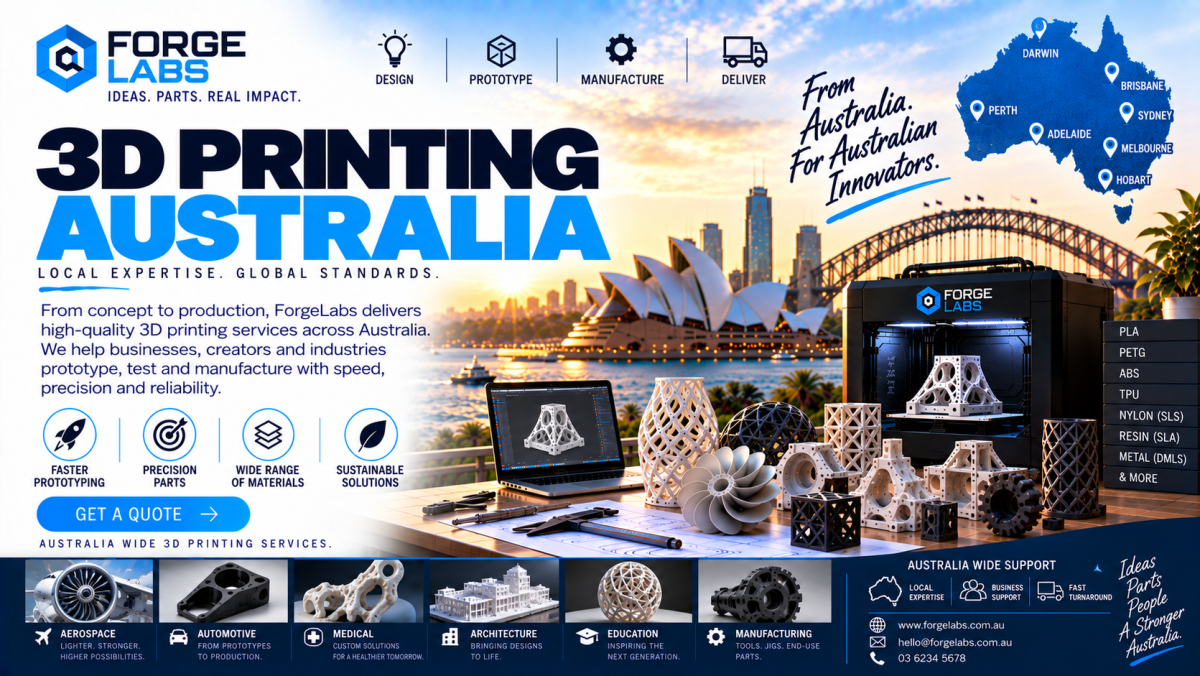
3D printing Australia can support this shift by giving businesses another way to produce components, prototypes, tools, and specialised parts directly from digital designs. Instead of relying exclusively on fixed production systems, companies can incorporate additive manufacturing into selected stages of their production planning.
The result is not necessarily a replacement for conventional manufacturing. Instead, additive manufacturing can become another production option that businesses can use when flexibility, customisation, low volumes, or design complexity are important.
The Changing Nature of Production Planning
Production planning involves deciding what needs to be manufactured, when it needs to be manufactured, which resources are required, and how products will move through the manufacturing process.
Traditional planning often works around relatively fixed assumptions:
- Expected demand
- Standard product designs
- Established suppliers
- Production quantities
- Manufacturing capacity
- Inventory levels
- Tooling availability
When these assumptions change, the production plan can become more difficult to manage.
Additive manufacturing introduces another layer of flexibility because some components can be produced directly from digital manufacturing information without requiring the same type of dedicated tooling associated with certain conventional processes.
Manufacturing According to Actual Demand
One potential advantage of additive manufacturing is the ability to produce certain components when they are required.
This can be relevant for parts that have:
- Low demand
- Irregular demand
- High design variation
- Short production runs
- Custom dimensions
- Specialised applications
Instead of manufacturing a large quantity simply because the production setup favours high volumes, businesses can evaluate whether selected parts can be produced closer to actual demand.
This can change the way companies think about inventory and production scheduling.
Supporting Smaller Production Runs
Large-scale manufacturing often benefits from economies associated with high production volumes.
However, many businesses do not require thousands of identical components.
They may need:
- Ten prototypes
- Fifty specialised parts
- A limited product run
- A small number of replacement components
- Custom manufacturing aids
For these applications, additive manufacturing can provide a production route that is more adaptable to smaller quantities.
The commercial suitability still depends on the geometry, material, production requirements, and quantity involved.
Reducing Dependence on Dedicated Tooling
Certain manufacturing processes depend heavily on tooling.
Tooling can be highly effective for repeat production, but it may become less attractive when a product is frequently modified or produced in relatively small quantities.
Additive manufacturing can reduce the need for some forms of dedicated tooling in appropriate applications because the geometry is generated directly from digital information.
This can be useful during:
- Product development
- Design validation
- Custom production
- Short-run manufacturing
- Engineering experimentation
Managing Product Variations
Modern businesses may sell products with multiple configurations.
Different customers may require different:
- Dimensions
- Interfaces
- Mounting systems
- Accessories
- Enclosures
- Functional features
Producing every variation through a conventional manufacturing system can increase complexity.
Digital manufacturing allows selected product characteristics to be changed within the CAD model.
The production process can then work from the corresponding digital version.
This creates a closer relationship between product configuration and manufacturing.
Digital Production Files as Manufacturing Assets
One of the defining characteristics of additive manufacturing is its reliance on digital production information.
A component can be represented through CAD data and associated manufacturing parameters.
This creates the possibility of maintaining a digital library of selected components.
Such a library could contain:
- Part numbers
- CAD models
- Approved revisions
- Material information
- Manufacturing requirements
- Inspection information
- Application details
The digital library can become part of the production planning process.
On-Demand Component Manufacturing
On-demand manufacturing can be particularly relevant to components that are difficult to forecast.
Consider a specialised machine component that may be required only occasionally.
Keeping a large quantity in physical inventory may not be necessary if the component can be manufactured within the required operational timeframe.
A business could maintain the approved digital design and produce the component when demand arises.
This approach needs to be evaluated carefully for critical applications, but it can provide additional flexibility for suitable parts.
Supporting Maintenance Operations
Production planning also overlaps with equipment maintenance.
Manufacturing facilities depend on machines, fixtures, tools, and support equipment.
When a small component fails, the entire operation can potentially be affected.
Additive manufacturing can support selected maintenance requirements by enabling the production of suitable replacement components, protective parts, or customised maintenance tools.
Examples can include:
- Covers
- Brackets
- Guides
- Spacers
- Mounting components
- Protective housings
- Custom fixtures
The suitability of a printed replacement depends on the component's technical requirements.
Custom Manufacturing Fixtures
Production lines rarely operate entirely with standard tools.
Many manufacturing processes require fixtures designed around a specific component or assembly.
3D printing can support the creation of customised:
- Alignment fixtures
- Assembly guides
- Inspection holders
- Positioning tools
- Drill guides
- Handling aids
These tools can be designed specifically for the manufacturing process.
When the product changes, the fixture can also be modified digitally.
Production Line Optimisation
A production line may contain small inefficiencies that are difficult to address using standard tooling.
For example, an operator may need a customised holder to position a component correctly.
A simple printed tool could potentially provide a more suitable interface.
Because additive manufacturing can produce specialised geometry, manufacturing teams can experiment with different production aids and evaluate their effectiveness.
The objective is not simply to add more printed components to a production environment. It is to use additive manufacturing where customised geometry provides a practical benefit.
Prototyping Before Production
Production planning becomes easier when product designs have already been tested.
A prototype can help identify problems involving:
- Assembly
- Dimensions
- Interfaces
- Ergonomics
- Clearances
- Manufacturing requirements
These findings can be incorporated into the final design before production planning becomes more complex.
This creates a valuable relationship between prototyping and manufacturing planning.
Design Changes and Production Flexibility
Product development frequently involves engineering changes.
A component may need a different mounting position or revised geometry.
With a digitally driven manufacturing workflow, the CAD model can be updated and a new production file can be generated.
This can be particularly useful for products that are still evolving.
Instead of treating every design change as a major manufacturing disruption, businesses can integrate controlled digital revisions into the production process.
Choosing the Right Additive Manufacturing Process
Not every component should be manufactured using the same technology.
FDM
FDM can be useful for prototypes, fixtures, housings, tools, and general-purpose components.
SLA
SLA can be considered when detailed geometry and surface quality are important.
SLS
SLS can support complex polymer components and functional applications.
MJF
MJF can be useful for functional polymer components and production-oriented applications requiring multiple parts.
Metal Additive Manufacturing
Metal additive manufacturing can support specialised engineering applications where metal properties are required and the geometry is appropriate.
Technology selection should consider the complete production requirement rather than focusing only on printer availability.
Material Planning
Production planning also requires appropriate material planning.
Different applications can require different material characteristics.
Depending on the component, engineers may consider:
- Strength
- Flexibility
- Stiffness
- Impact resistance
- Temperature resistance
- Chemical resistance
- Surface characteristics
- Durability
The material should be selected according to the component's actual purpose.
Balancing Additive and Conventional Manufacturing
A flexible production strategy does not have to choose between additive manufacturing and conventional manufacturing.
Businesses can use both.
For example:
Prototyping: 3D printing
Custom fixtures: 3D printing
Short-run components: Additive manufacturing
High-volume production: Conventional manufacturing
Precision finishing: CNC machining
This type of hybrid strategy can allow each manufacturing method to be used where it provides the appropriate capabilities.
Combining 3D Printing With CNC Machining
Some components can benefit from both technologies.
Additive manufacturing can produce the overall geometry, while CNC machining can be used for selected surfaces or interfaces requiring tighter dimensional control.
This can be useful for components with:
- Precision holes
- Threads
- Mounting surfaces
- Critical interfaces
- Tight tolerances
The combination can provide more flexibility than relying on a single manufacturing process.
The Role of CAD in Production Planning
CAD becomes particularly important when additive manufacturing is incorporated into a production environment.
The digital model can contain the information required to manufacture the component, but it also needs to be controlled.
Businesses should consider:
- File organisation
- Version control
- Design approvals
- Material specifications
- Manufacturing parameters
- Inspection requirements
This helps ensure that the correct component version is produced.
Production Planning for Custom Products
Custom products require a different planning approach from standard products.
Instead of asking only:
“How many units are we producing?”
businesses may also need to consider:
- Which configurations are required?
- Which components are standard?
- Which components are customised?
- Which parts can be manufactured on demand?
- Which parts need to remain physically stocked?
Additive manufacturing can provide additional flexibility for the customised portion of the product.
Supporting Product Launches
Launching a new product often involves uncertainty.
Businesses may not know exactly how much demand will develop.
A company may therefore want to produce an initial quantity, gather customer feedback, and adjust the product before committing to larger production volumes.
Additive manufacturing can support this stage by providing a manufacturing option for prototypes and selected short-run components.
As demand becomes clearer, the company can evaluate whether another manufacturing method is more appropriate for larger volumes.
Custom Packaging and Product Accessories
Additive manufacturing can also support components surrounding a product rather than the primary product itself.
Examples include:
- Product display fixtures
- Custom holders
- Protective inserts
- Demonstration models
- Assembly aids
- Specialised packaging components
These applications can benefit from digital design and relatively low-volume production.
Supporting Engineering Teams
Engineering teams often require parts that are not part of the standard production catalogue.
They may need a custom test fixture, a prototype bracket, or a temporary assembly tool.
Waiting for a conventional supplier to manufacture such a component can interrupt development activities.
An additive manufacturing workflow can provide another option for producing suitable engineering components.
Using 3D Scanning in Production Planning
3D scanning can complement additive manufacturing when existing physical components need to be digitised.
A scanning workflow can support:
- Reverse engineering
- Replacement-part development
- Dimensional analysis
- Design modification
- Inspection
The captured information can then become part of a digital manufacturing workflow.
This is especially useful when the original CAD information is unavailable.
Quality Control for Additive Production
Flexible manufacturing still requires quality control.
Depending on the application, businesses may need to evaluate:
- Dimensions
- Fit
- Material
- Surface condition
- Mechanical performance
- Repeatability
Inspection requirements should be established according to the component's function.
A production process should be repeatable enough to meet the requirements established for the component.
Working With a Manufacturing Partner
Implementing additive manufacturing into production planning can involve several technical decisions.
Businesses may need assistance with:
- CAD
- Design optimisation
- Material selection
- Process selection
- 3D scanning
- Prototyping
- Production
- Finishing
- Inspection
Forge Labs offers additive manufacturing alongside capabilities such as CAD, 3D scanning, CNC machining, and other manufacturing services.
This broader range of capabilities can be useful when a production project requires more than a straightforward printed component.
Building a Flexible Manufacturing Workflow
A business can approach additive manufacturing through a structured workflow:
Step 1: Identify the Application
Determine what needs to be manufactured and why.
Step 2: Evaluate the Quantity
Understand whether the requirement involves one part, a short run, or repeated production.
Step 3: Review the Design
Check whether the existing design is suitable for additive manufacturing.
Step 4: Select the Material
Match the material to the intended application.
Step 5: Choose the Manufacturing Process
Select the additive technology based on geometry and functional requirements.
Step 6: Produce a Prototype or Initial Batch
Manufacture an initial version for evaluation.
Step 7: Inspect and Test
Verify the component against the relevant requirements.
Step 8: Establish the Production Workflow
Document the approved design and manufacturing process.
This creates a repeatable approach to incorporating additive manufacturing into production planning.
Preparing for More Digital Manufacturing
Manufacturing is increasingly connected to digital engineering.
Design files, production information, inspection data, and inventory records can work together as part of a broader digital manufacturing environment.
In this environment, 3D printing can serve as one manufacturing pathway within a larger system.
The long-term objective is not simply to print more parts.
It is to create a manufacturing process that can respond more effectively to changing requirements.
Conclusion
3D printing Australia can provide businesses with another way to approach production planning, particularly when flexibility, customisation, low volumes, complex geometry, or on-demand manufacturing are important.
Additive manufacturing can support prototypes, production fixtures, replacement components, short production runs, customised products, and engineering tools.
Its strongest role is often complementary rather than competitive with conventional manufacturing. Businesses can combine 3D printing with CNC machining, injection moulding, conventional production, CAD, scanning, and inspection according to the requirements of each project.
By connecting digital design with physical manufacturing, companies can create production workflows that are more adaptable to changing products, quantities, and operational requirements.






Comments (0)